QUESTION IMAGE
Question
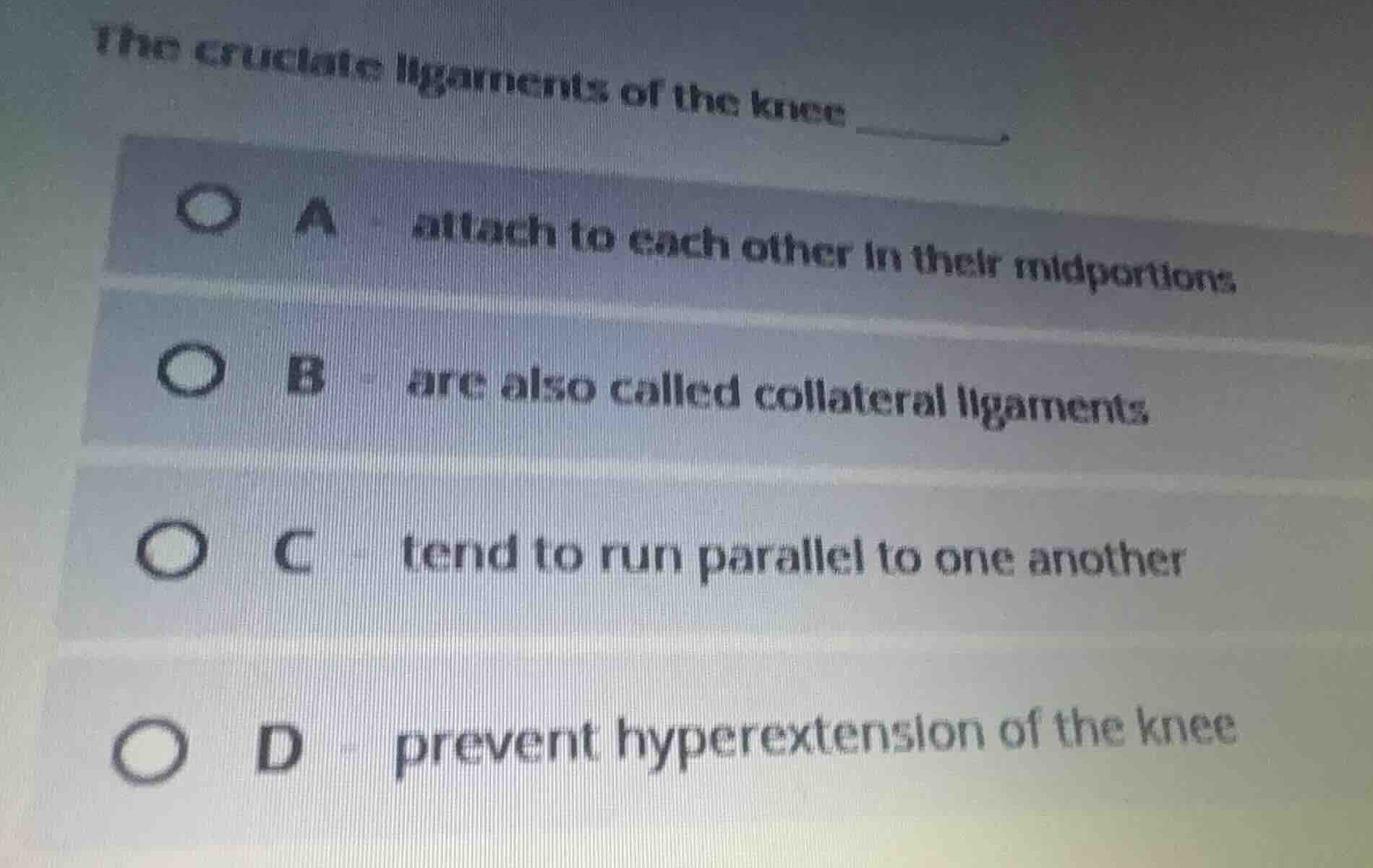
the cruciate ligaments of the knee _______
a attach to each other in their midportions
b are also called collateral ligaments
c tend to run parallel to one another
d prevent hyperextension of the knee
Analyze the question stem
The question asks about the characteristics or functions of the cruciate ligaments of the knee.
Evaluate Option A
Option A states they "attach to each other in their midportions." While the anterior cruciate ligament (ACL) and posterior cruciate ligament (PCL) cross each other (forming an "X"), they do not physically attach or fuse to each other in their midportions; they remain separate anatomical structures.
Evaluate Option B
Option B states they "are also called collateral ligaments." This is incorrect. The collateral ligaments (MCL and LCL) are located on the sides of the knee joint, whereas the cruciate ligaments (ACL and PCL) are located inside the joint capsule (intracapsular).
Evaluate Option C
Option C states they "tend to run parallel to one another." This is incorrect. The word "cruciate" is derived from the Latin word for cross (crux). These two ligaments cross each other obliquely, rather than running parallel.
Evaluate Option D
Option D states they "prevent hyperextension of the knee." This is correct. Specifically, the anterior cruciate ligament (ACL) becomes taut during extension and plays a primary role in preventing hyperextension of the knee joint.

Snap & solve any problem in the app
Get step-by-step solutions on Sovi AI
Photo-based solutions with guided steps
Explore more problems and detailed explanations
- (A) attach to each other in their midportions
- (B) are also called collateral ligaments
- (C) tend to run parallel to one another
- (D) prevent hyperextension of the knee (Correct answer)