Sovi.AI - AI Math Tutor

Scan to solve math questions

QUESTION IMAGE

convert the following expression to radical form. \\z^{\\frac{1}{9}}\\ …

Question

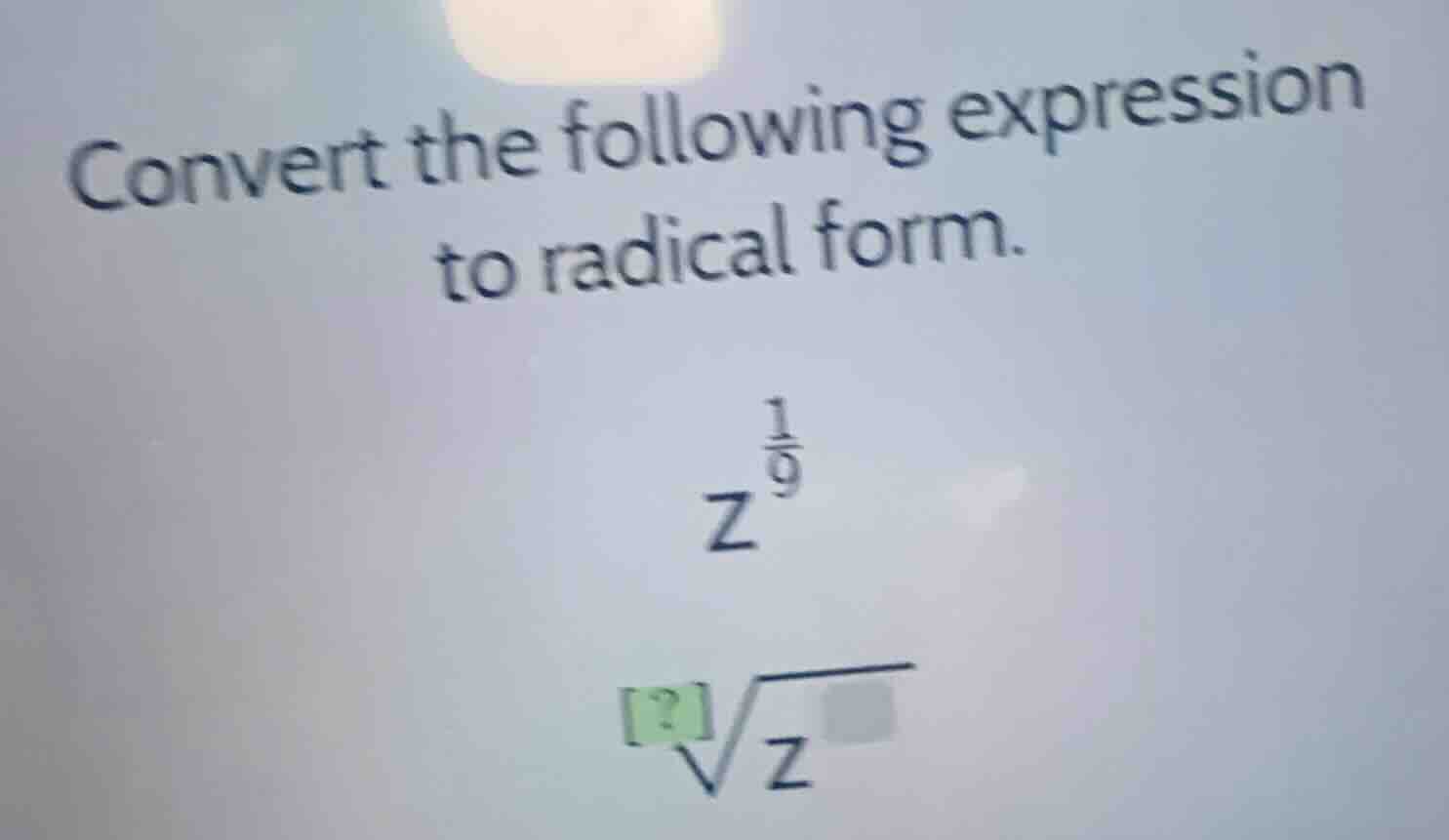
convert the following expression to radical form.

\\z^{\frac{1}{9}}\\

\\\sqrt?{z^{\square}}\\

Explanation:

Response

<pre_analysis>
{
"quality": "clear",
"question_count": 1,
"skills_matched": [
"step_cot",
"blank_filling_formatter",
"explain_then_answer",
"tutor"
],
"needs_drawing": false,
"concepts_used": [],
"new_concepts": [
"Rational Exponents",
"Radical Form"
],
"current_concepts": [
"Rational Exponents",
"Radical Form"
]
}
</pre_analysis>

<reasoning>

Identify the given expression

The problem asks us to convert the exponential expression \(z^{\frac{1}{9}}\) into its equivalent radical form.

Recall the definition of rational exponents

A rational exponent of the form \(\frac{m}{n}\) represents a radical operation. The general conversion rule is:
\[x^{\frac{m}{n}} = \sqrt[n]{x^m}\]
where \(n\) is the index of the radical and \(m\) is the power of the radicand.

Apply the conversion rule

For the given expression \(z^{\frac{1}{9}}\):

  • The base is \(z\).
  • The numerator of the exponent is \(m = 1\).
  • The denominator of the exponent is \(n = 9\).

Substituting these values into the rule gives:
\[z^{\frac{1}{9}} = \sqrt[9]{z^1} = \sqrt[9]{z}\]

Determine the missing value

The question shows a template with a green box containing a question mark \([?]\) as the index of the radical:
\[\sqrt[[?]]{z^{\Box}}\]
Comparing this template to our result \(\sqrt[9]{z^1}\), the index in the position of \([?]\) must be \(9\).
</reasoning>

<answer>
Convert the following expression to radical form.
\(z^{\frac{1}{9}} =\) <blank>\(\sqrt[9]{z}\)</blank>
</answer>

<post_analysis>
{
"subject": "Mathematics",
"question_type": "Fill-in-the-blank",
"knowledge_point": [
"Mathematics",
"Algebra",
"Rational Exponents"
]
}
</post_analysis>

Answer:

<pre_analysis>
{
"quality": "clear",
"question_count": 1,
"skills_matched": [
"step_cot",
"blank_filling_formatter",
"explain_then_answer",
"tutor"
],
"needs_drawing": false,
"concepts_used": [],
"new_concepts": [
"Rational Exponents",
"Radical Form"
],
"current_concepts": [
"Rational Exponents",
"Radical Form"
]
}
</pre_analysis>

<reasoning>

Identify the given expression

The problem asks us to convert the exponential expression \(z^{\frac{1}{9}}\) into its equivalent radical form.

Recall the definition of rational exponents

A rational exponent of the form \(\frac{m}{n}\) represents a radical operation. The general conversion rule is:
\[x^{\frac{m}{n}} = \sqrt[n]{x^m}\]
where \(n\) is the index of the radical and \(m\) is the power of the radicand.

Apply the conversion rule

For the given expression \(z^{\frac{1}{9}}\):

  • The base is \(z\).
  • The numerator of the exponent is \(m = 1\).
  • The denominator of the exponent is \(n = 9\).

Substituting these values into the rule gives:
\[z^{\frac{1}{9}} = \sqrt[9]{z^1} = \sqrt[9]{z}\]

Determine the missing value

The question shows a template with a green box containing a question mark \([?]\) as the index of the radical:
\[\sqrt[[?]]{z^{\Box}}\]
Comparing this template to our result \(\sqrt[9]{z^1}\), the index in the position of \([?]\) must be \(9\).
</reasoning>

<answer>
Convert the following expression to radical form.
\(z^{\frac{1}{9}} =\) <blank>\(\sqrt[9]{z}\)</blank>
</answer>

<post_analysis>
{
"subject": "Mathematics",
"question_type": "Fill-in-the-blank",
"knowledge_point": [
"Mathematics",
"Algebra",
"Rational Exponents"
]
}
</post_analysis>