Sovi.AI - AI Math Tutor

Scan to solve math questions

QUESTION IMAGE

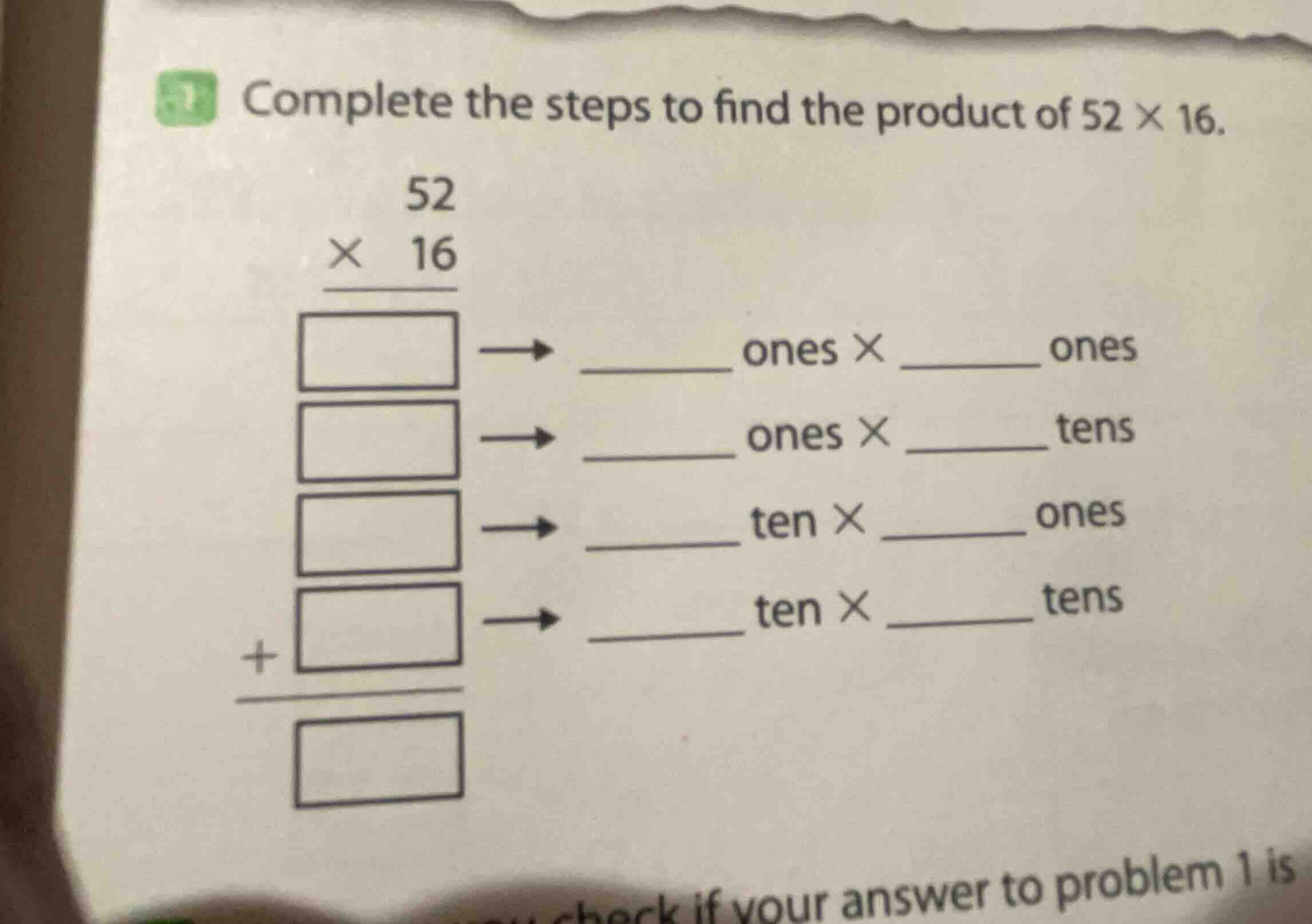
complete the steps to find the product of \\(52 \\times 16\\). \\ \\beg…
18,331 Learners found this answer helpful

Question

complete the steps to find the product of \\(52 \times 16\\).

\\
\

$$\begin{array}{r} 52 \\\\ \\times \\quad 16 \\\\ \\hline \\end{array}$$

\\

\\(\
ightarrow\\) ____ ones \\(\times\\) ____ ones
\\(\
ightarrow\\) ____ ones \\(\times\\) ____ tens
\\(\
ightarrow\\) ____ ten \\(\times\\) ____ ones
\\(\
ightarrow\\) ____ ten \\(\times\\) ____ tens

Explanation:

Response

<pre_analysis>
{
"quality": "clear",
"question_count": 1,
"skills_matched": [
"step_cot",
"blank_filling_formatter",
"explain_then_answer",
"tutor"
],
"needs_drawing": false,
"concepts_used": [],
"new_concepts": [
"Partial Products",
"Multi-Digit Multiplication",
"Place Value Multiplication"
],
"current_concepts": [
"Partial Products",
"Multi-Digit Multiplication",
"Place Value Multiplication"
]
}
</pre_analysis>

<reasoning>

Identify the place values of the digits

To find the partial products of \(52 \times 16\), we first break down each number by place value:

  • For \(52\): \(5\) is in the tens place (\(50\)) and \(2\) is in the ones place (\(2\)).
  • For \(16\): \(1\) is in the tens place (\(10\)) and \(6\) is in the ones place (\(6\)).

Calculate the first partial product

The first step asks for:
\[
\text{ones} \times \text{ones}
\]
Using the ones digit from \(16\) and the ones digit from \(52\):
\[
6 \text{ ones} \times 2 \text{ ones} = 6 \times 2 = 12
\]

Calculate the second partial product

The second step asks for:
\[
\text{ones} \times \text{tens}
\]
Using the ones digit from \(16\) and the tens digit from \(52\):
\[
6 \text{ ones} \times 5 \text{ tens} = 6 \times 50 = 300
\]

Calculate the third partial product

The third step asks for:
\[
\text{ten} \times \text{ones}
\]
Using the tens digit from \(16\) and the ones digit from \(52\):
\[
1 \text{ ten} \times 2 \text{ ones} = 10 \times 2 = 20
\]

Calculate the fourth partial product

The fourth step asks for:
\[
\text{ten} \times \text{tens}
\]
Using the tens digit from \(16\) and the tens digit from \(52\):
\[
1 \text{ ten} \times 5 \text{ tens} = 10 \times 50 = 500
\]

Sum the partial products

To find the final product, we add all four partial products together:
\[
12 + 300 + 20 + 500 = 832
\]
</reasoning>

<answer>
Complete the steps to find the product of \(52 \times 16\).

\[

$$\begin{array}{r@{\quad}l} 52 \\ \times\ 16 \\ \hline \mathbf{12} & ightarrow \quad \mathbf{6} \text{ ones} \times \mathbf{2} \text{ ones} \\ \mathbf{300} & ightarrow \quad \mathbf{6} \text{ ones} \times \mathbf{5} \text{ tens} \\ \mathbf{20} & ightarrow \quad \mathbf{1} \text{ ten} \times \mathbf{2} \text{ ones} \\ +\quad \mathbf{500} & ightarrow \quad \mathbf{1} \text{ ten} \times \mathbf{5} \text{ tens} \\ \hline \mathbf{832} \end{array}$$

\]

The completed steps are:

  • <blank>\(12\)</blank> \(

ightarrow\) <blank>\(6\)</blank> ones \(\times\) <blank>\(2\)</blank> ones

  • <blank>\(300\)</blank> \(

ightarrow\) <blank>\(6\)</blank> ones \(\times\) <blank>\(5\)</blank> tens

  • <blank>\(20\)</blank> \(

ightarrow\) <blank>\(1\)</blank> ten \(\times\) <blank>\(2\)</blank> ones

  • <blank>\(500\)</blank> \(

ightarrow\) <blank>\(1\)</blank> ten \(\times\) <blank>\(5\)</blank> tens

  • The final sum is <blank>\(832\)</blank>

</answer>

<post_analysis>
{
"subject": "Mathematics",
"question_type": "Fill-in-the-blank",
"knowledge_point": [
"Mathematics",
"Algebra",
"Multi-Digit Multiplication"
]
}
</post_analysis>

Answer:

<pre_analysis>
{
"quality": "clear",
"question_count": 1,
"skills_matched": [
"step_cot",
"blank_filling_formatter",
"explain_then_answer",
"tutor"
],
"needs_drawing": false,
"concepts_used": [],
"new_concepts": [
"Partial Products",
"Multi-Digit Multiplication",
"Place Value Multiplication"
],
"current_concepts": [
"Partial Products",
"Multi-Digit Multiplication",
"Place Value Multiplication"
]
}
</pre_analysis>

<reasoning>

Identify the place values of the digits

To find the partial products of \(52 \times 16\), we first break down each number by place value:

  • For \(52\): \(5\) is in the tens place (\(50\)) and \(2\) is in the ones place (\(2\)).
  • For \(16\): \(1\) is in the tens place (\(10\)) and \(6\) is in the ones place (\(6\)).

Calculate the first partial product

The first step asks for:
\[
\text{ones} \times \text{ones}
\]
Using the ones digit from \(16\) and the ones digit from \(52\):
\[
6 \text{ ones} \times 2 \text{ ones} = 6 \times 2 = 12
\]

Calculate the second partial product

The second step asks for:
\[
\text{ones} \times \text{tens}
\]
Using the ones digit from \(16\) and the tens digit from \(52\):
\[
6 \text{ ones} \times 5 \text{ tens} = 6 \times 50 = 300
\]

Calculate the third partial product

The third step asks for:
\[
\text{ten} \times \text{ones}
\]
Using the tens digit from \(16\) and the ones digit from \(52\):
\[
1 \text{ ten} \times 2 \text{ ones} = 10 \times 2 = 20
\]

Calculate the fourth partial product

The fourth step asks for:
\[
\text{ten} \times \text{tens}
\]
Using the tens digit from \(16\) and the tens digit from \(52\):
\[
1 \text{ ten} \times 5 \text{ tens} = 10 \times 50 = 500
\]

Sum the partial products

To find the final product, we add all four partial products together:
\[
12 + 300 + 20 + 500 = 832
\]
</reasoning>

<answer>
Complete the steps to find the product of \(52 \times 16\).

\[

$$\begin{array}{r@{\quad}l} 52 \\ \times\ 16 \\ \hline \mathbf{12} & ightarrow \quad \mathbf{6} \text{ ones} \times \mathbf{2} \text{ ones} \\ \mathbf{300} & ightarrow \quad \mathbf{6} \text{ ones} \times \mathbf{5} \text{ tens} \\ \mathbf{20} & ightarrow \quad \mathbf{1} \text{ ten} \times \mathbf{2} \text{ ones} \\ +\quad \mathbf{500} & ightarrow \quad \mathbf{1} \text{ ten} \times \mathbf{5} \text{ tens} \\ \hline \mathbf{832} \end{array}$$

\]

The completed steps are:

  • <blank>\(12\)</blank> \(

ightarrow\) <blank>\(6\)</blank> ones \(\times\) <blank>\(2\)</blank> ones

  • <blank>\(300\)</blank> \(

ightarrow\) <blank>\(6\)</blank> ones \(\times\) <blank>\(5\)</blank> tens

  • <blank>\(20\)</blank> \(

ightarrow\) <blank>\(1\)</blank> ten \(\times\) <blank>\(2\)</blank> ones

  • <blank>\(500\)</blank> \(

ightarrow\) <blank>\(1\)</blank> ten \(\times\) <blank>\(5\)</blank> tens

  • The final sum is <blank>\(832\)</blank>

</answer>

<post_analysis>
{
"subject": "Mathematics",
"question_type": "Fill-in-the-blank",
"knowledge_point": [
"Mathematics",
"Algebra",
"Multi-Digit Multiplication"
]
}
</post_analysis>