QUESTION IMAGE
Question
chapter 6 - deformation of solids
- (a) define the young modulus. 1
(b) the young modulus of steel is \\(1.9 \times 10^{11}\text{ pa}\\). the young modulus of copper is \\(1.2 \times 10^{11}\text{ pa}\\).
a steel wire and a copper wire each have the same cross-sectional area and length. the two wires are each extended by equal forces.
(i) use the definition of the young modulus to determine the ratio
\\\frac{\text{extension of the copper wire}}{\text{extension of the steel wire}}\\ 3
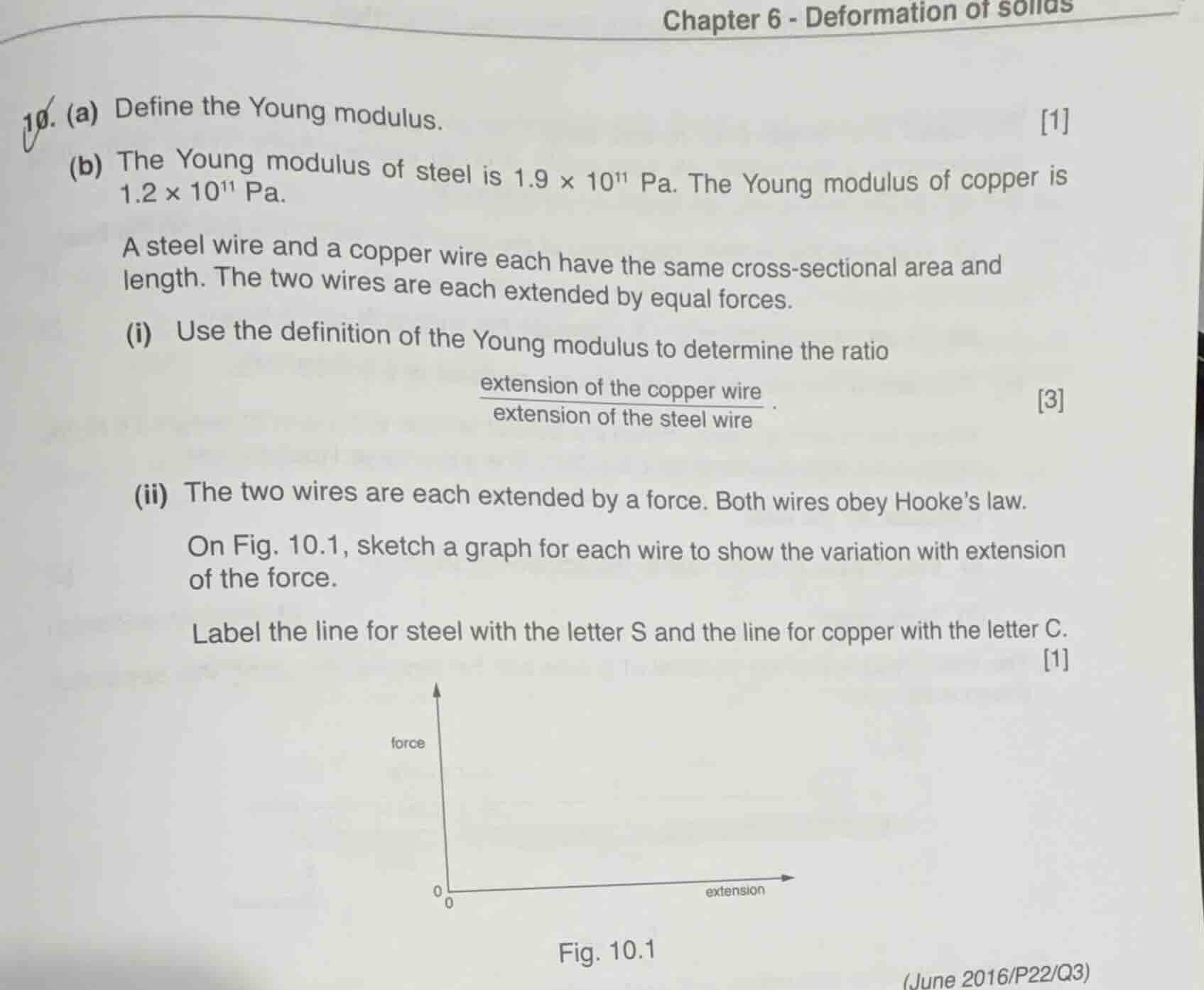
(ii) the two wires are each extended by a force. both wires obey hookes law.
on fig. 10.1, sketch a graph for each wire to show the variation with extension of the force.
label the line for steel with the letter s and the line for copper with the letter c. 1
Define the Young modulus
Using the Young Modulus knowledge point
where stress is force per unit cross-sectional area and strain is extension per unit original length, provided the limit of proportionality is not exceeded.
Express extension in terms of Young modulus
Using the Young Modulus knowledge point
Calculate the ratio of extensions
Using the Young Modulus knowledge point
Determine the relationship between gradients
Using the Hookes Law knowledge point
Both wires obey Hooke's law, so their force-extension graphs are straight lines passing through the origin. The gradient of the line for steel (S) is steeper than that for copper (C).

Snap & solve any problem in the app
Get step-by-step solutions on Sovi AI
Photo-based solutions with guided steps
Explore more problems and detailed explanations
Question 10(a)
The Young modulus is defined as the ratio of tensile stress to tensile strain.
Question 10(b)(i)
Question 10(b)(ii)
The graph consists of two straight lines starting from the origin \((0,0)\):
- A straight line with a steeper gradient labeled S (representing steel).
- A straight line with a shallower gradient labeled C (representing copper).