QUESTION IMAGE
Question
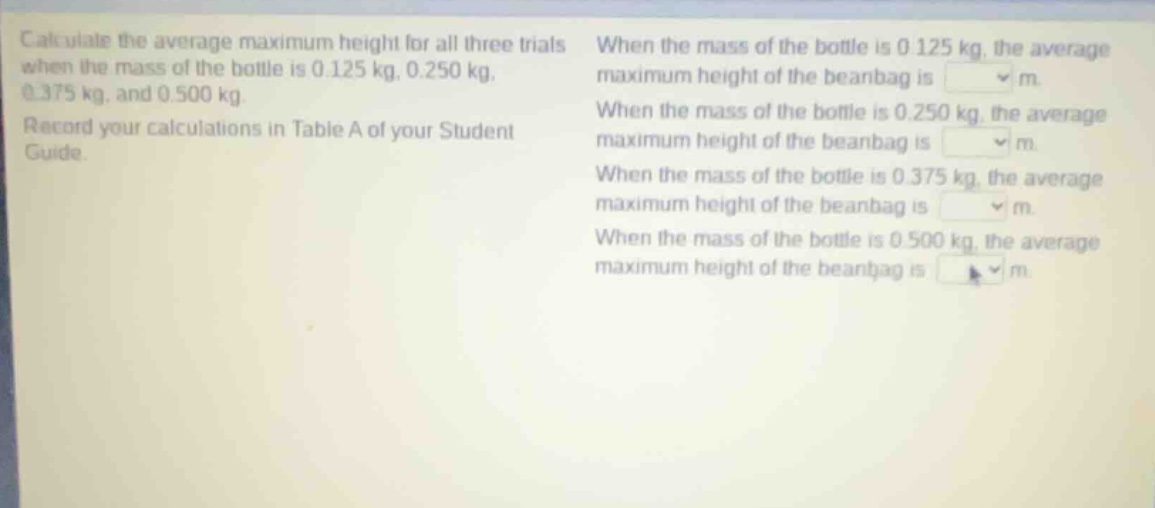
calculate the average maximum height for all three trials when the mass of the bottle is 0.125 kg, 0.250 kg, 0.375 kg, and 0.500 kg. record your calculations in table a of your student guide. when the mass of the bottle is 0.125 kg, the average maximum height of the beanbag is \boxed{} m. when the mass of the bottle is 0.250 kg, the average maximum height of the beanbag is \boxed{} m. when the mass of the bottle is 0.375 kg, the average maximum height of the beanbag is \boxed{} m. when the mass of the bottle is 0.500 kg, the average maximum height of the beanbag is \boxed{} m.
To solve this, we need the maximum height values for each of the three trials corresponding to each bottle mass (0.125 kg, 0.250 kg, 0.375 kg, 0.500 kg). Since those values are not provided in the question, we can't perform the calculations.
However, the formula for the average maximum height (\(h_{avg}\)) for a given bottle mass is:
where \(h_1\), \(h_2\), and \(h_3\) are the maximum heights from the three trials for that bottle mass.
Once you have the three height values for each bottle mass, substitute them into the formula above to find the average for each case.
For example, if for a bottle mass of 0.125 kg, the three trial heights are \(h_1 = 1.0\) m, \(h_2 = 1.1\) m, \(h_3 = 1.2\) m, then:
Repeat this process for each bottle mass (0.250 kg, 0.375 kg, 0.500 kg) using their respective trial height values.
Please provide the maximum height values for the three trials of each bottle mass, and we can help you with the calculations.

Snap & solve any problem in the app
Get step-by-step solutions on Sovi AI
Photo-based solutions with guided steps
Explore more problems and detailed explanations
To solve this, we need the maximum height values for each of the three trials corresponding to each bottle mass (0.125 kg, 0.250 kg, 0.375 kg, 0.500 kg). Since those values are not provided in the question, we can't perform the calculations.
However, the formula for the average maximum height (\(h_{avg}\)) for a given bottle mass is:
where \(h_1\), \(h_2\), and \(h_3\) are the maximum heights from the three trials for that bottle mass.
Once you have the three height values for each bottle mass, substitute them into the formula above to find the average for each case.
For example, if for a bottle mass of 0.125 kg, the three trial heights are \(h_1 = 1.0\) m, \(h_2 = 1.1\) m, \(h_3 = 1.2\) m, then:
Repeat this process for each bottle mass (0.250 kg, 0.375 kg, 0.500 kg) using their respective trial height values.
Please provide the maximum height values for the three trials of each bottle mass, and we can help you with the calculations.