QUESTION IMAGE
Question
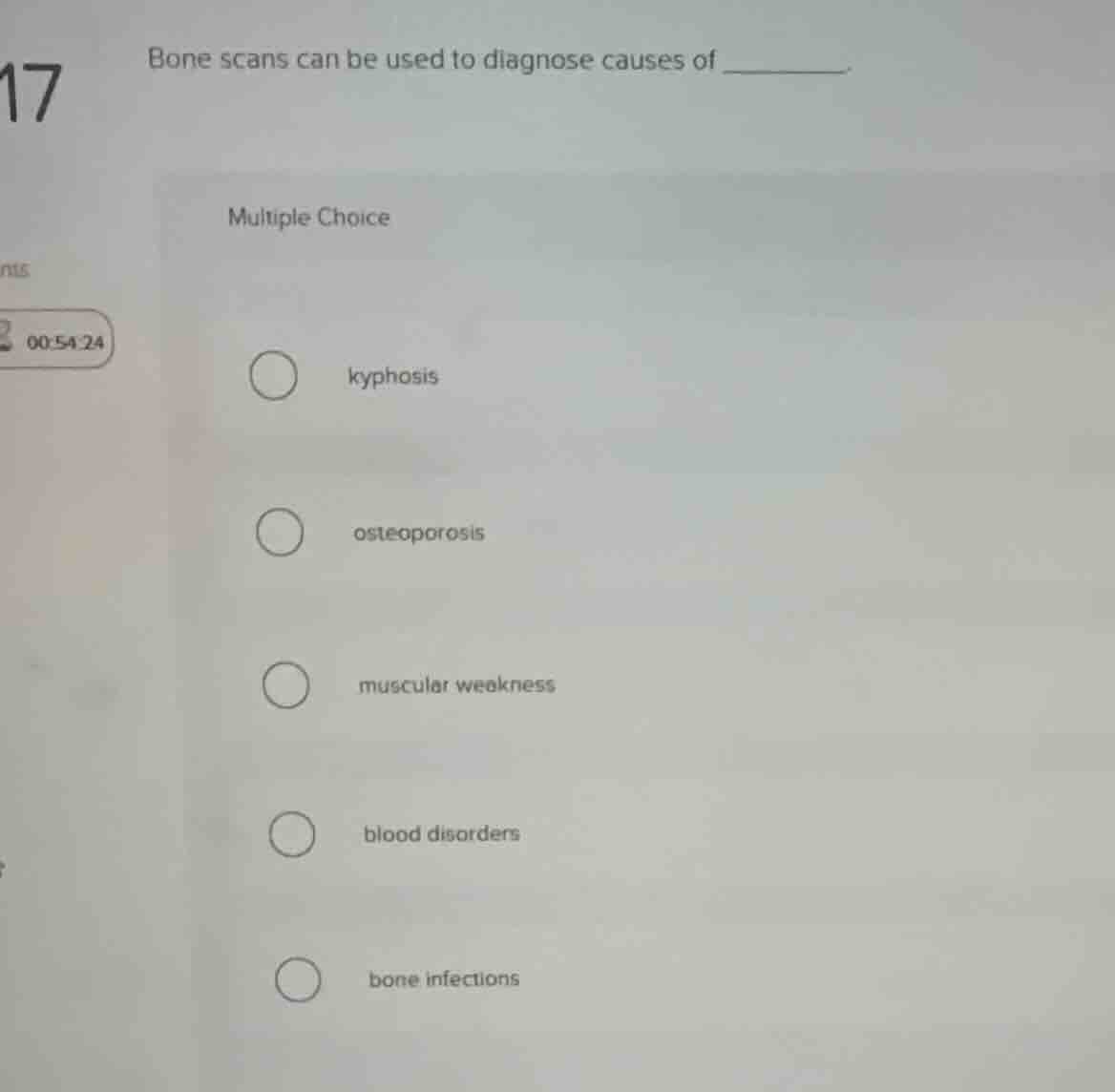
bone scans can be used to diagnose causes of _______
multiple choice
kyphosis
osteoporosis
muscular weakness
blood disorders
bone infections
<pre_analysis>
{
"quality": "clear",
"question_count": 1,
"skills_matched": [
"direct_cot",
"multiple_choice_formatter",
"explain_then_answer",
"tutor",
"mastery_adaptive_brevity"
],
"needs_drawing": false,
"concepts_used": [
"Bone Scans"
],
"new_concepts": [],
"current_concepts": [
"Bone Scans",
"Skeletal Pathology"
]
}
</pre_analysis>
<reasoning>
Analyze the diagnostic purpose of bone scans
Using the Bone Scans knowledge point
- A nuclear medicine bone scan detects areas of abnormal bone metabolism (increased or decreased bone turnover).
- It is highly sensitive for identifying active bone processes such as bone infections (osteomyelitis), fractures, and bone tumors.
Evaluate the given multiple-choice options
- kyphosis: This is a structural spinal curvature abnormality, typically diagnosed via standard X-rays rather than a nuclear bone scan.
- osteoporosis: This metabolic bone disease characterized by low bone density is diagnosed using a Dual-Energy X-ray Absorptiometry (DEXA) scan, not a nuclear bone scan.
- muscular weakness: This is a neuromuscular issue, evaluated using electromyography (EMG) or nerve conduction studies.
- blood disorders: These are typically diagnosed via blood tests (complete blood count) or bone marrow biopsies.
- bone infections: Active infections trigger an inflammatory response and increased bone remodeling, which shows up as a "hot spot" on a nuclear bone scan.
</reasoning>
<answer>
<mcq-option>kyphosis</mcq-option>
<mcq-option>osteoporosis</mcq-option>
<mcq-option>muscular weakness</mcq-option>
<mcq-option>blood disorders</mcq-option>
<mcq-correct>bone infections</mcq-correct>
</answer>
<post_analysis>
{
"subject": "Natural Science",
"question_type": "Multiple Choice",
"knowledge_point": [
"Natural Science",
"Medicine",
"Bone Scans"
]
}
</post_analysis>
Snap & solve any problem in the app
Get step-by-step solutions on Sovi AI
Photo-based solutions with guided steps
Explore more problems and detailed explanations
<pre_analysis>
{
"quality": "clear",
"question_count": 1,
"skills_matched": [
"direct_cot",
"multiple_choice_formatter",
"explain_then_answer",
"tutor",
"mastery_adaptive_brevity"
],
"needs_drawing": false,
"concepts_used": [
"Bone Scans"
],
"new_concepts": [],
"current_concepts": [
"Bone Scans",
"Skeletal Pathology"
]
}
</pre_analysis>
<reasoning>
Analyze the diagnostic purpose of bone scans
Using the Bone Scans knowledge point
- A nuclear medicine bone scan detects areas of abnormal bone metabolism (increased or decreased bone turnover).
- It is highly sensitive for identifying active bone processes such as bone infections (osteomyelitis), fractures, and bone tumors.
Evaluate the given multiple-choice options
- kyphosis: This is a structural spinal curvature abnormality, typically diagnosed via standard X-rays rather than a nuclear bone scan.
- osteoporosis: This metabolic bone disease characterized by low bone density is diagnosed using a Dual-Energy X-ray Absorptiometry (DEXA) scan, not a nuclear bone scan.
- muscular weakness: This is a neuromuscular issue, evaluated using electromyography (EMG) or nerve conduction studies.
- blood disorders: These are typically diagnosed via blood tests (complete blood count) or bone marrow biopsies.
- bone infections: Active infections trigger an inflammatory response and increased bone remodeling, which shows up as a "hot spot" on a nuclear bone scan.
</reasoning>
<answer>
<mcq-option>kyphosis</mcq-option>
<mcq-option>osteoporosis</mcq-option>
<mcq-option>muscular weakness</mcq-option>
<mcq-option>blood disorders</mcq-option>
<mcq-correct>bone infections</mcq-correct>
</answer>
<post_analysis>
{
"subject": "Natural Science",
"question_type": "Multiple Choice",
"knowledge_point": [
"Natural Science",
"Medicine",
"Bone Scans"
]
}
</post_analysis>