QUESTION IMAGE
Question
analyzing work for errors
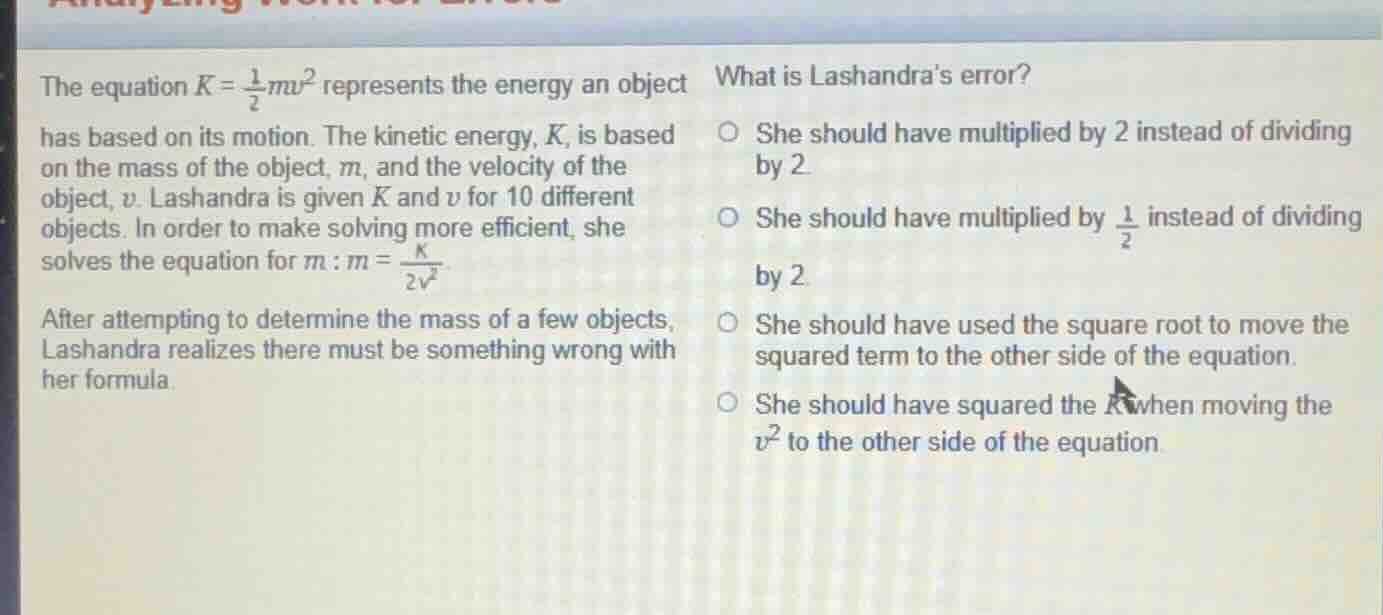
the equation \\(k = \frac{1}{2}mv^2\\) represents the energy an object has based on its motion. the kinetic energy, \\(k\\), is based on the mass of the object, \\(m\\), and the velocity of the object, \\(v\\). lashandra is given \\(k\\) and \\(v\\) for 10 different objects. in order to make solving more efficient, she solves the equation for \\(m\\): \\(m = \frac{k}{2v^2}\\).
after attempting to determine the mass of a few objects, lashandra realizes there must be something wrong with her formula.
what is lashandras error?
- she should have multiplied by 2 instead of dividing by 2.
- she should have multiplied by \\(1/2\\) instead of dividing by 2.
- she should have used the square root to move the squared term to the other side of the equation.
- she should have squared the \\(k\\) when moving the \\(v^2\\) to the other side of the equation.
State the given equation and target variable
Using the Literal Equations knowledge point
Target: Solve for \(m\).
Isolate the variable term
Using the Algebraic Rearrangement knowledge point
Solve for the target variable
Using the Algebraic Rearrangement knowledge point
Identify the error in the student's work
Lashandra's incorrect formula:
Comparing this to the correct formula:
She divided by \(2\) instead of multiplying by \(2\).
Analyze the incorrect options
- Option A correctly identifies that she should have multiplied by \(2\) instead of dividing by \(2\).
- Option B suggests multiplying by \(\frac{1}{2}\), which is equivalent to dividing by \(2\), keeping the error.
- Option C suggests using a square root. This is incorrect because the target variable is \(m\), which is not squared; only \(v\) is squared. No square root is needed to isolate \(m\).
- Option D suggests squaring \(K\), which has no algebraic basis.

Snap & solve any problem in the app
Get step-by-step solutions on Sovi AI
Photo-based solutions with guided steps
Explore more problems and detailed explanations
- (A) She should have multiplied by 2 instead of dividing by 2. (Correct answer)
- (B) She should have multiplied by \(\frac{1}{2}\) instead of dividing by 2.
- (C) She should have used the square root to move the squared term to the other side of the equation.
- (D) She should have squared the K when moving the \(v^2\) to the other side of the equation.