QUESTION IMAGE
Question
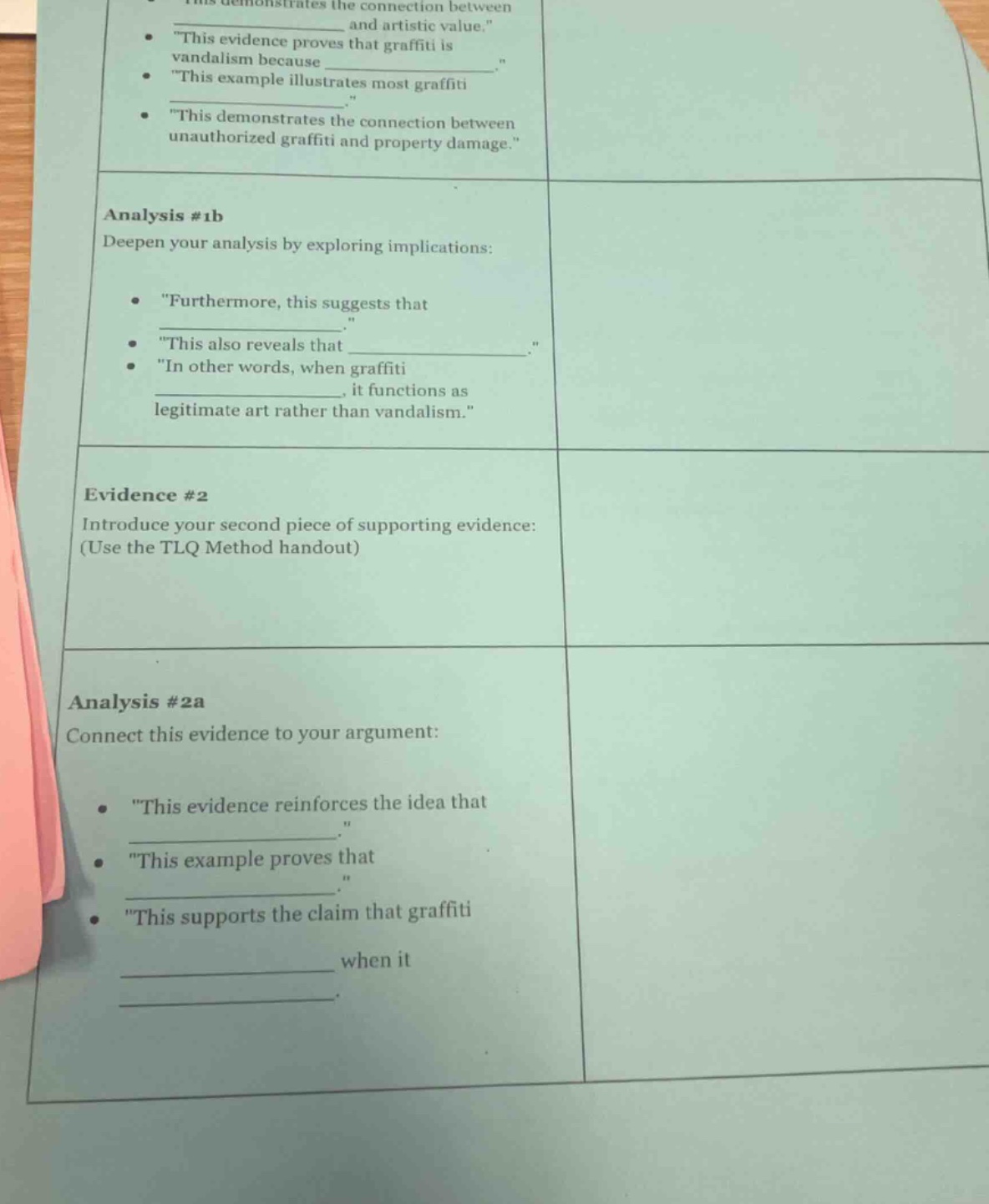
analysis #1b
deepen your analysis by exploring implications:
- \furthermore, this suggests that ________.\
- \this also reveals that ________.\
- \in other words, when graffiti ________, it functions as legitimate art rather than vandalism.\
evidence #2
introduce your second piece of supporting evidence:
(use the tlq method handout)
analysis #2a
connect this evidence to your argument:
- \this evidence reinforces the idea that ________.\
- \this example proves that ________.\
- \this supports the claim that graffiti ______ when it ______.\
Analyze the prompt requirements for Analysis #1b
The section asks to deepen the analysis of graffiti by exploring implications using sentence frames:
- "Furthermore, this suggests that..." (exploring broader implications of graffiti as art or vandalism).
- "This also reveals that..." (uncovering deeper layers of the debate).
- "In other words, when graffiti [blank], it functions as legitimate art rather than vandalism." (defining the condition under which graffiti becomes art).
Analyze the prompt requirements for Evidence #2
The section asks to introduce a second piece of supporting evidence using the TLQ (Transition, Lead-in, Quote) Method. Since this is a blank template worksheet, the goal is to provide a structured frame or a model example of how to integrate a quote about graffiti using TLQ.
Analyze the prompt requirements for Analysis #2a
The section asks to connect the second piece of evidence to the argument using sentence frames:
- "This evidence reinforces the idea that..."
- "This example proves that..."
- "This supports the claim that graffiti [blank] when it [blank]."

Snap & solve any problem in the app
Get step-by-step solutions on Sovi AI
Photo-based solutions with guided steps
Explore more problems and detailed explanations
Analysis #1b
- "Furthermore, this suggests that the distinction between vandalism and public art is often defined by permission rather than aesthetic quality."
- "This also reveals that society's perception of public spaces is constantly shifting to accommodate new forms of creative expression."
- "In other words, when graffiti is created with community consent and artistic intent, it functions as legitimate art rather than vandalism."
Evidence #2
- Transition/Lead-in/Quote (TLQ) Model:
For instance, in her article discussing urban expression, art historian Jane Doe argues, "When street art is embraced by local neighborhoods, it transforms neglected concrete walls into vibrant cultural landmarks" (Doe 45).
Analysis #2a
- "This evidence reinforces the idea that community engagement is vital to validating street art."
- "This example proves that visual art has the power to revitalize urban environments and foster a sense of shared identity."
- "This supports the claim that graffiti serves a positive social purpose when it reflects the voices and values of the local community."