QUESTION IMAGE
Question
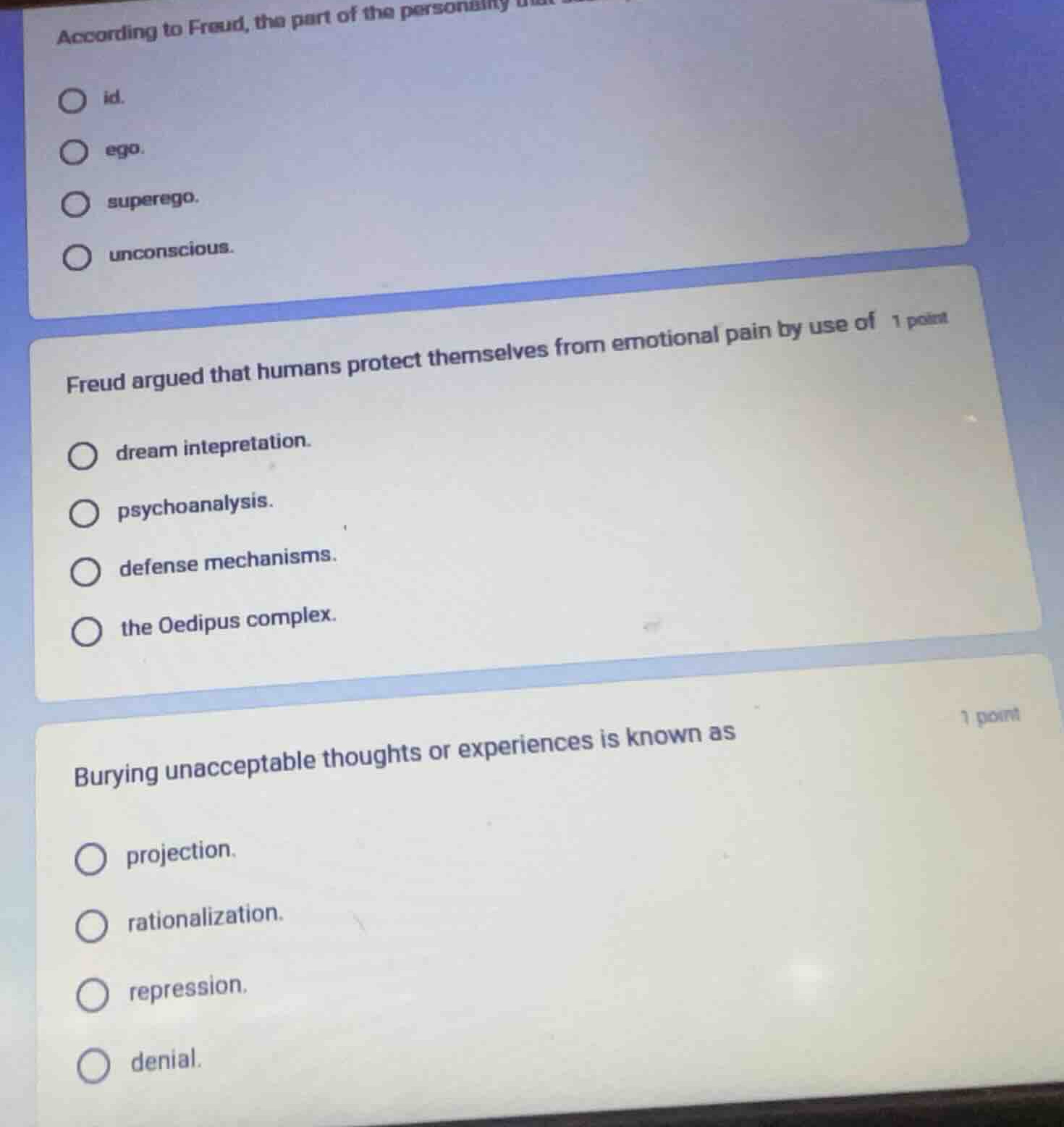
according to freud, the part of the personality that...
id.
ego.
superego.
unconscious.
freud argued that humans protect themselves from emotional pain by use of 1 point
dream interpretation.
psychoanalysis.
defense mechanisms.
the oedipus complex.
burying unacceptable thoughts or experiences is known as 1 point
projection.
rationalization.
repression.
denial.
Identify the first question's focus
The first visible question is partially cut off at the top but asks: "According to Freud, the part of the personality that..." with options: id, ego, superego, unconscious. Based on standard Freudian psychology questions of this type, it refers to the components of personality. However, the second and third questions are fully visible and can be answered directly. Let's reconstruct the first question as identifying a core component of personality, or focus on the fully visible questions. Since the first question is cut off ("According to Freud, the part of the personality that..."), we can evaluate the options. The ego is the conscious, realistic part, the id is the primal, pleasure-seeking part, and the superego is the moral conscience. Without the rest of the sentence, a definitive single answer for Question 1 is structurally incomplete, but we can provide the best-fit analysis for all three. Let's look at the visible parts: "According to Freud, the part of the personality that [mediates/operates on reality principle...]" is typically the ego, or "[operates on pleasure principle]" is the id. Given standard curriculum questions: "According to Freud, the part of the personality that mediates among the demands of the id, superego, and reality" is the ego. Let's assume the standard question asks about the realistic mediator, which is the ego.
Analyze the second question
The second question asks: "Freud argued that humans protect themselves from emotional pain by use of"
- dream interpretation: a method to access the unconscious, not a direct protective shield.
- psychoanalysis: the overall clinical method/theory.
- defense mechanisms: unconscious psychological strategies used to protect a person from anxiety arising from unacceptable thoughts or feelings.
- the Oedipus complex: a developmental stage concept.
Therefore, "defense mechanisms" is the correct choice.
Analyze the third question
The third question asks: "Burying unacceptable thoughts or experiences is known as"
- projection: attributing one's own unacceptable thoughts onto others.
- rationalization: creating self-justifying explanations for behavior.
- repression: the basic defense mechanism that banishes anxiety-arousing thoughts, feelings, and memories from consciousness (i.e., burying them).
- denial: refusing to believe or even perceive painful realities.
Therefore, "repression" is the correct choice.

Snap & solve any problem in the app
Get step-by-step solutions on Sovi AI
Photo-based solutions with guided steps
Explore more problems and detailed explanations
Question 1
- (A) id.
- (B) ego. (Correct answer)
- (C) superego.
- (D) unconscious.
Question 2
- (A) dream intepretation.
- (B) psychoanalysis.</mcq-correct>
- (C) defense mechanisms. (Correct answer)
<mcq-option>(D) the Oedipus complex.
Question 3
- (A) projection.
- (B) rationalization.
- (C) repression. (Correct answer)
- (D) denial.