QUESTION IMAGE
Question
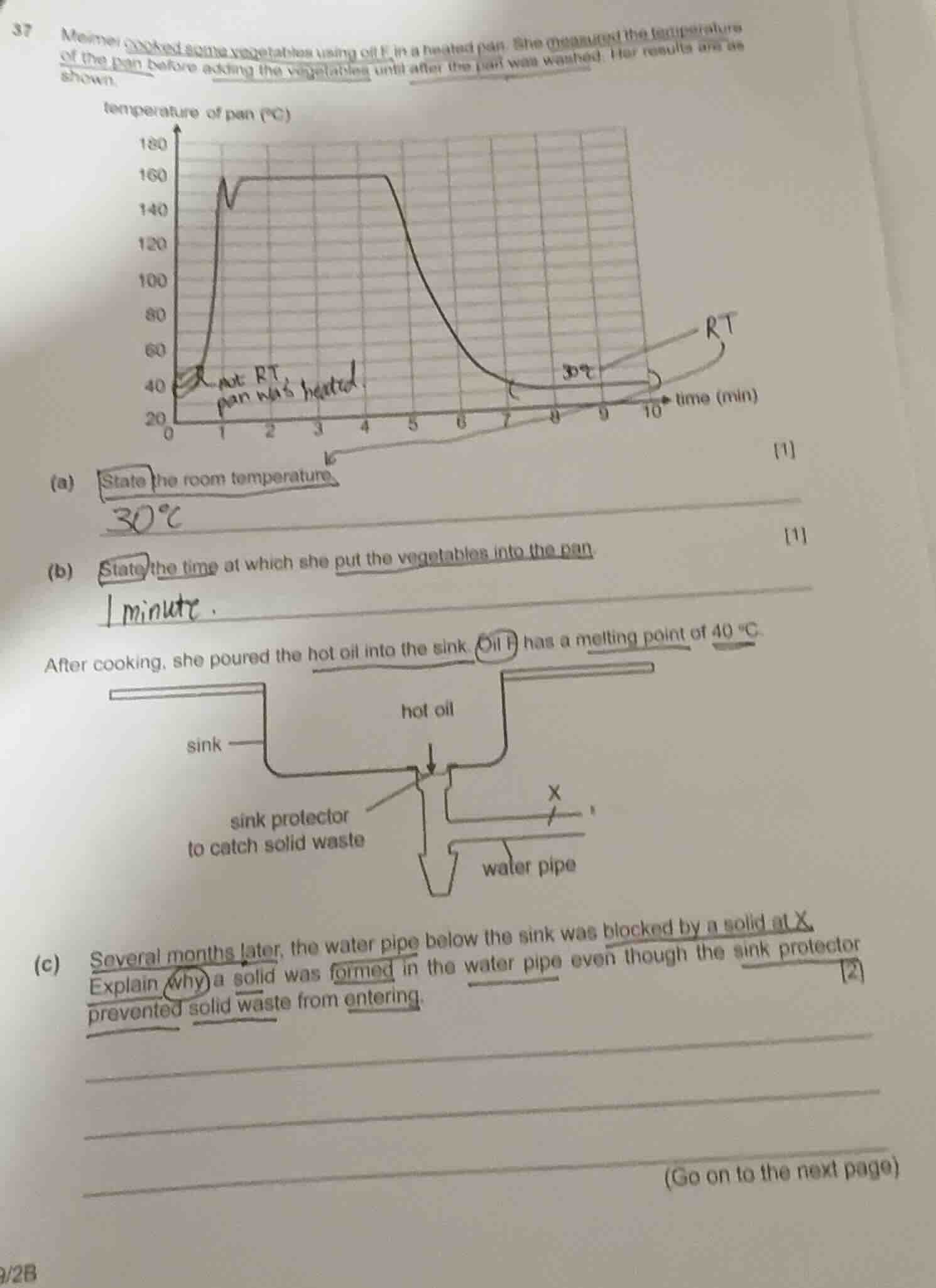
37 meimei cooked some vegetables using oil f in a heated pan. she measured the temperature of the pan before adding the vegetables until after the pan was washed. her results are as shown.
(a) state the room temperature.
(b) state the time at which she put the vegetables into the pan.
after cooking, she poured the hot oil into the sink. oil f has a melting point of 40 °c.
(c) several months later, the water pipe below the sink was blocked by a solid at x. explain why a solid was formed in the water pipe even though the sink protector prevented solid waste from entering.
Identify room temperature from graph
Analyze the temperature graph.
The temperature levels off at \(30^\circ\text{C}\) at the end.
This represents room temperature.
Determine vegetable addition time
Look for a sudden temperature drop.
At \(1\text{ min}\), temperature drops from \(160^\circ\text{C}\) to \(140^\circ\text{C}\).
This indicates cold vegetables were added.
Explain pipe blockage at X
Analyze the state of Oil F.
Oil F is poured hot as a liquid.
The water pipe is at room temperature (\(30^\circ\text{C}\)).
The melting point of Oil F is \(40^\circ\text{C}\).
Relate temperature to state change
Compare temperatures to explain solidification.
As hot oil flows past X, it loses heat.
Its temperature drops below \(40^\circ\text{C}\).
The liquid oil freezes into a solid.
This solidifies and blocks the pipe.

Snap & solve any problem in the app
Get step-by-step solutions on Sovi AI
Photo-based solutions with guided steps
Explore more problems and detailed explanations
Question 1
\(30^\circ\text{C}\)
Question 2
\(1\text{ minute}\)
Question 3
The hot liquid oil F loses heat to the cooler water pipe and surrounding air. As its temperature drops below its melting point of \(40^\circ\text{C}\) (towards the room temperature of \(30^\circ\text{C}\)), the oil solidifies (freezes) into a solid at X, causing a blockage.