QUESTION IMAGE
Question
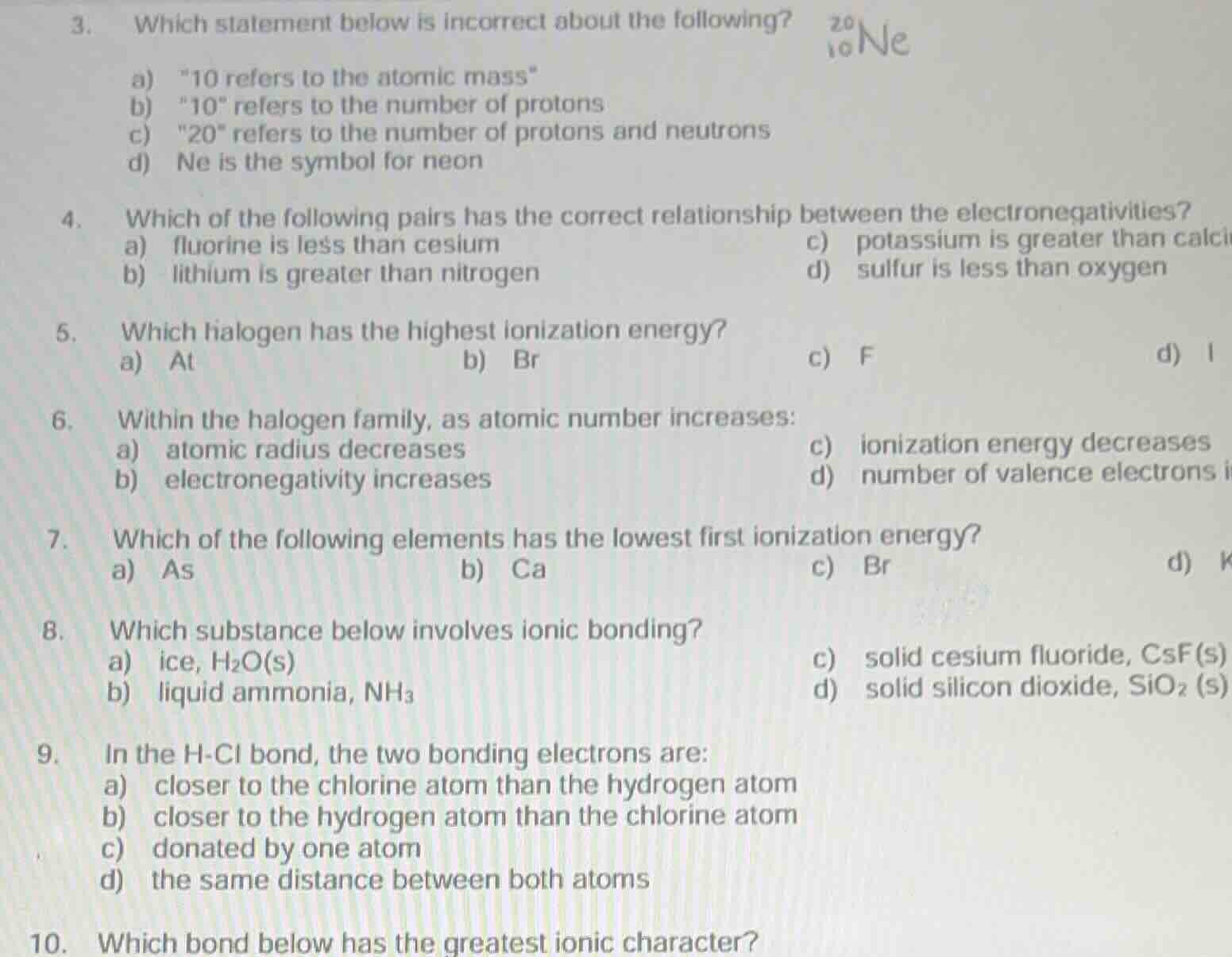
- which statement below is incorrect about the following? \\(^{20}_{10}\text{ne}\\)
a) \10 refers to the atomic mass\
b) \10\ refers to the number of protons
c) \20\ refers to the number of protons and neutrons
d) ne is the symbol for neon
- which of the following pairs has the correct relationship between the electronegativities?
a) fluorine is less than cesium
b) lithium is greater than nitrogen
c) potassium is greater than calcium
d) sulfur is less than oxygen
- which halogen has the highest ionization energy?
a) at
b) br
c) f
d) i
- within the halogen family, as atomic number increases:
a) atomic radius decreases
b) electronegativity increases
c) ionization energy decreases
d) number of valence electrons increases
- which of the following elements has the lowest first ionization energy?
a) as
b) ca
c) br
d) k
- which substance below involves ionic bonding?
a) ice, \\(\text{h}_2\text{o(s)}\\)
b) liquid ammonia, \\(\text{h}_3\\)
c) solid cesium fluoride, \\(\text{csf(s)}\\)
d) solid silicon dioxide, \\(\text{sio}_2\text{(s)}\\)
- in the h-cl bond, the two bonding electrons are:
a) closer to the chlorine atom than the hydrogen atom
b) closer to the hydrogen atom than the chlorine atom
c) donated by one atom
d) the same distance between both atoms
- which bond below has the greatest ionic character?
Analyze atomic notation of neon
Compare electronegativity relationships
Determine highest ionization energy among halogens
Analyze trends in the halogen family as atomic number increases
Determine lowest first ionization energy
Identify substance with ionic bonding
Analyze electron distribution in H-Cl bond
Determine bond with greatest ionic character

Snap & solve any problem in the app
Get step-by-step solutions on Sovi AI
Photo-based solutions with guided steps
Explore more problems and detailed explanations
Question 3
a) "10 refers to the atomic mass"
Question 4
d) sulfur is less than oxygen
Question 5
c) F
Question 6
c) ionization energy decreases
Question 7
d) K
Question 8
c) solid cesium fluoride, CsF(s)
Question 9
a) closer to the chlorine atom than the hydrogen atom
Question 10
The question is cut off at the bottom, but the bond with the greatest ionic character is the one with the largest electronegativity difference between the two bonded atoms (typically a bond between a highly active metal and a highly active nonmetal, such as Cs-F or K-F).