QUESTION IMAGE
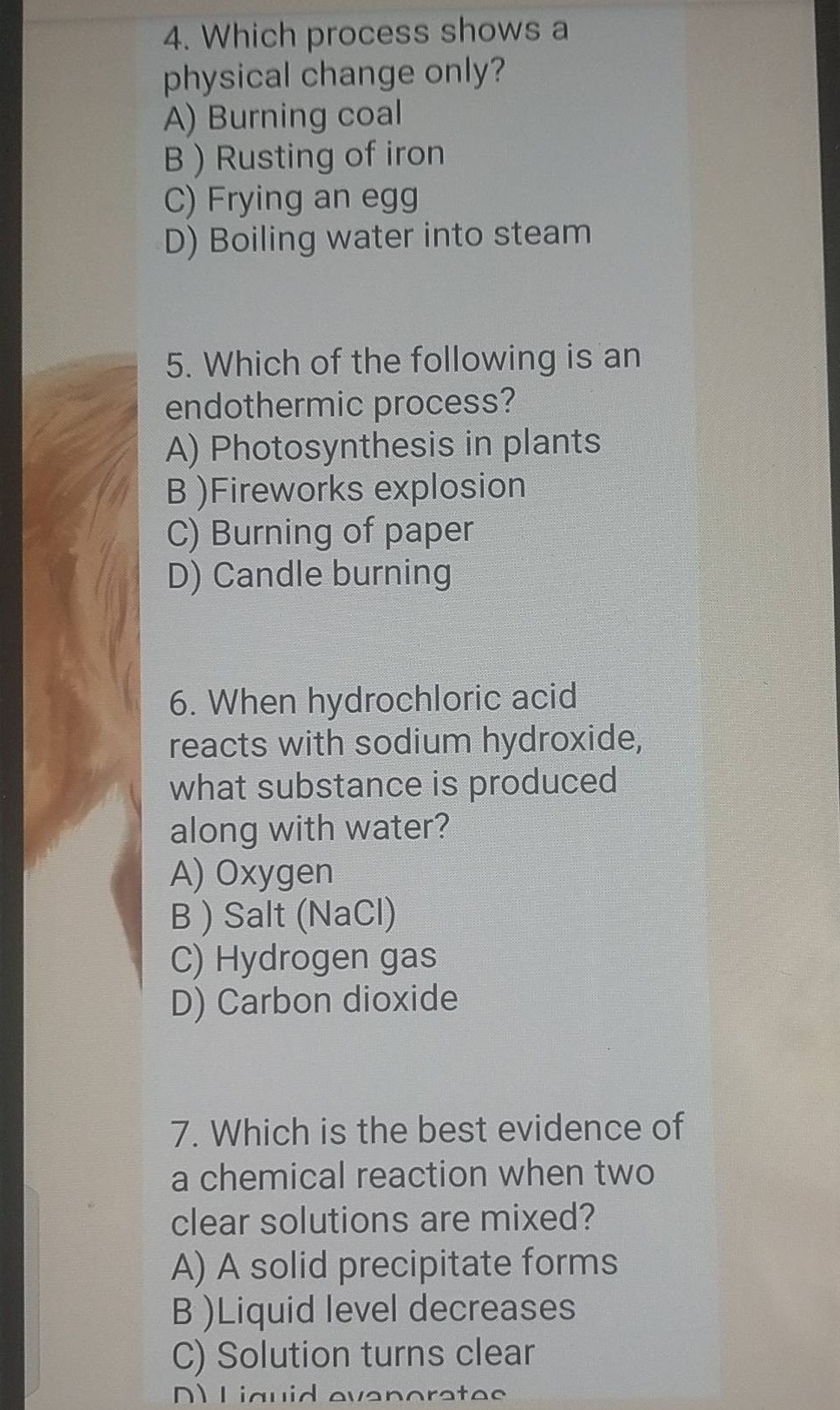
Question
- which process shows a physical change only?
a) burning coal
b ) rusting of iron
c) frying an egg
d) boiling water into steam
- which of the following is an endothermic process?
a) photosynthesis in plants
b )fireworks explosion
c) burning of paper
d) candle burning
- when hydrochloric acid reacts with sodium hydroxide, what substance is produced along with water?
a) oxygen
b ) salt (nacl)
c) hydrogen gas
d) carbon dioxide
- which is the best evidence of a chemical reaction when two clear solutions are mixed?
a) a solid precipitate forms
b )liquid level decreases
c) solution turns clear
d) liquid evaporates
🆕 New Concept Discovered: Physical vs. Chemical Changes · Endothermic vs. Exothermic Processes
Step 1: Analyze Question 4 (Physical vs. Chemical Changes)
A physical change alters the form or state of a substance without changing its chemical identity (no new substances are made). A chemical change transforms a substance into one or more entirely new substances with different chemical properties.
- A) Burning coal: Combustion reaction that produces carbon dioxide and ash (Chemical).
- B) Rusting of iron: Iron reacts with oxygen and moisture to form iron oxide (Chemical).
- C) Frying an egg: Heat denatures and permanently changes the structure of proteins (Chemical).
- D) Boiling water into steam: Liquid water changes state to gaseous water (\(\text{H}_2\text{O}\) remains \(\text{H}_2\text{O}\)) (Physical).
Therefore, the process showing a physical change only is D.
Step 2: Analyze Question 5 (Endothermic vs. Exothermic Processes)
An endothermic process absorbs heat/energy from its surroundings to proceed. An exothermic process releases heat/energy into its surroundings.
- A) Photosynthesis in plants: Plants absorb light energy from the sun to convert carbon dioxide and water into glucose and oxygen (Endothermic).
- B) Fireworks explosion: Releases massive amounts of heat, light, and sound (Exothermic).
- C) Burning of paper: Combustion reaction that releases heat and light (Exothermic).
- D) Candle burning: Combustion reaction that releases heat and light (Exothermic).
Therefore, the endothermic process is A.
Step 3: Analyze Question 6 (Acid-Base Neutralization)
When an acid reacts with a base, they undergo a neutralization reaction to produce a salt and water:
Here, hydrochloric acid (\(\text{HCl}\)) reacts with sodium hydroxide (\(\text{NaOH}\)):
The substance produced along with water is sodium chloride, commonly known as salt (\(\text{NaCl}\)).
Therefore, the correct option is B.
Step 4: Analyze Question 7 (Evidence of a Chemical Reaction)
When two clear liquid solutions are mixed, several indicators can point to a chemical reaction occurring. A key piece of evidence is the formation of an insoluble solid from the reaction of dissolved ions, known as a precipitate.
- A) A solid precipitate forms: Direct evidence of a new insoluble substance being created (Chemical reaction).
- B) Liquid level decreases: Usually due to evaporation, which is a physical change.
- C) Solution turns clear: If they were already clear solutions, remaining clear does not indicate a reaction.
- D) Liquid evaporates: A physical phase change from liquid to gas.
Therefore, the best evidence of a chemical reaction is A.

Snap & solve any problem in the app
Get step-by-step solutions on Sovi AI
Photo-based solutions with guided steps
Explore more problems and detailed explanations
- Question 4: D) Boiling water into steam
- Question 5: A) Photosynthesis in plants
- Question 6: B) Salt (NaCl)
- Question 7: A) A solid precipitate forms