QUESTION IMAGE
Question
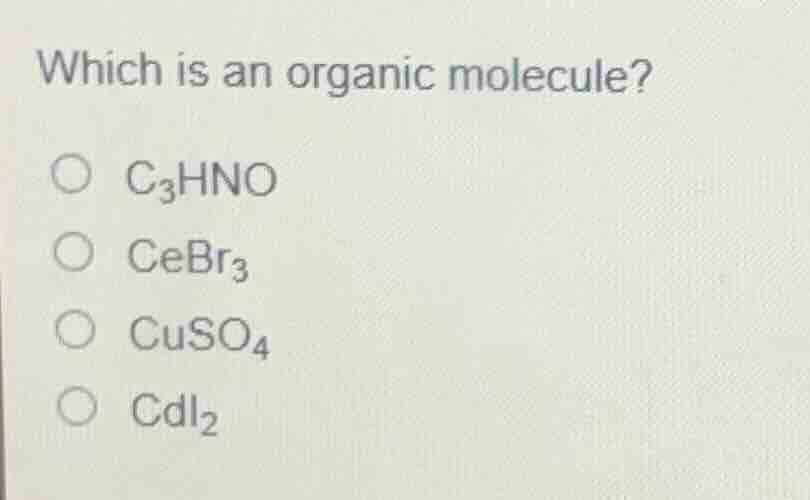
which is an organic molecule?
\\(c_3hno\\)
\\(cebr_3\\)
\\(cuso_4\\)
\\(cdi_2\\)
Define organic compounds
Organic chemistry focuses on carbon-based molecules. Organic Compounds typically contain carbon-hydrogen (\(\text{C}-\text{H}\)) bonds.
Analyze the options
We examine each chemical formula to identify its elements:
- \(\text{C}_3\text{HNO}\): Contains carbon (\(\text{C}\)), hydrogen (\(\text{H}\)), nitrogen (\(\text{N}\)), and oxygen (\(\text{O}\)). This is an organic molecule.
- \(\text{CeBr}_3\): Cerium(III) bromide. Contains cerium (\(\text{Ce}\)) and bromine (\(\text{Br}\)). This is an Inorganic Compounds representative.
- \(\text{CuSO}_4\): Copper(II) sulfate. Contains copper (\(\text{Cu}\)), sulfur (\(\text{S}\)), and oxygen (\(\text{O}\)). This is an inorganic salt.
- \(\text{CdI}_2\): Cadmium iodide. Contains cadmium (\(\text{Cd}\)) and iodine (\(\text{I}\)). This is an inorganic salt.
Identify the correct choice
The only molecule containing carbon and hydrogen is \(\text{C}_3\text{HNO}\).

Snap & solve any problem in the app
Get step-by-step solutions on Sovi AI
Photo-based solutions with guided steps
Explore more problems and detailed explanations
- (A) \(\text{C}_3\text{HNO}\) (Correct answer)
- (B) \(\text{CeBr}_3\)
- (C) \(\text{CuSO}_4\)
- (D) \(\text{CdI}_2\)