Sovi.AI - AI Math Tutor

Scan to solve math questions

QUESTION IMAGE

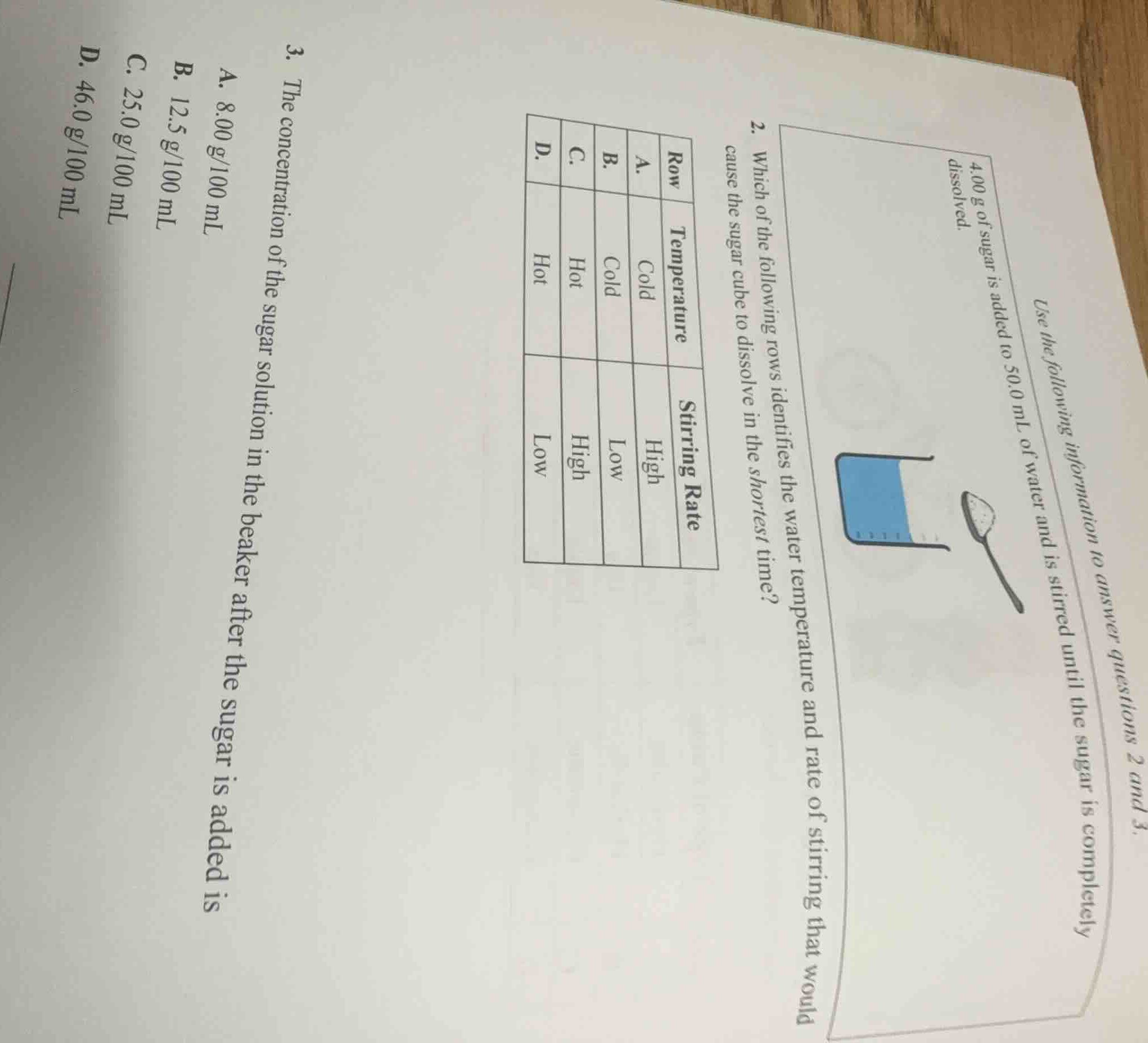
use the following information to answer questions 2 and 3. 4.00 g of su…

Question

use the following information to answer questions 2 and 3.

4.00 g of sugar is added to 50.0 ml of water and is stirred until the sugar is completely dissolved.

  1. which of the following rows identifies the water temperature and rate of stirring that would cause the sugar cube to dissolve in the shortest time?

\

$$\begin{array}{|c|c|c|} \\hline \\text{row} & \\text{temperature} & \\text{stirring rate} \\\\ \\hline \\text{a.} & \\text{cold} & \\text{high} \\\\ \\hline \\text{b.} & \\text{cold} & \\text{low} \\\\ \\hline \\text{c.} & \\text{hot} & \\text{high} \\\\ \\hline \\text{d.} & \\text{hot} & \\text{low} \\\\ \\hline \\end{array}$$
  1. the concentration of the sugar solution in the beaker after the sugar is added is

a. 8.00 g/100 ml
b. 12.5 g/100 ml
c. 25.0 g/100 ml
d. 46.0 g/100 ml

Explanation:

Response

<pre_analysis>
{
"quality": "clear",
"question_count": 2,
"skills_matched": [
"step_cot",
"multiple_choice_formatter",
"explain_then_answer",
"tutor"
],
"needs_drawing": false,
"concepts_used": [],
"new_concepts": [
"Factors Affecting Dissolving",
"Solution Concentration"
],
"current_concepts": [
"Factors Affecting Dissolving",
"Solution Concentration"
]
}
</pre_analysis>

<reasoning>

Analyze factors affecting dissolving rate

To dissolve a solute in the shortest time, we need to maximize the rate of dissolution.

  1. Temperature: Higher temperatures increase the kinetic energy of water molecules, causing them to move faster and collide more frequently and energetically with the solute, which speeds up dissolving. Thus, "Hot" water is faster than "Cold" water.
  2. Stirring Rate: Stirring brings fresh solvent into contact with the solute and helps distribute the dissolved particles. A "High" stirring rate dissolves the solute faster than a "Low" stirring rate.

Combining these, the shortest dissolving time occurs with Hot temperature and a High stirring rate, which corresponds to Row C.

Calculate the concentration of the solution

We are given:

  • Mass of solute (sugar) = \(4.00\text{ g}\)
  • Volume of solvent (water) = \(50.0\text{ mL}\)

The concentration needs to be expressed in units of \(\text{g}/100\text{ mL}\).
We set up a proportion to find the mass of sugar per \(100\text{ mL}\) of water:
\[
\text{Concentration} = \frac{4.00\text{ g}}{50.0\text{ mL}} = \frac{x}{100\text{ mL}}
\]

Solving for \(x\):
\[
x = \frac{4.00\text{ g} \times 100\text{ mL}}{50.0\text{ mL}} = 8.00\text{ g}
\]

Thus, the concentration is \(8.00\text{ g}/100\text{ mL}\), which corresponds to option A.
</reasoning>

<answer>

Question 2

<mcq-option>A. Row A (Cold, High)</mcq-option>
<mcq-option>B. Row B (Cold, Low)</mcq-option>
<mcq-correct>C. Row C (Hot, High)</mcq-correct>
<mcq-option>D. Row D (Hot, Low)</mcq-option>

Question 3

<mcq-correct>A. 8.00 g/100 mL</mcq-correct>
<mcq-option>B. 12.5 g/100 mL</mcq-option>
<mcq-option>C. 25.0 g/100 mL</mcq-option>
<mcq-option>D. 46.0 g/100 mL</mcq-option>
</answer>

<post_analysis>
{
"subject": "Natural Science",
"question_type": "Multiple Choice",
"knowledge_point": [
"Natural Science",
"Chemistry",
"Solutions and Solubility"
]
}
</post_analysis>

Answer:

<pre_analysis>
{
"quality": "clear",
"question_count": 2,
"skills_matched": [
"step_cot",
"multiple_choice_formatter",
"explain_then_answer",
"tutor"
],
"needs_drawing": false,
"concepts_used": [],
"new_concepts": [
"Factors Affecting Dissolving",
"Solution Concentration"
],
"current_concepts": [
"Factors Affecting Dissolving",
"Solution Concentration"
]
}
</pre_analysis>

<reasoning>

Analyze factors affecting dissolving rate

To dissolve a solute in the shortest time, we need to maximize the rate of dissolution.

  1. Temperature: Higher temperatures increase the kinetic energy of water molecules, causing them to move faster and collide more frequently and energetically with the solute, which speeds up dissolving. Thus, "Hot" water is faster than "Cold" water.
  2. Stirring Rate: Stirring brings fresh solvent into contact with the solute and helps distribute the dissolved particles. A "High" stirring rate dissolves the solute faster than a "Low" stirring rate.

Combining these, the shortest dissolving time occurs with Hot temperature and a High stirring rate, which corresponds to Row C.

Calculate the concentration of the solution

We are given:

  • Mass of solute (sugar) = \(4.00\text{ g}\)
  • Volume of solvent (water) = \(50.0\text{ mL}\)

The concentration needs to be expressed in units of \(\text{g}/100\text{ mL}\).
We set up a proportion to find the mass of sugar per \(100\text{ mL}\) of water:
\[
\text{Concentration} = \frac{4.00\text{ g}}{50.0\text{ mL}} = \frac{x}{100\text{ mL}}
\]

Solving for \(x\):
\[
x = \frac{4.00\text{ g} \times 100\text{ mL}}{50.0\text{ mL}} = 8.00\text{ g}
\]

Thus, the concentration is \(8.00\text{ g}/100\text{ mL}\), which corresponds to option A.
</reasoning>

<answer>

Question 2

<mcq-option>A. Row A (Cold, High)</mcq-option>
<mcq-option>B. Row B (Cold, Low)</mcq-option>
<mcq-correct>C. Row C (Hot, High)</mcq-correct>
<mcq-option>D. Row D (Hot, Low)</mcq-option>

Question 3

<mcq-correct>A. 8.00 g/100 mL</mcq-correct>
<mcq-option>B. 12.5 g/100 mL</mcq-option>
<mcq-option>C. 25.0 g/100 mL</mcq-option>
<mcq-option>D. 46.0 g/100 mL</mcq-option>
</answer>

<post_analysis>
{
"subject": "Natural Science",
"question_type": "Multiple Choice",
"knowledge_point": [
"Natural Science",
"Chemistry",
"Solutions and Solubility"
]
}
</post_analysis>