QUESTION IMAGE
Question
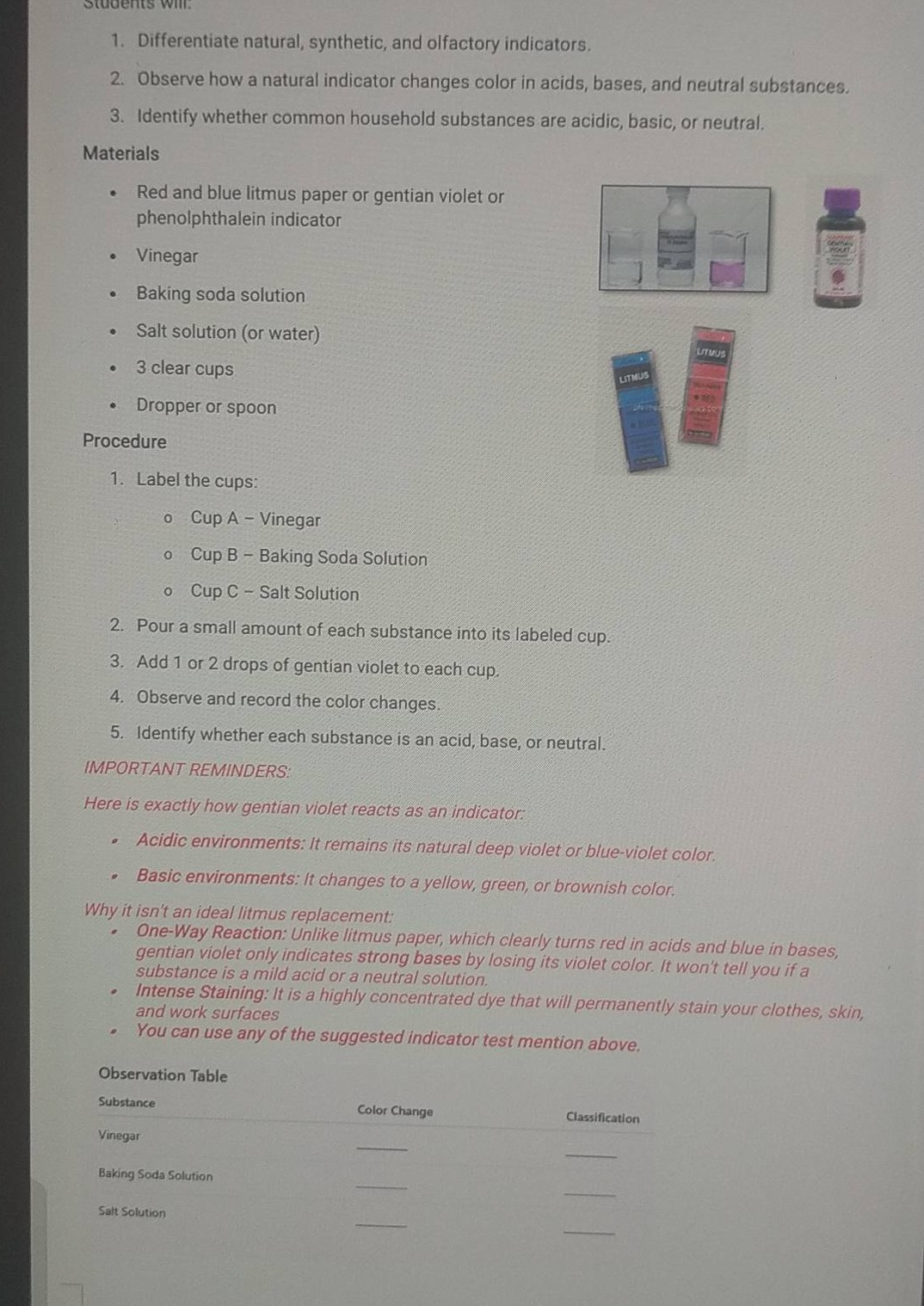
students will:
- differentiate natural, synthetic, and olfactory indicators.
- observe how a natural indicator changes color in acids, bases, and neutral substances.
- identify whether common household substances are acidic, basic, or neutral.
materials
- red and blue litmus paper or gentian violet or phenolphthalein indicator
- vinegar
- baking soda solution
- salt solution (or water)
- 3 clear cups
- dropper or spoon
procedure
- label the cups:
- cup a - vinegar
- cup b - baking soda solution
- cup c - salt solution
- pour a small amount of each substance into its labeled cup.
- add 1 or 2 drops of gentian violet to each cup.
- observe and record the color changes.
- identify whether each substance is an acid, base, or neutral.
important reminders:
here is exactly how gentian violet reacts as an indicator:
- acidic environments: it remains its natural deep violet or blue-violet color.
- basic environments: it changes to a yellow, green, or brownish color.
why it isnt an ideal litmus replacement:
- one-way reaction: unlike litmus paper, which clearly turns red in acids and blue in bases, gentian violet only indicates strong bases by losing its violet color. it wont tell you if a substance is a mild acid or a neutral solution.
- intense staining: it is a highly concentrated dye that will permanently stain your clothes, skin, and work surfaces
- you can use any of the suggested indicator test mention above.
observation table
| substance | color change | classification |
|---|---|---|
| baking soda solution | ______ | ______ |
| salt solution | ______ | ______ |
🆕 New Concept Discovered: Acid-Base Indicators and pH Classification
Using chemical indicators to identify acidic, basic, and neutral substances.
Step 1: Identify the Nature of Each Substance
To classify each household substance, we first determine whether it is acidic, basic, or neutral:
- Vinegar contains acetic acid, making it an acidic substance.
- Baking Soda (Sodium Bicarbonate) Solution is a weak base, making it a basic substance.
- Salt Solution (Sodium Chloride in water) is a neutral salt dissolved in neutral water, making it a neutral substance.
Step 2: Determine Color Changes with Gentian Violet
Using the "IMPORTANT REMINDERS" provided in the lab sheet, we apply the color reaction rules for gentian violet:
- Acidic environments: It remains its natural deep violet or blue-violet color.
- Basic environments: It changes to a yellow, green, or brownish color.
- Neutral environments: The text notes that gentian violet "won't tell you if a substance is a mild acid or a neutral solution," meaning it behaves similarly to how it does in mild acids, remaining its natural deep violet or blue-violet color.
Applying these rules:
- Vinegar (Acidic): Deep violet / Blue-violet
- Baking Soda Solution (Basic): Yellow / Green / Brownish
- Salt Solution (Neutral): Deep violet / Blue-violet
Step 3: Complete the Observation Table
We compile the color changes and classifications into the final table format.

Snap & solve any problem in the app
Get step-by-step solutions on Sovi AI
Photo-based solutions with guided steps
Explore more problems and detailed explanations
Below is the completed Observation Table based on the lab instructions:
| Substance | Color Change | Classification |
|---|---|---|
| Baking Soda Solution | Yellow / Green / Brownish | Basic |
| Salt Solution | Deep violet / Blue-violet | Neutral |