QUESTION IMAGE
Question
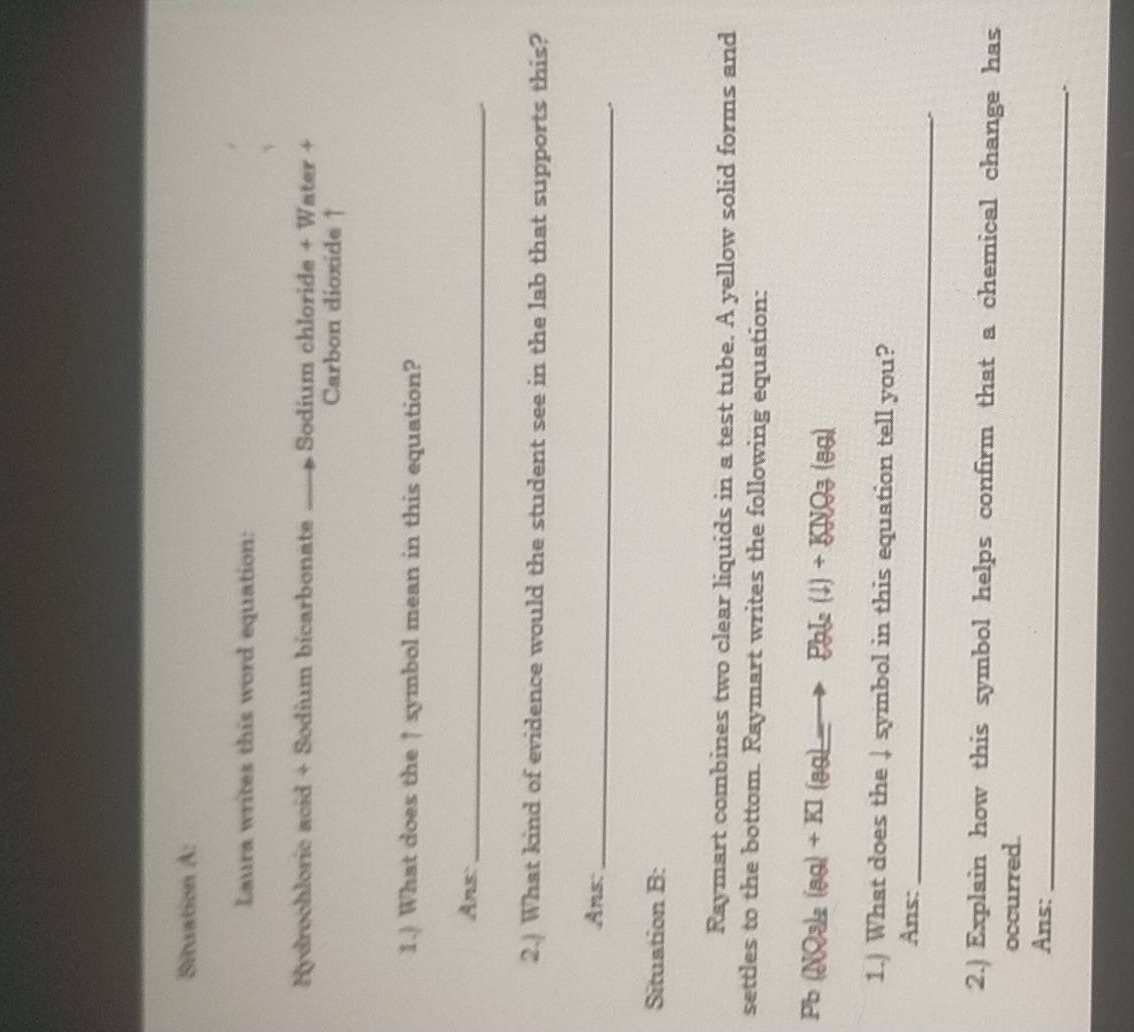
situation a:
laura writes this word equation:
hydrochloric acid + sodium bicarbonate \
ightarrow sodium chloride + water +
carbon dioxide \uparrow
1.) what does the \uparrow symbol mean in this equation?
ans:
2.) what kind of evidence would the student see in the lab that supports this?
ans:
situation b:
raymart combines two clear liquids in a test tube. a yellow solid forms and settles to the bottom. raymart writes the following equation:
\text{pb(no}_3)_2\text{(aq)} + \text{ki(aq)} \
ightarrow \text{pbi}_2\downarrow + \text{kno}_3\text{(aq)}
1.) what does the \downarrow symbol in this equation tell you?
ans:
2.) explain how this symbol helps confirm that a chemical change has occurred.
ans:
🆕 New Concept Discovered: Chemical Equation Symbols
Arrows indicating state changes in reactions
---
Situation A
Step 1: Meaning of the upward arrow symbol
In a chemical equation, an upward-pointing arrow \( \uparrow \) placed next to a product indicates that a substance is released as a gas.
Step 2: Laboratory evidence for a gas
When a gas is produced in a liquid mixture during a laboratory experiment, the most direct visual evidence is the formation of bubbles or fizzing (effervescence).
---
Situation B
Step 3: Meaning of the downward arrow symbol
In a chemical equation, a downward-pointing arrow \( \downarrow \) placed next to a product indicates the formation of a precipitate, which is an insoluble solid that separates from a liquid solution.
Step 4: Evidence of a chemical change
The formation of a precipitate (solid) from two clear liquids is a key indicator of a chemical reaction. It shows that a new substance with different solubility properties has been created, confirming that a chemical change has occurred.
---

Snap & solve any problem in the app
Get step-by-step solutions on Sovi AI
Photo-based solutions with guided steps
Explore more problems and detailed explanations
Situation A:
- What does the \( \uparrow \) symbol mean in this equation?
- Ans: It indicates that a gas is produced and released during the reaction.
- What kind of evidence would the student see in the lab that supports this?
- Ans: The student would see bubbles forming or fizzing (effervescence) in the solution.
---
Situation B:
- What does the \( \downarrow \) symbol mean in this equation?
- Ans: It indicates the formation of a precipitate (an insoluble solid that falls out of solution).
- Explain how this symbol helps confirm that a chemical change has occurred.
- Ans: The formation of a solid precipitate from two clear liquid solutions indicates that a new substance with different chemical properties has been formed.