QUESTION IMAGE
Question
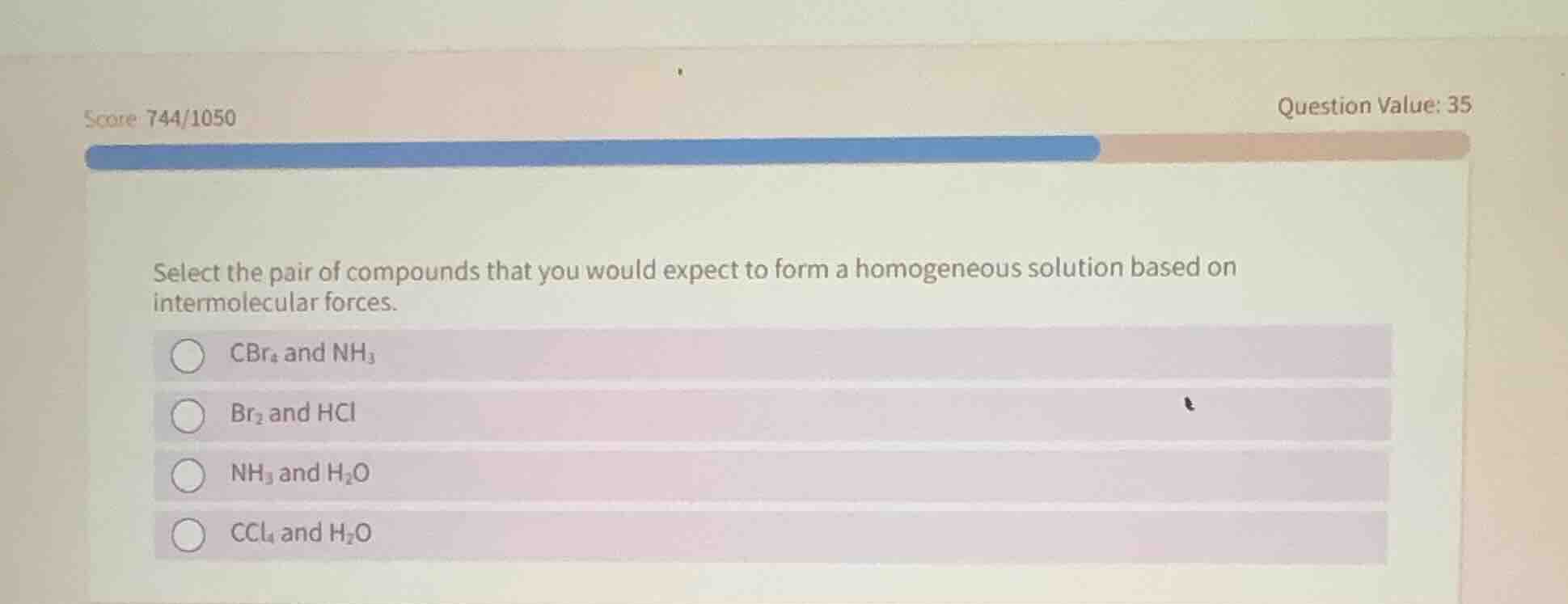
select the pair of compounds that you would expect to form a homogeneous solution based on intermolecular forces.
\\(\text{cbr}_4\\) and \\(\text{nh}_3\\)
\\(\text{br}_2\\) and \\(\text{hcl}\\)
\\(\text{nh}_3\\) and \\(\text{h}_2\text{o}\\)
\\(\text{ccl}_4\\) and \\(\text{h}_2\text{o}\\)
Analyze the "like dissolves like" principle
Using the Intermolecular Forces knowledge point
- Substances with similar intermolecular forces tend to be soluble in one another (forming a homogeneous solution).
- Polar solutes dissolve in polar solvents (e.g., dipole-dipole interactions or hydrogen bonding).
- Nonpolar solutes dissolve in nonpolar solvents (e.g., London dispersion forces).
Evaluate the given pairs of compounds
Using the Hydrogen Bonding and Intermolecular Forces knowledge points
- \(\text{CBr}_4\) (nonpolar, London dispersion forces) and \(\text{NH}_3\) (polar, hydrogen bonding): Dissimilar forces; unlikely to form a homogeneous solution.
- \(\text{Br}_2\) (nonpolar, London dispersion forces) and \(\text{HCl}\) (polar, dipole-dipole): Dissimilar forces; unlikely to form a homogeneous solution.
- \(\text{NH}_3\) (polar, hydrogen bonding) and \(\text{H}_2\text{O}\) (polar, hydrogen bonding): Similar forces; both form strong hydrogen bonds with each other, leading to high solubility and a homogeneous solution.
- \(\text{CCl}_4\) (nonpolar, London dispersion forces) and \(\text{H}_2\text{O}\) (polar, hydrogen bonding): Dissimilar forces; immiscible.
Identify the correct option
Using the Intermolecular Forces knowledge point
- The pair \(\text{NH}_3\) and \(\text{H}_2\text{O}\) shares highly compatible intermolecular forces, making them miscible.

Snap & solve any problem in the app
Get step-by-step solutions on Sovi AI
Photo-based solutions with guided steps
Explore more problems and detailed explanations
- (A) \(\text{CBr}_4\) and \(\text{NH}_3\)
- (B) \(\text{Br}_2\) and \(\text{HCl}\)
- (C) \(\text{NH}_3\) and \(\text{H}_2\text{O}\) (Correct answer)
- (D) \(\text{CCl}_4\) and \(\text{H}_2\text{O}\)