QUESTION IMAGE
Question
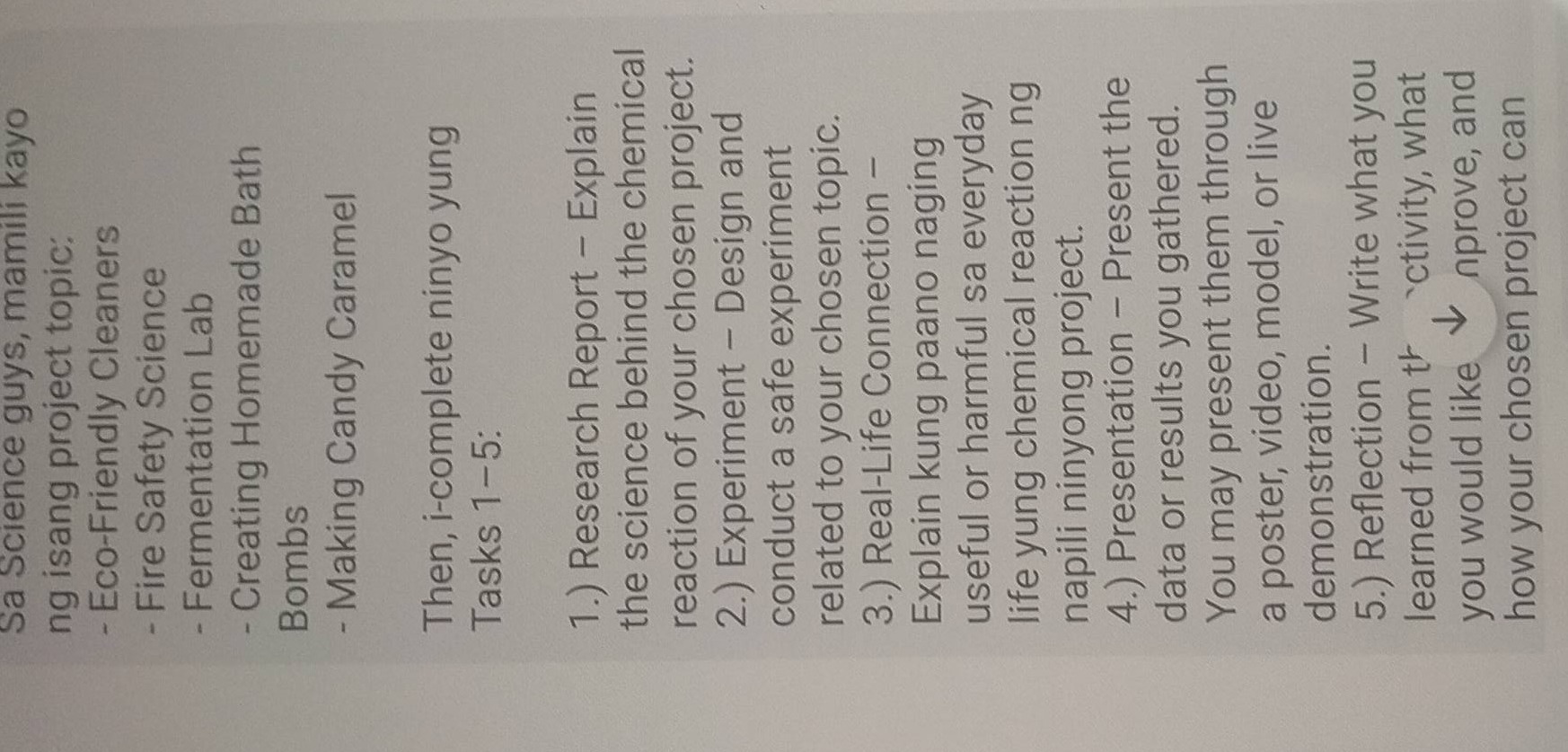
sa science guys, mamili kayo ng isang project topic:
- eco-friendly cleaners
- fire safety science
- fermentation lab
- creating homemade bath bombs
- making candy caramel
then, i-complete ninyo yung tasks 1-5:
1.) research report - explain the science behind the chemical reaction of your chosen project.
2.) experiment - design and conduct a safe experiment related to your chosen topic.
3.) real-life connection - explain kung paano naging useful or harmful sa everyday life yung chemical reaction ng napili ninyong project.
4.) presentation - present the data or results you gathered. you may present them through a poster, video, model, or live demonstration.
5.) reflection - write what you learned from the activity, what you would like to improve, and how your chosen project can
🆕 New Concept Discovered: Scientific Project Design
Structuring a science project from theory to reflection
To complete this assignment, you need to choose one of the five provided topics and complete Tasks 1 through 5. Let's select Creating Homemade Bath Bombs as our project topic because it involves a very clear, safe, and engaging chemical reaction (acid-base neutralization) that is easy to explain, experiment with, and connect to daily life.
---
Step 1: Research Report (Task 1)
The science behind bath bombs is an acid-base reaction.
- The Reactants: The two main active ingredients in a bath bomb are baking soda (sodium bicarbonate, a weak base) and citric acid (a weak acid). In their dry, powder form, they do not react because the ions cannot move freely to interact.
- The Trigger: When you drop the bath bomb into water, the water acts as a solvent, dissolving the solids and allowing the sodium bicarbonate (\(\text{NaHCO}_3\)) and citric acid (\(\text{C}_6\text{H}_8\text{O}_7\)) to mix and react.
- The Reaction: This neutralization reaction rapidly produces carbon dioxide gas (\(\text{CO}_2\)). The chemical equation representing this reaction is:
- The Result: The rapid release of \(\text{CO}_2\) gas creates the characteristic fizzing and bubbling effect, which helps disperse scents, oils, and colors throughout the bathwater.
---
Step 2: Experiment Design (Task 2)
Here is a safe, simple experiment to test how water temperature affects the rate of the chemical reaction (fizzing time).
- Materials Needed:
- 3 identical homemade bath bombs (made by mixing 1 cup baking soda, 1/2 cup citric acid, 1/2 cup cornstarch, and a few drops of water/essential oil pressed into molds and dried).
- 3 clear bowls or large glasses.
- Water of three different temperatures: Ice cold water, room temperature water, and warm water.
- A stopwatch.
- Procedure:
- Fill Bowl 1 with ice-cold water, Bowl 2 with room-temperature water, and Bowl 3 with warm water (ensure equal volumes of water in each).
- Drop one bath bomb into Bowl 1 and start the stopwatch immediately. Record the time it takes for the bath bomb to completely dissolve and stop fizzing.
- Repeat the process for Bowl 2 and Bowl 3.
- Safety Precautions: Wear safety glasses to prevent splashes into the eyes. Do not ingest any ingredients.
---
Step 3: Real-Life Connection (Task 3)
- Useful Aspects:
- Personal Care and Wellness: Bath bombs are highly useful in daily life for relaxation and skincare. The effervescent reaction helps disperse moisturizing oils (like coconut or jojoba oil) and aromatherapy scents evenly in the water, which helps soothe muscles and hydrate the skin.
- Household Cleaning: The same effervescent acid-base reaction is used in toilet bowl cleaning tablets to help scrub away grime without manual scrubbing.
- Harmful Aspects:
- Skin Irritation: For individuals with sensitive skin or eczema, the citric acid, artificial fragrances, or dyes in bath bombs can cause irritation, redness, or allergic reactions.
- Environmental Impact: If synthetic dyes and microplastics (like glitter) are added to bath bombs, they can wash down the drain and contribute to water pollution.
---
Step 4: Presentation Plan (Task 4)
To present this project dynamically, you can create a **Video Demons…

Snap & solve any problem in the app
Get step-by-step solutions on Sovi AI
Photo-based solutions with guided steps
Explore more problems and detailed explanations
Chosen Topic: Creating Homemade Bath Bombs
- Research Report: The fizzing is caused by an acid-base neutralization reaction between sodium bicarbonate (base) and citric acid (acid) triggered by water, releasing carbon dioxide gas:
- Experiment: Drop identical bath bombs into equal volumes of cold, room temperature, and warm water. Use a stopwatch to measure which temperature dissolves the bath bomb the fastest.
- Real-Life Connection: Useful for skin hydration and aromatherapy relaxation; can be harmful if artificial dyes/fragrances irritate sensitive skin or if non-biodegradable glitters pollute waterways.
- Presentation: A video demonstration showing the side-by-side comparison of the reaction in different water temperatures, accompanied by a bar graph of the reaction times.
- Reflection: Learned how temperature influences reaction rates through kinetic energy. Future improvements include testing different ingredient ratios to optimize fizz duration.