QUESTION IMAGE
Question
reviewing kinetic-molecular theory
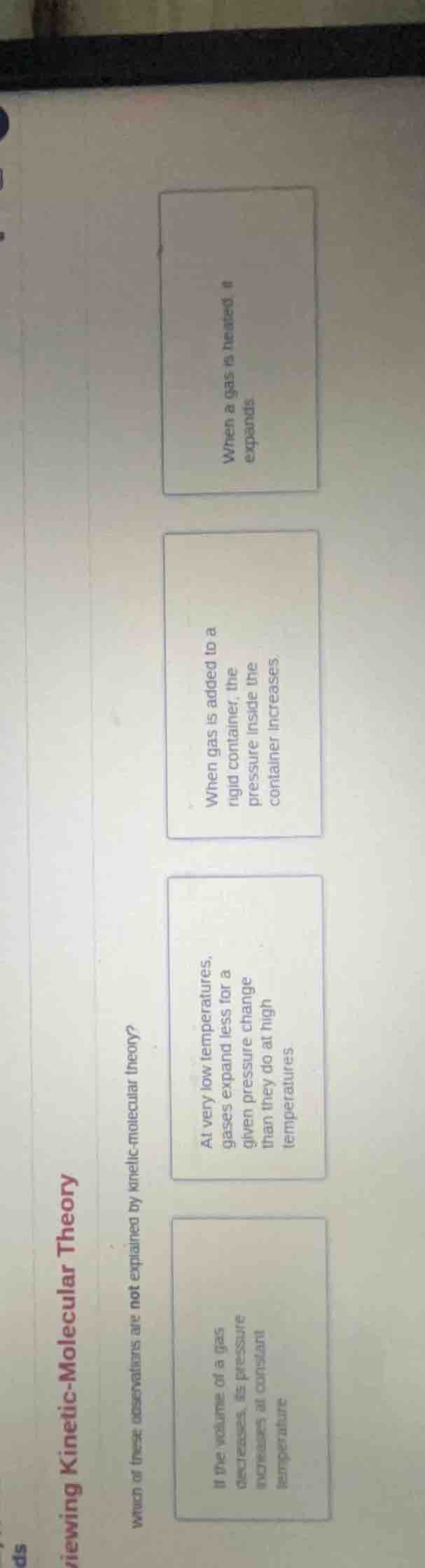
which of these observations are not explained by kinetic-molecular theory?
- if the volume of a gas decreases, its pressure increases at constant temperature.
- at very low temperatures, gases expand less for a given pressure change than they do at high temperatures.
- when gas is added to a rigid container, the pressure inside the container increases.
- when a gas is heated, it expands.
Analyze Kinetic-Molecular Theory assumptions
The Kinetic Molecular Theory assumes that gas particles have negligible volume and exert no intermolecular attractive forces on each other. These assumptions describe an ideal gas.
Evaluate each observation
- Observation 1: "If the volume of a a gas decreases, its pressure increases at constant temperature" (Boyle's Law). This is explained by Kinetic Molecular Theory because decreasing volume increases collision frequency.
- Observation 2: "At very low temperatures, gases expand less for a given pressure change than they do at high temperatures." At low temperatures, intermolecular attractions become significant, causing deviations from ideal behavior. This is a Real Gas Deviations phenomenon, which is not explained by the basic assumptions of Kinetic Molecular Theory.
- Observation 3: "When gas is added to a rigid container, the pressure inside the container increases." This is explained by Kinetic Molecular Theory because more particles lead to more frequent collisions.
- Observation 4: "When a gas is heated, it expands." This is explained by Kinetic Molecular Theory because heating increases kinetic energy, causing particles to push outward.
Identify the non-explained observation
The observation regarding low-temperature behavior deviates from ideal gas behavior due to Intermolecular Forces, which the basic Kinetic Molecular Theory assumes do not exist.

Snap & solve any problem in the app
Get step-by-step solutions on Sovi AI
Photo-based solutions with guided steps
Explore more problems and detailed explanations
- If the volume of a gas decreases, its pressure increases at constant temperature
- At very low temperatures, gases expand less for a given pressure change than they do at high temperatures (Correct answer)
- When gas is added to a rigid container, the pressure inside the container increases
- When a gas is heated, it expands