QUESTION IMAGE
Question
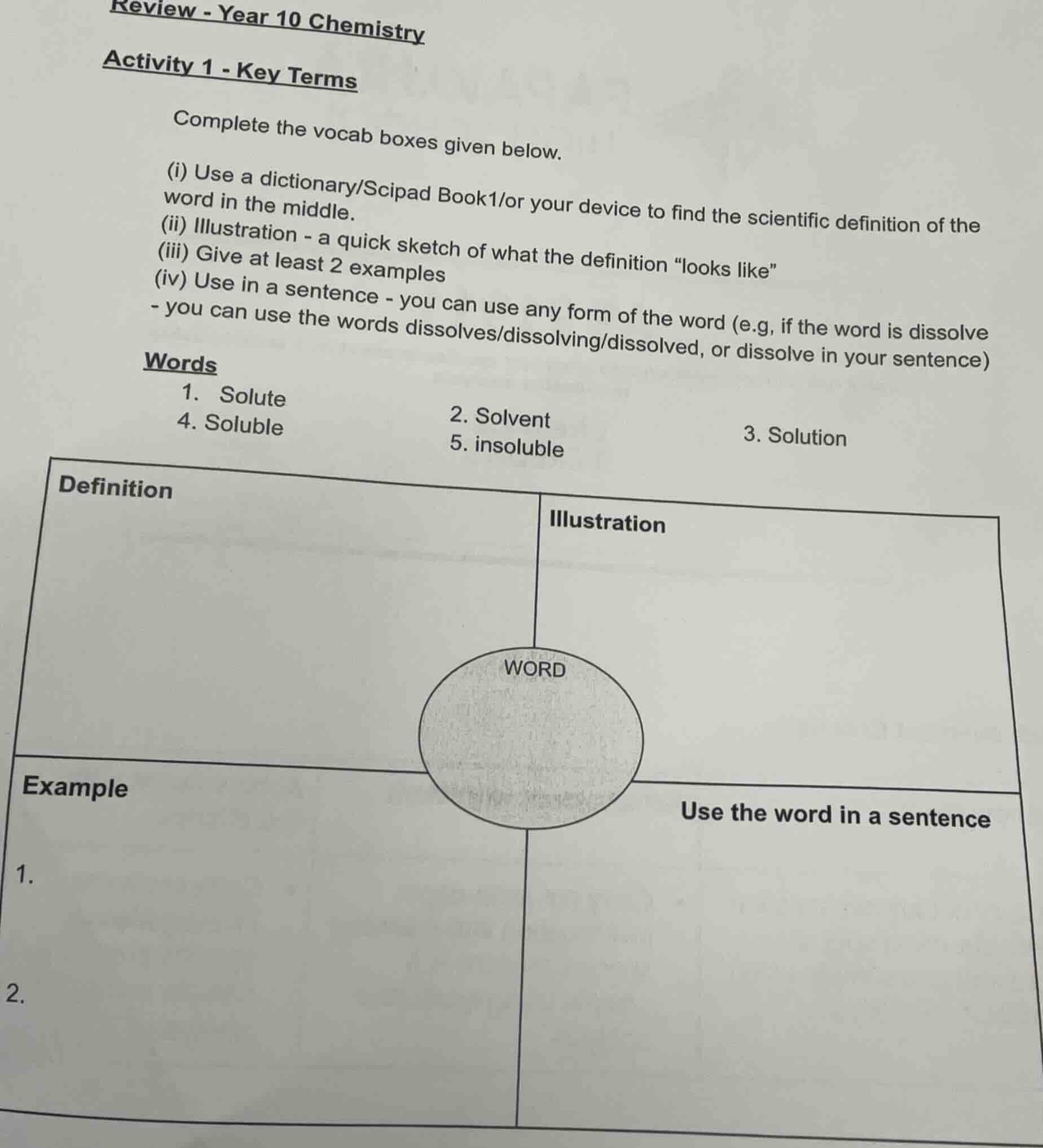
review - year 10 chemistry
activity 1 - key terms
complete the vocab boxes given below.
(i) use a dictionary/scipad book1/or your device to find the scientific definition of the word in the middle.
(ii) illustration - a quick sketch of what the definition \looks like\
(iii) give at least 2 examples
(iv) use in a sentence - you can use any form of the word (e.g, if the word is dissolve - you can use the words dissolves/dissolving/dissolved, or dissolve in your sentence)
words
- solute
- solvent
- solution
- soluble
- insoluble
Define vocabulary terms
Using the Solute and Solvent and Chemical Solutions knowledge points, we define the five key terms:
- Solute: The substance dissolved in a solvent.
- Solvent: The dissolving medium, usually a liquid.
- Solution: A homogeneous mixture of solute and solvent.
- Soluble: Able to be dissolved in a solvent.
- Insoluble: Incapable of being dissolved in a solvent.
Provide examples
Using the Solute and Solvent and Chemical Solutions knowledge points, we identify common examples:
- Solute: Salt, sugar.
- Solvent: Water, ethanol.
- Solution: Saltwater, fizzy drinks.
- Soluble: Salt in water, sugar in tea.
- Insoluble: Sand in water, oil in water.
Create contextual sentences
Using the Solute and Solvent and Chemical Solutions knowledge points, we construct clear scientific sentences:
- Solute: The solute dissolved quickly when heated.
- Solvent: Water is known as the universal solvent.
- Solution: Stirring helps create a uniform solution.
- Soluble: Sugar is highly soluble in warm water.
- Insoluble: Plastic is insoluble in water.
Describe illustrations
Using the Solute and Solvent and Chemical Solutions knowledge points, we describe simple visual representations:
- Solute: Small particles entering a liquid.
- Solvent: A beaker filled with liquid molecules.
- Solution: A uniform mixture of two particle types.
- Soluble: Particles dispersing completely in liquid.
- Insoluble: Particles settling at the bottom.

Snap & solve any problem in the app
Get step-by-step solutions on Sovi AI
Photo-based solutions with guided steps
Explore more problems and detailed explanations
Question 1: Solute
- Definition: A substance that is dissolved in a solvent to form a solution.
- Illustration: A sketch showing solid particles (like salt crystals) being added into a beaker of liquid.
- Examples:
- Salt (sodium chloride)
- Sugar (sucrose)
- Sentence: The solute dissolved completely in the warm water after stirring.
Question 2: Solvent
- Definition: A substance, typically a liquid, that dissolves a solute to form a solution.
- Illustration: A sketch of a beaker filled with liquid water molecules, ready to dissolve a substance.
- Examples:
- Water
- Ethanol (alcohol)
- Sentence: Water is often called the universal solvent because it dissolves many substances.
Question 3: Solution
- Definition: A homogeneous mixture composed of two or more substances, where a solute is completely dissolved in a solvent.
- Illustration: A sketch of a beaker containing a completely clear, uniform liquid with evenly distributed particles.
- Examples:
- Saltwater
- Air (a gaseous solution)
- Sentence: The chemist prepared a saltwater solution for the laboratory experiment.
Question 4: Soluble
- Definition: Capable of being dissolved, especially in a liquid solvent.
- Illustration: A sketch showing solid particles dispersing and disappearing into a liquid.
- Examples:
- Table salt in water
- Food coloring in water
- Sentence: Sugar is highly soluble in hot tea, making it easy to sweeten.
Question 5: Insoluble
- Definition: Incapable of being dissolved in a specific liquid solvent.
- Illustration: A sketch showing solid particles settling at the bottom of a beaker filled with liquid, remaining separate.
- Examples:
- Sand in water
- Oil in water
- Sentence: Sand is insoluble in water, so it settles at the bottom of the container.