QUESTION IMAGE
Question
question
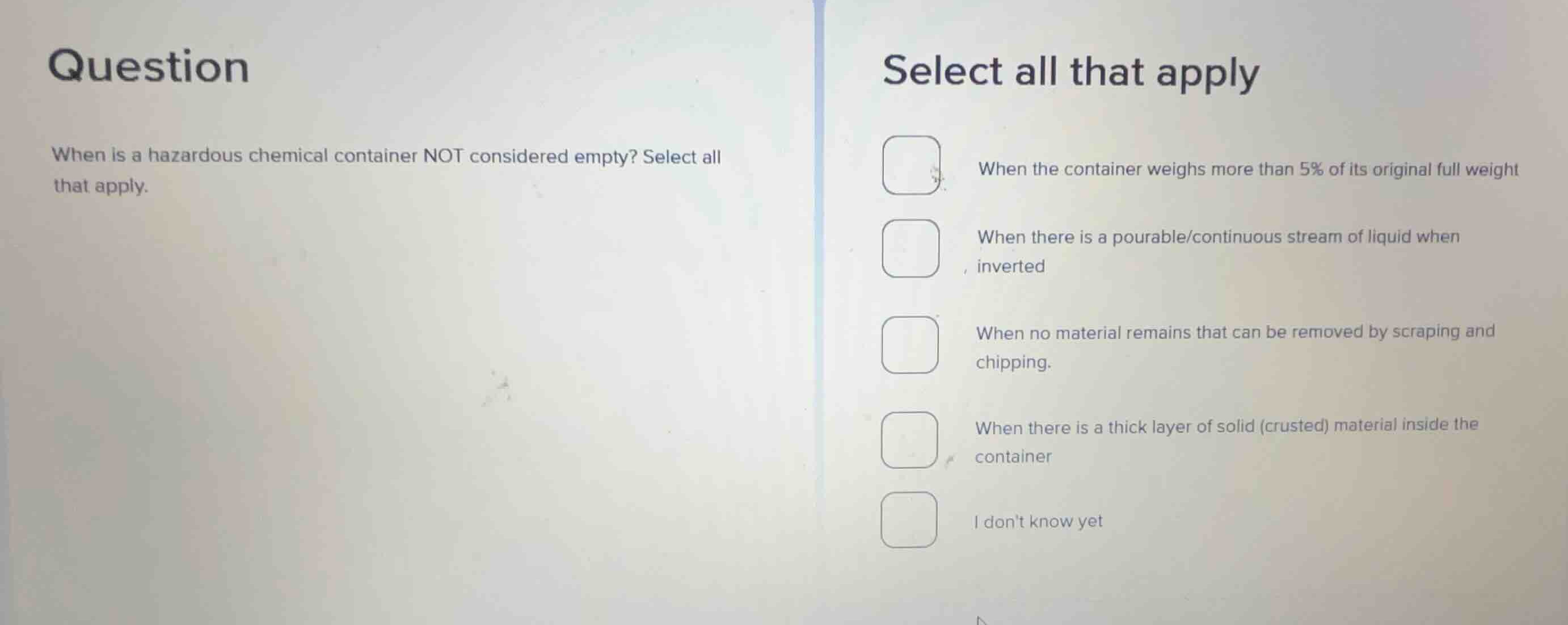
when is a hazardous chemical container not considered empty? select all that apply.
select all that apply
- when the container weighs more than 5% of its original full weight
- when there is a pourable/continuous stream of liquid when inverted
- when no material remains that can be removed by scraping and chipping.
- when there is a thick layer of solid (crusted) material inside the container
- i dont know yet
Identify regulatory standards
Under environmental and occupational safety regulations (such as RCRA and OSHA), a container is Hazardous Waste if it is not "RCRA empty." We must evaluate when a container is NOT considered empty.
Evaluate the first option
The first option states: "When the container weighs more than 3% of its original full weight" (or 5% depending on specific local policies, but standard RCRA rules for acute hazardous waste or general containers specify strict weight thresholds, often 3% by weight of the total capacity). If it weighs more than the threshold, it is NOT empty. Sutter Health Waste Management guidelines align with standard safety protocols where residual weight indicates it is not empty.
Evaluate the second option
The second option states: "When there is a pourable/continuous stream of liquid when inverted." If liquid can still pour out in a continuous stream, the container has not been fully emptied by common practice methods (pouring, pumping, aspirating). Therefore, it is NOT considered empty.
Evaluate the third option
The third option states: "When no material remains that can be removed by scraping and chipping." If no material remains that can be removed, then the container is considered empty. Therefore, this option describes a state where it IS considered empty, so we do not select it.
Evaluate the fourth option
The fourth option states: "When there is a thick layer of solid (crusted) material inside the container." If there is a thick layer of solid, crusted material remaining, hazardous residue is still present and can potentially be removed or remains hazardous. Thus, it is NOT considered empty.

Snap & solve any problem in the app
Get step-by-step solutions on Sovi AI
Photo-based solutions with guided steps
Explore more problems and detailed explanations
- When the container weighs more than 5% of its original full weight (Correct answer)
- When there is a pourable/continuous stream of liquid when inverted (Correct answer)
- When no material remains that can be removed by scraping and chipping.
- When there is a thick layer of solid (crusted) material inside the container (Correct answer)
- I don't know yet