QUESTION IMAGE
Question
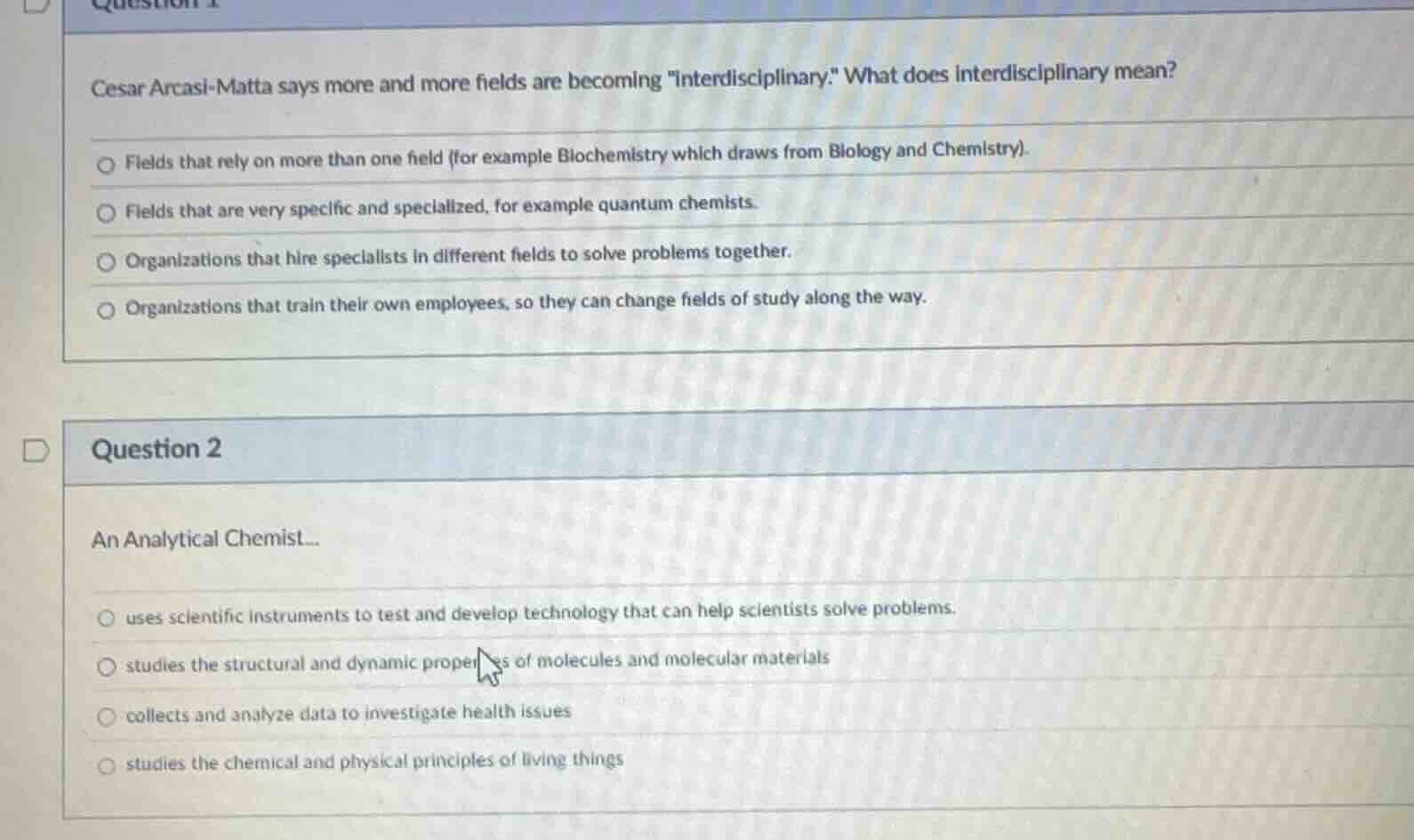
question 1
cesar arcasi-matta says more and more fields are becoming \interdisciplinary.\ what does interdisciplinary mean?
- fields that rely on more than one field (for example biochemistry which draws from biology and chemistry).
- fields that are very specific and specialized, for example quantum chemists.
- organizations that hire specialists in different fields to solve problems together.
- organizations that train their own employees, so they can change fields of study along the way.
question 2
an analytical chemist...
- uses scientific instruments to test and develop technology that can help scientists solve problems.
- studies the structural and dynamic properties of molecules and molecular materials
- collects and analyze data to investigate health issues
- studies the chemical and physical principles of living things
Define interdisciplinary fields
The term "interdisciplinary" combines the prefix "inter-" (meaning between or among) with "disciplinary" (relating to branches of knowledge or academic disciplines). Therefore, an interdisciplinary field is one that crosses traditional boundaries to combine elements, methods, or concepts from more than one academic discipline. The first option correctly defines this by using biochemistry (a blend of biology and chemistry) as a clear example.
Define analytical chemistry
Analytical chemistry is the science of obtaining, processing, and communicating information about the composition and structure of matter. Analytical chemists use scientific instruments, methods, and techniques to separate, identify, and quantify chemical components. This aligns with the first option under Question 2, which describes using scientific instruments to test and develop technology to solve problems.

Snap & solve any problem in the app
Get step-by-step solutions on Sovi AI
Photo-based solutions with guided steps
Explore more problems and detailed explanations
Question 1
- (A) Fields that rely on more than one field (for example Biochemistry which draws from Biology and Chemistry). (Correct answer)
- (B) Fields that are very specific and specialized, for example quantum chemists.
- (C) Organizations that hire specialists in different fields to solve problems together.
- (D) Organizations that train their own employees, so they can change fields of study along the way.
Question 2
- (A) uses scientific instruments to test and develop technology that can help scientists solve problems. (Correct answer)
- (B) studies the structural and dynamic properties of molecules and molecular materials
- (C) collects and analyze data to investigate health issues
- (D) studies the chemical and physical principles of living things