QUESTION IMAGE
Question
question 23 of 25
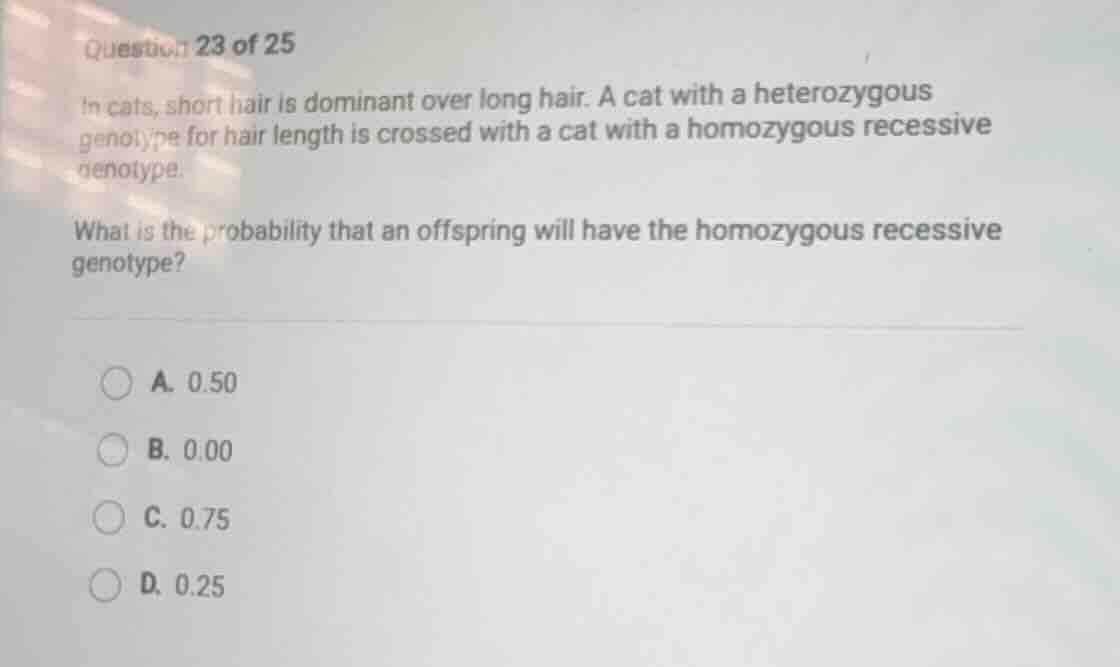
in cats, short hair is dominant over long hair. a cat with a heterozygous genotype for hair length is crossed with a cat with a homozygous recessive genotype.
what is the probability that an offspring will have the homozygous recessive genotype?
a. 0.50
b. 0.00
c. 0.75
d. 0.25
<pre_analysis>
{
"quality": "clear",
"question_count": 1,
"skills_matched": [
"step_cot",
"multiple_choice_formatter",
"explain_then_answer",
"quick"
],
"needs_drawing": false,
"concepts_used": [
"Monohybrid Cross",
"Genotype",
"Dominance"
],
"new_concepts": [],
"current_concepts": [
"Monohybrid Cross",
"Genotype",
"Dominance",
"Mendelian Genetics"
]
}
</pre_analysis>
<reasoning>
Define alleles and parental genotypes
Let \(H\) represent the dominant allele for short hair, and \(h\) represent the recessive allele for long hair.
- Heterozygous parent: \(Hh\)
- Homozygous recessive parent: \(hh\)
Determine offspring genotypes using a Punnett square
Cross \(Hh \times hh\):
- Gametes from heterozygous parent: \(H\), \(h\)
- Gametes from homozygous recessive parent: \(h\)
The resulting offspring genotypes are:
- \(Hh\) (heterozygous)
- \(hh\) (homozygous recessive)
Calculate the probability of the homozygous recessive genotype
The ratio of offspring genotypes is:
- \(50\%\) \(Hh\)
- \(50\%\) \(hh\)
Therefore, the probability of an offspring having the homozygous recessive genotype (\(hh\)) is:
\[
P(hh) = 0.50
\]
</reasoning>
<answer>
<mcq-correct>(A) 0.50</mcq-correct>
<mcq-option>(B) 0.00</mcq-option>
<mcq-option>(C) 0.75</mcq-option>
<mcq-option>(D) 0.25</mcq-option>
</answer>
<post_analysis>
{
"subject": "Natural Science",
"question_type": "Multiple Choice",
"knowledge_point": [
"Natural Science",
"Biology",
"Mendelian Genetics"
]
}
</post_analysis>
Snap & solve any problem in the app
Get step-by-step solutions on Sovi AI
Photo-based solutions with guided steps
Explore more problems and detailed explanations
<pre_analysis>
{
"quality": "clear",
"question_count": 1,
"skills_matched": [
"step_cot",
"multiple_choice_formatter",
"explain_then_answer",
"quick"
],
"needs_drawing": false,
"concepts_used": [
"Monohybrid Cross",
"Genotype",
"Dominance"
],
"new_concepts": [],
"current_concepts": [
"Monohybrid Cross",
"Genotype",
"Dominance",
"Mendelian Genetics"
]
}
</pre_analysis>
<reasoning>
Define alleles and parental genotypes
Let \(H\) represent the dominant allele for short hair, and \(h\) represent the recessive allele for long hair.
- Heterozygous parent: \(Hh\)
- Homozygous recessive parent: \(hh\)
Determine offspring genotypes using a Punnett square
Cross \(Hh \times hh\):
- Gametes from heterozygous parent: \(H\), \(h\)
- Gametes from homozygous recessive parent: \(h\)
The resulting offspring genotypes are:
- \(Hh\) (heterozygous)
- \(hh\) (homozygous recessive)
Calculate the probability of the homozygous recessive genotype
The ratio of offspring genotypes is:
- \(50\%\) \(Hh\)
- \(50\%\) \(hh\)
Therefore, the probability of an offspring having the homozygous recessive genotype (\(hh\)) is:
\[
P(hh) = 0.50
\]
</reasoning>
<answer>
<mcq-correct>(A) 0.50</mcq-correct>
<mcq-option>(B) 0.00</mcq-option>
<mcq-option>(C) 0.75</mcq-option>
<mcq-option>(D) 0.25</mcq-option>
</answer>
<post_analysis>
{
"subject": "Natural Science",
"question_type": "Multiple Choice",
"knowledge_point": [
"Natural Science",
"Biology",
"Mendelian Genetics"
]
}
</post_analysis>