QUESTION IMAGE
Question
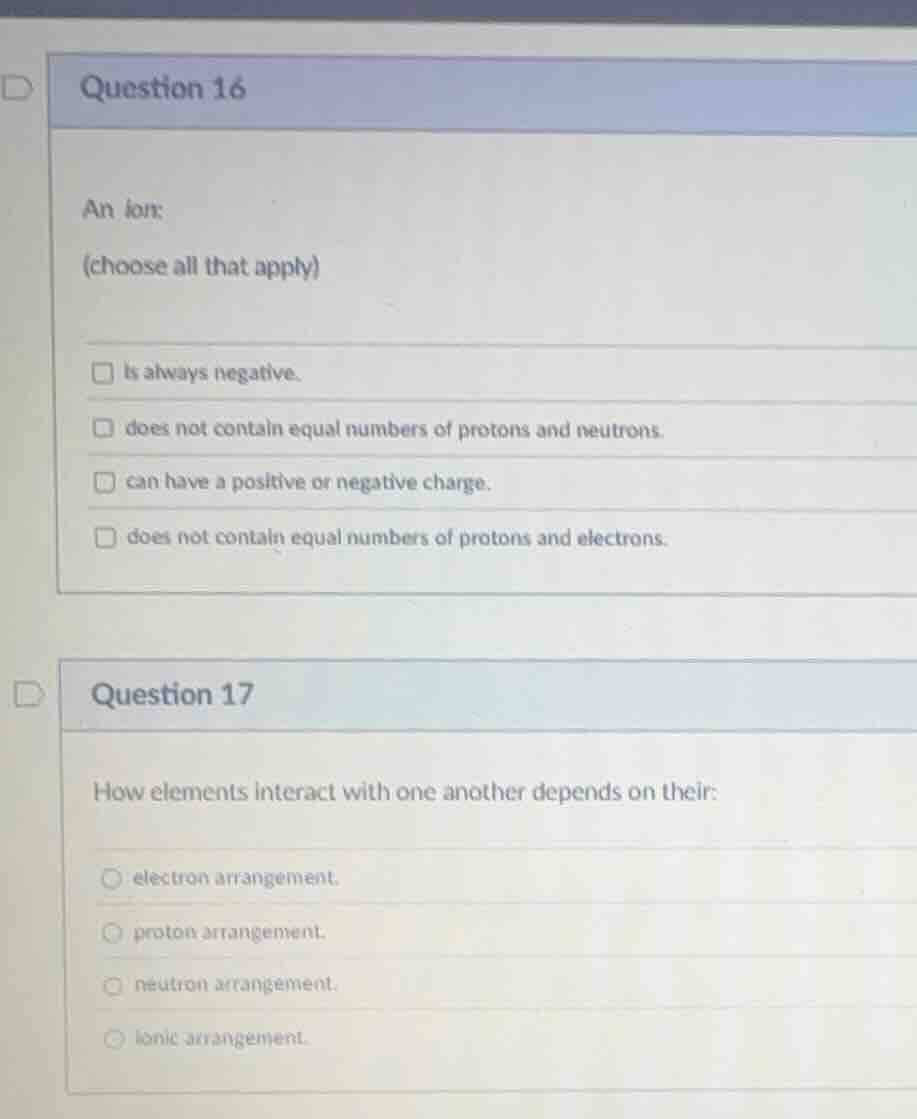
question 16
an ion:
(choose all that apply)
- is always negative.
- does not contain equal numbers of protons and neutrons.
- can have a positive or negative charge.
- does not contain equal numbers of protons and electrons.
question 17
how elements interact with one another depends on their:
- electron arrangement.
- proton arrangement.
- neutron arrangement.
- ionic arrangement.
Analyze Question 16
Using the Atomic Number and Protons knowledge point, we define an ion as an atom or molecule with a net electrical charge. This charge arises because the total number of electrons is not equal to the total number of protons.
- "is always negative": Incorrect, as cations are positive.
- "does not contain equal numbers of protons and neutrons": Incorrect, neutrons determine isotopes, not ions.
- "can have a positive or negative charge": Correct, ions can be cations (+) or anions (-).
- "does not contain equal numbers of protons and electrons": Correct, an imbalance between protons and electrons creates the net charge.
Analyze Question 17
Using the Valence Electrons and Chemical Bonding knowledge points, chemical interactions and bonding between elements are determined by their outer electrons. The distribution and sharing of these electrons govern how atoms react.
- "electron arrangement": Correct, chemical reactivity depends on electron configuration.
- "proton arrangement": Incorrect, protons reside in the nucleus and do not participate in chemical bonds.
- "neutron arrangement": Incorrect, neutrons do not affect chemical bonding.
- "ionic arrangement": Incorrect, this refers to crystal lattices rather than fundamental atomic interaction drivers.

Snap & solve any problem in the app
Get step-by-step solutions on Sovi AI
Photo-based solutions with guided steps
Explore more problems and detailed explanations
Question 16
- is always negative.
- does not contain equal numbers of protons and neutrons.
- can have a positive or negative charge. (Correct answer)
- does not contain equal numbers of protons and electrons. (Correct answer)
Question 17
- electron arrangement. (Correct answer)
- proton arrangement.
- neutron arrangement.
- ionic arrangement.