QUESTION IMAGE
Question
question 15
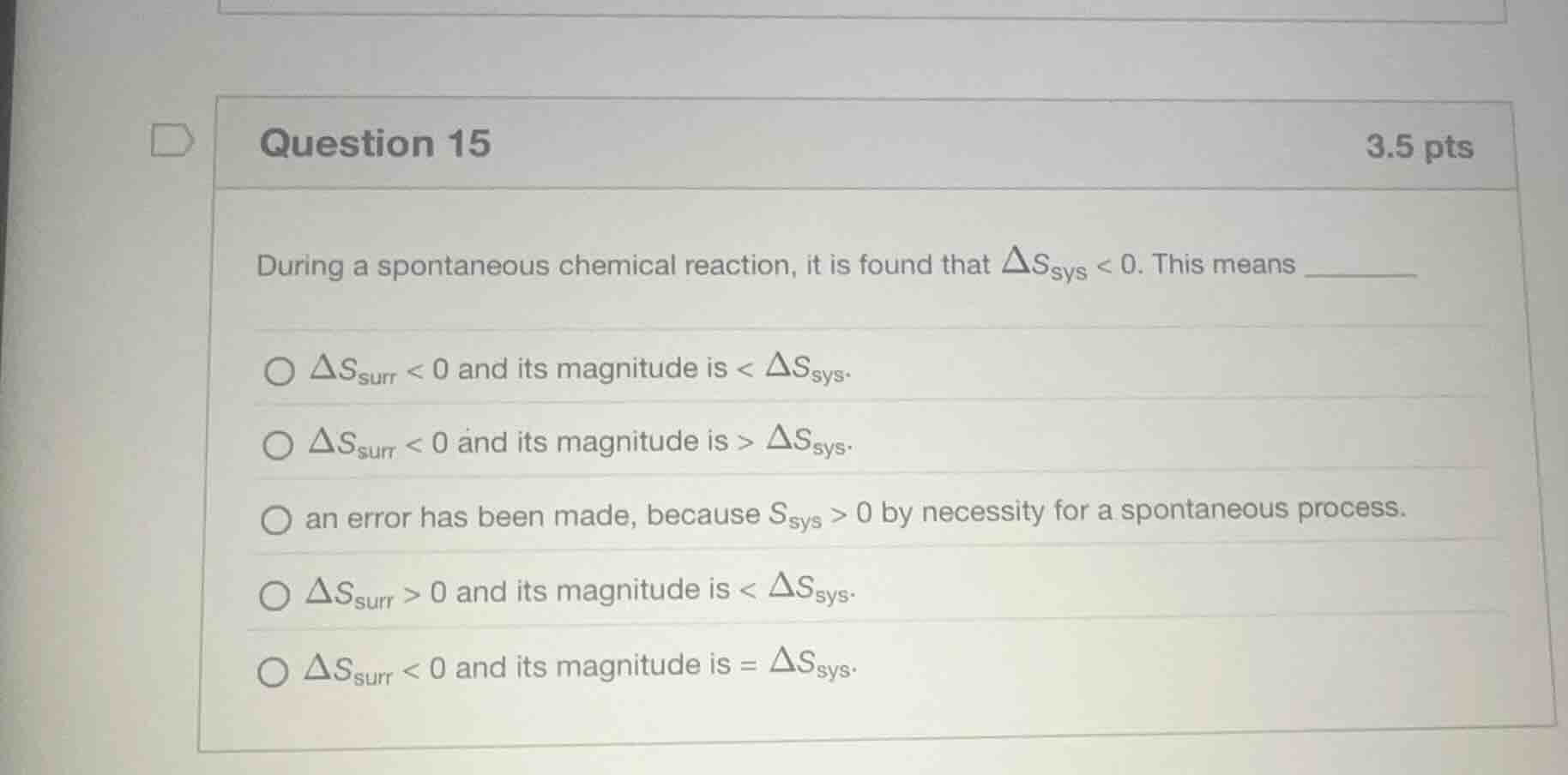
during a spontaneous chemical reaction, it is found that \\(\delta s_{\text{sys}} < 0\\). this means _______
\\(\delta s_{\text{surr}} < 0\\) and its magnitude is \\(< \delta s_{\text{sys}}\\).
\\(\delta s_{\text{surr}} < 0\\) and its magnitude is \\(> \delta s_{\text{sys}}\\).
an error has been made, because \\(s_{\text{sys}} > 0\\) by necessity for a spontaneous process.
\\(\delta s_{\text{surr}} > 0\\) and its magnitude is \\(< \delta s_{\text{sys}}\\).
\\(\delta s_{\text{surr}} < 0\\) and its magnitude is \\(= \delta s_{\text{sys}}\\).
State the condition for spontaneity
Using the Second Law of Thermodynamics and Spontaneous Processes knowledge points
Analyze the given system entropy change
Using the Spontaneous Processes knowledge point
Determine the sign and magnitude of surroundings entropy change
Using the Second Law of Thermodynamics knowledge point

Snap & solve any problem in the app
Get step-by-step solutions on Sovi AI
Photo-based solutions with guided steps
Explore more problems and detailed explanations
- \(\Delta S_{\text{surr}} < 0\) and its magnitude is \(< \Delta S_{\text{sys}}\).
- \(\Delta S_{\text{surr}} < 0\) and its magnitude is \(> \Delta S_{\text{sys}}\).
- an error has been made, because \(S_{\text{sys}} > 0\) by necessity for a spontaneous process.
- \(\Delta S_{\text{surr}} > 0\) and its magnitude is \(> \Delta S_{\text{sys}}\). (Correct answer)
- \(\Delta S_{\text{surr}} < 0\) and its magnitude is \(= \Delta S_{\text{sys}}\).