QUESTION IMAGE
Question
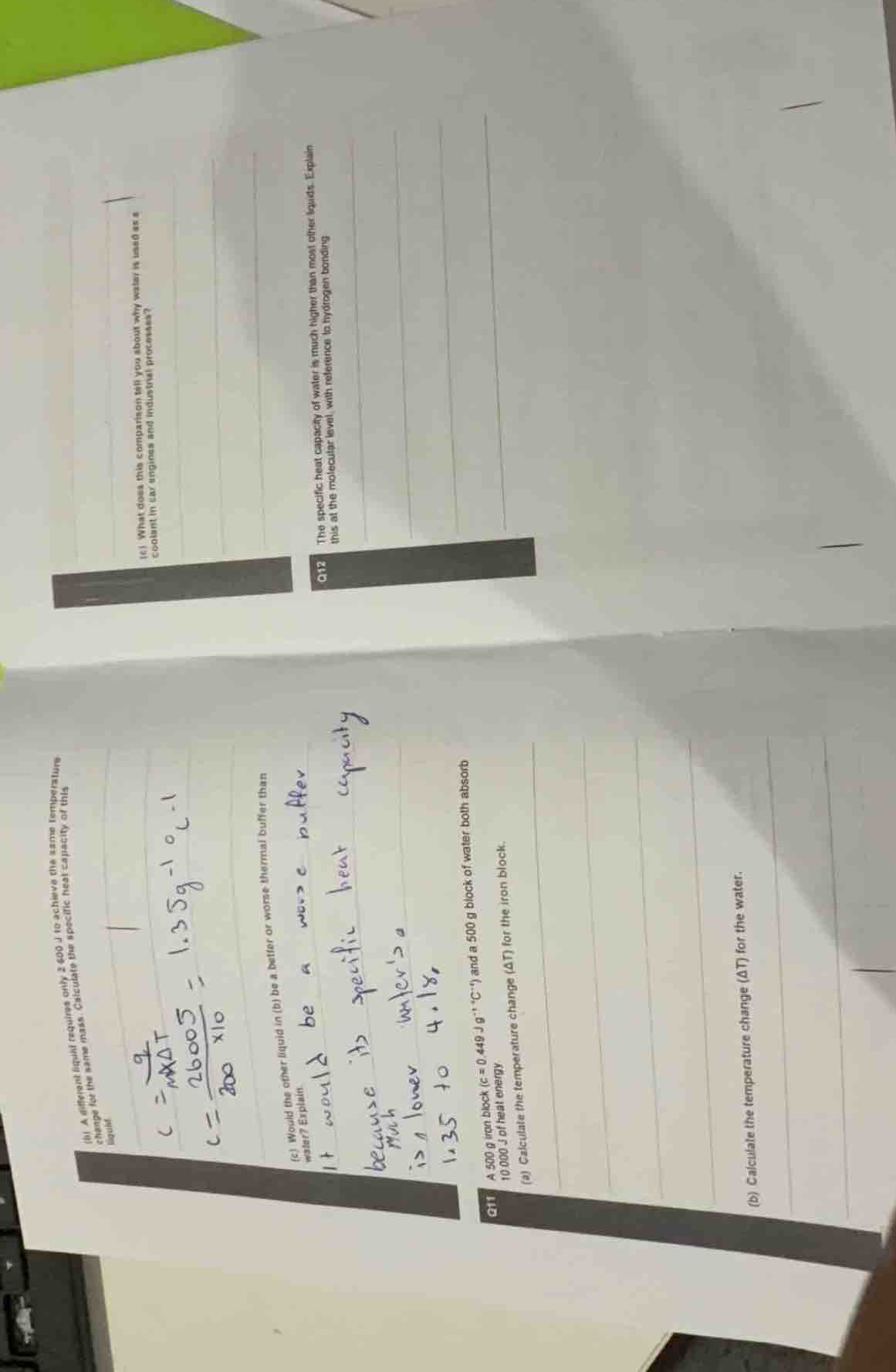
q11 a 500 g iron block (c = 0.449 j g^{-1} °c^{-1}) and a 500 g block of water both absorb 10,000 j of heat energy.
(a) calculate the temperature change (\delta t) for the iron block.
(b) calculate the temperature change (\delta t) for the water.
(b) a different liquid requires only 2,600 j to achieve the same temperature change for the same mass. calculate the specific heat capacity of this liquid.
(c) would the other liquid in (b) be a better or worse thermal buffer than water? explain.
q12 the specific heat capacity of water is much higher than most other liquids. explain this at the molecular level, with reference to hydrogen bonding.
(c) what does this comparison tell you about why water is used as a coolant in car engines and industrial processes?
Calculate temperature change for the iron block
Calculate temperature change for the water block
Explain water as a coolant and its high specific heat capacity

Snap & solve any problem in the app
Get step-by-step solutions on Sovi AI
Photo-based solutions with guided steps
Explore more problems and detailed explanations
Question 11
(a) The temperature change (\(\Delta T\)) for the iron block is:
(b) The temperature change (\(\Delta T\)) for the water is:
(c) This comparison shows that water can absorb much more heat energy than iron for the same temperature rise, explaining why water is highly effective as a coolant to prevent overheating in car engines and industrial processes.
Question 12
At the molecular level, water molecules form extensive networks of hydrogen bonds. A large amount of heat energy must first be absorbed to disrupt and break these strong intermolecular hydrogen bonds before the kinetic energy of the water molecules can increase, resulting in an exceptionally high specific heat capacity.