QUESTION IMAGE
Question
problem 1
critical path, workers, and the hybrid schedule
task graphs | critical path | data parallel
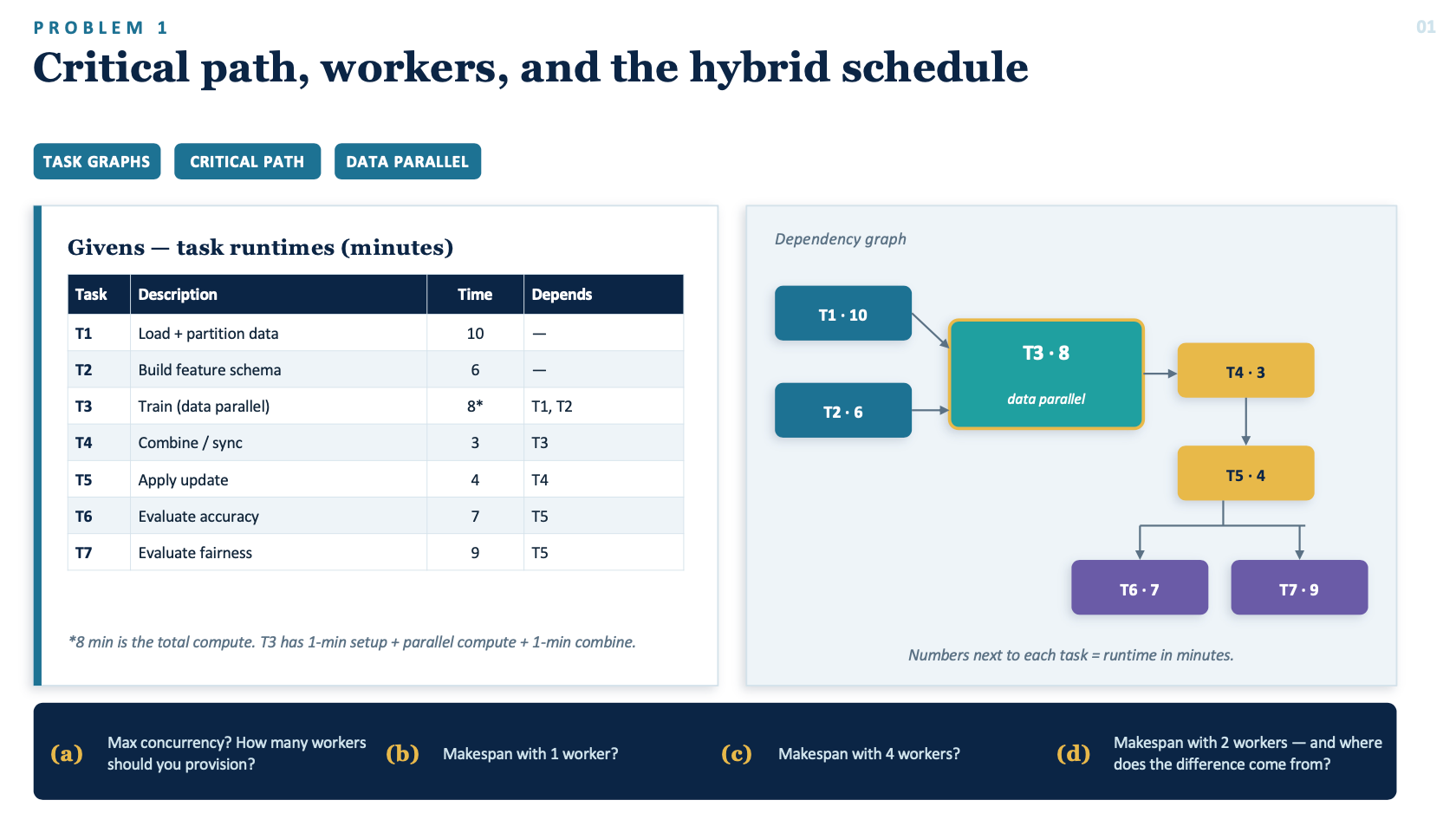
givens - task runtimes (minutes)
| task | description | time | depends |
|---|---|---|---|
| t2 | build feature schema | 6 | — |
| t3 | train (data parallel) | 8* | t1, t2 |
| t4 | combine / sync | 3 | t3 |
| t5 | apply update | 4 | t4 |
| t6 | evaluate accuracy | 7 | t5 |
| t7 | evaluate fairness | 9 | t5 |
*8 min is the total compute. t3 has 1-min setup + parallel compute + 1-min combine.
dependency graph
numbers next to each task = runtime in minutes.
(a) max concurrency? how many workers should you provision?
(b) makespan with 1 worker?
(c) makespan with 4 workers?
(d) makespan with 2 workers — and where does the difference come from?
🆕 New Concept Discovered: Task Scheduling and Makespan
Calculating execution times with resource constraints.
Step 1: Max Concurrency and Worker Provisioning (a)
To find the maximum concurrency, we look at the maximum number of tasks that can run in parallel at any single point in time:
- At the start, T1 and T2 can run in parallel (concurrency of 2).
- T3 is a data-parallel task. The note states: "T3 has 1-min setup + parallel compute + 1-min combine." The total compute is \(8\) minutes. Thus, the parallel compute portion takes:
In a data-parallel setting, this compute can be split across multiple workers.
- At the end, T6 and T7 can run in parallel (concurrency of 2).
Therefore, the maximum structural concurrency of independent tasks in the graph is 2 (either T1/T2 or T6/T7). If we provision for this maximum task-level concurrency, we should provision 2 workers.
Step 2: Makespan with 1 Worker (b)
With only 1 worker, no tasks can be executed in parallel. The total time (makespan) is simply the sum of the runtimes of all tasks:
Step 3: Makespan with 4 Workers (c)
With 4 workers, we can parallelize tasks up to the maximum available concurrency at each stage:
- Start (T1, T2):
- Worker 1 takes T1 (10 min).
- Worker 2 takes T2 (6 min).
- Both finish at \(t = 10\) min.
- Train (T3):
- Starts at \(t = 10\).
- 1-min setup (sequential): \(t = 10\) to \(11\).
- 6-min parallel compute split among 4 workers:
This runs from \(t = 11\) to \(12.5\).
- 1-min combine (sequential): \(t = 12.5\) to \(13.5\).
- Combine/sync (T4):
- Runs from \(t = 13.5\) to \(16.5\) (3 min).
- Apply update (T5):
- Runs from \(t = 16.5\) to \(20.5\) (4 min).
- Evaluate (T6, T7):
- Worker 1 takes T7 (9 min) \(
ightarrow\) finishes at \(20.5 + 9 = 29.5\).
- Worker 2 takes T6 (7 min) \(
ightarrow\) finishes at \(20.5 + 7 = 27.5\).
The total makespan is determined by the last finishing task (T7) at 29.5 minutes.
Step 4: Makespan with 2 Workers (d)
With 2 workers:
- Start (T1, T2):
- Worker 1 takes T1 (10 min), Worker 2 takes T2 (6 min).
- Both finish by \(t = 10\).
- Train (T3):
- Starts at \(t = 10\).
- 1-min setup: \(t = 10\) to \(11\).
- 6-min parallel compute split among 2 workers:
This runs from \(t = 11\) to \(14\).
- 1-min combine: \(t = 14\) to \(15\).
- Combine/sync (T4):
- Runs from \(t = 15\) to \(18\) (3 min).
- Apply update (T5):
- Runs from \(t = 18\) to \(22\) (4 min).
- Evaluate (T6, T7):
- Worker 1 takes T7 (9 min) \(
ightarrow\) finishes at \(22 + 9 = 31\).
- Worker 2 takes T6 (7 min) \(
ightarrow\) finishes at \(22 + 7 = 29\).
The total makespan is 31 minutes.
Where does the difference come from?
Comparing 2 workers (31 min) vs 4 workers (29.5 min), the difference of 1.5 minutes comes entirely from the parallel compute phase of T3:
- With 2 workers, the parallel compute of T3 takes \(\frac{6}{2} = 3\) minutes.
- With 4 workers, it takes \(\frac{6}{4} = 1.5\) minutes.
- All other phases (T1/T2 and…

Snap & solve any problem in the app
Get step-by-step solutions on Sovi AI
Photo-based solutions with guided steps
Explore more problems and detailed explanations
- (a) Max concurrency is 2. You should provision 2 workers for task-level concurrency.
- (b) Makespan with 1 worker is 47 minutes.
- (c) Makespan with 4 workers is 29.5 minutes.
- (d) Makespan with 2 workers is 31 minutes. The 1.5-minute difference comes entirely from the parallel compute portion of T3, which scales from 3 minutes (with 2 workers) down to 1.5 minutes (with 4 workers).