QUESTION IMAGE
Question
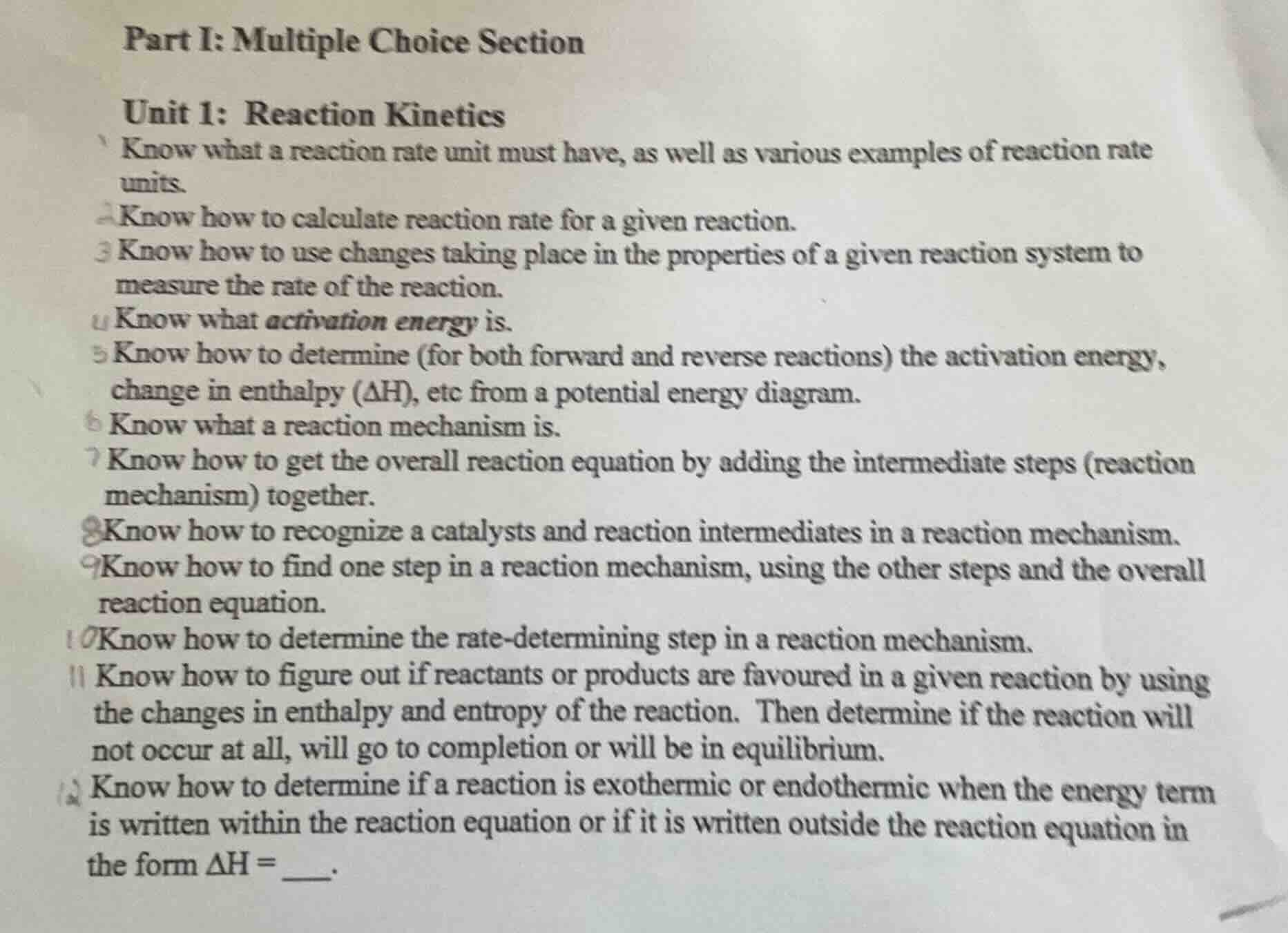
part i: multiple choice section
unit 1: reaction kinetics
- know what a reaction rate unit must have, as well as various examples of reaction rate units.
- know how to calculate reaction rate for a given reaction.
- know how to use changes taking place in the properties of a given reaction system to measure the rate of the reaction.
- know what activation energy is.
- know how to determine (for both forward and reverse reactions) the activation energy, change in enthalpy (\delta h), etc from a potential energy diagram.
- know what a reaction mechanism is.
- know how to get the overall reaction equation by adding the intermediate steps (reaction mechanism) together.
- know how to recognize a catalysts and reaction intermediates in a reaction mechanism.
- know how to find one step in a reaction mechanism, using the other steps and the overall reaction equation.
- know how to determine the rate-determining step in a reaction mechanism.
- know how to figure out if reactants or products are favoured in a given reaction by using the changes in enthalpy and entropy of the reaction. then determine if the reaction will not occur at all, will go to completion or will be in equilibrium.
- know how to determine if a reaction is exothermic or endothermic when the energy term is written within the reaction equation or if it is written outside the reaction equation in the form \delta h = \\_\\_\\_.
Analyze the document content
The provided image contains a study guide or list of learning objectives for "Part I: Multiple Choice Section" under "Unit 1: Reaction Kinetics". It lists 12 key learning objectives (numbered 1 through 12) that a student needs to know for their upcoming assessment. Since there is no specific question or problem to solve, the best way to assist is to provide a structured overview and summary of these 12 core kinetics concepts to help you study.
Summarize reaction rate and measurement (Objectives 1-3)
- Reaction Rate Units: Typically expressed as change in concentration over time, such as \(\text{M/s}\), \(\text{mol}\cdot\text{L}^{-1}\cdot\text{s}^{-1}\), or other units of concentration/amount per unit time.
- Calculating Rate: Determined by measuring the change in concentration of a reactant or product over a time interval:
- Measuring Rates: Can be monitored using physical property changes over time, such as pressure (for gas-producing reactions), pH (for acid/base reactions), color intensity/absorbance (using spectrophotometry), or mass.
Explain activation energy and potential energy diagrams (Objectives 4-5)
- Activation Energy (\(E_a\)): The minimum kinetic energy colliding reactant particles must possess to form the transition state (activated complex) and undergo a chemical reaction.
- Potential Energy Diagrams:
- Forward Activation Energy (\(E_{a,\text{fwd}}\)): The energy difference between the transition state (peak) and the reactants.
- Reverse Activation Energy (\(E_{a,\text{rev}}\)): The energy difference between the transition state (peak) and the products.
- Enthalpy Change (\(\Delta H\)): The difference in potential energy between products and reactants:
Describe reaction mechanisms and intermediates (Objectives 6-10)
- Reaction Mechanism: The step-by-step sequence of elementary reactions (steps) by which an overall chemical change occurs.
- Overall Equation: Obtained by adding all elementary steps together and canceling species that appear on both sides.
- Catalysts vs. Intermediates:
- Catalyst: Consumed in an early step and regenerated in a later step (not in the overall reaction).
- Intermediate: Produced in an early step and consumed in a later step (not in the overall reaction).
- Rate-Determining Step: The slowest elementary step in a reaction mechanism, which limits the overall rate of the reaction.
Evaluate reaction favorability and thermochemistry (Objectives 11-12)
- Favorability (Enthalpy and Entropy):
- Reactions are thermodynamically favored when they release heat (\(\Delta H < 0\)) and increase disorder (\(\Delta S > 0\)).
- If both factors favor the products, the reaction generally goes to completion. If they oppose each other, an equilibrium is established.
- Exothermic vs. Endothermic:
- Exothermic: Releases heat. Written as a product in the equation: \(\text{Reac…

Snap & solve any problem in the app
Get step-by-step solutions on Sovi AI
Photo-based solutions with guided steps
Explore more problems and detailed explanations
The image displays a study guide containing 12 key learning objectives for Unit 1: Reaction Kinetics. Here is a summary of the core concepts you need to know for your test:
- Reaction Rates: Units are always concentration over time (e.g., \(\text{M/s}\) or \(\text{mol}/(\text{L}\cdot\text{s})\)). Rates can be measured by tracking changes in pressure, pH, mass, or color intensity.
- Activation Energy (\(E_a\)): The minimum energy barrier reactants must overcome to react. On a potential energy diagram, \(E_{a,\text{fwd}} = \text{Peak} - \text{Reactants}\), and \(E_{a,\text{rev}} = \text{Peak} - \text{Products}\).
- Reaction Mechanisms: The series of elementary steps that make up an overall reaction.
- Intermediates are produced first and consumed later.
- Catalysts are present at the start, consumed, and regenerated at the end.
- The rate-determining step is the slowest step in the mechanism.
- Thermodynamics & Favorability:
- Exothermic reactions release heat (\(\Delta H < 0\); energy is on the product side).
- Endothermic reactions absorb heat (\(\Delta H > 0\); energy is on the reactant side).
- Reaction spontaneity and equilibrium are determined by the balance between enthalpy (\(\Delta H\)) and entropy (\(\Delta S\)).