Sovi.AI - AI Math Tutor

Scan to solve math questions

QUESTION IMAGE

7 multiple choice 10 points according to the theory of plate tectonics,…

Question

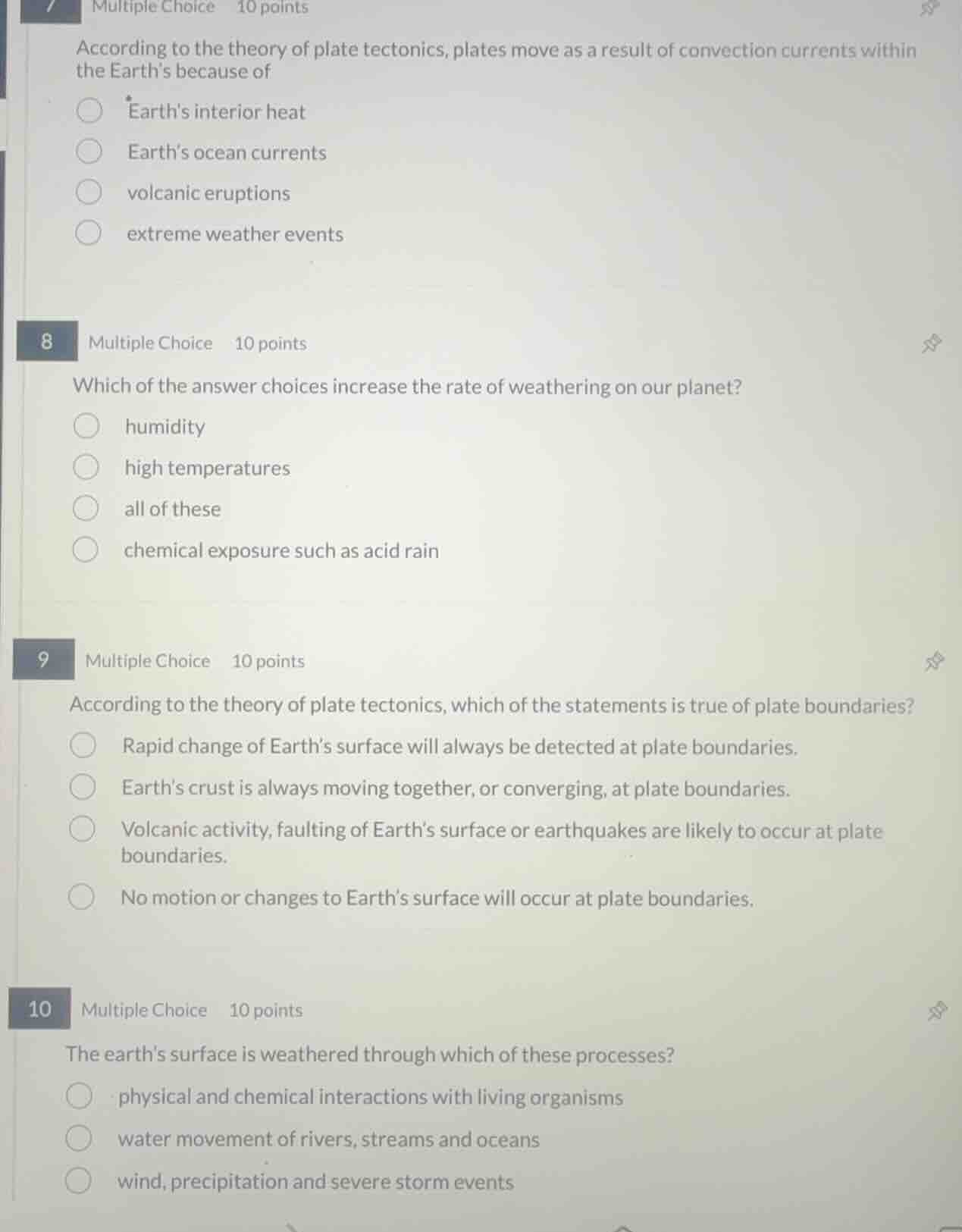
7 multiple choice 10 points
according to the theory of plate tectonics, plates move as a result of convection currents within the earths because of
earths interior heat
earths ocean currents
volcanic eruptions
extreme weather events

8 multiple choice 10 points
which of the answer choices increase the rate of weathering on our planet?
humidity
high temperatures
all of these
chemical exposure such as acid rain

9 multiple choice 10 points
according to the theory of plate tectonics, which of the statements is true of plate boundaries?
rapid change of earths surface will always be detected at plate boundaries.
earths crust is always moving together, or converging, at plate boundaries.
volcanic activity, faulting of earths surface or earthquakes are likely to occur at plate boundaries.
no motion or changes to earths surface will occur at plate boundaries.

10 multiple choice 10 points
the earths surface is weathered through which of these processes?
physical and chemical interactions with living organisms
water movement of rivers, streams and oceans
wind, precipitation and severe storm events

Explanation:

Response

<pre_analysis>
{
"quality": "clear",
"question_count": 4,
"skills_matched": [
"direct_cot",
"explain_then_answer",
"tutor"
],
"needs_drawing": false,
"concepts_used": [
"Plate Tectonics"
],
"new_concepts": [
"Weathering Processes",
"Plate Boundaries"
],
"current_concepts": [
"Plate Tectonics",
"Weathering Processes",
"Plate Boundaries"
]
}
</pre_analysis>

<reasoning>

Analyze driving forces of plate tectonics

The theory of Plate Tectonics explains that lithospheric plates move over the asthenosphere. This motion is driven by thermal convection currents in the mantle. The source of energy that heats the mantle and drives these currents is the Earth's interior heat, which comes from radioactive decay and residual heat from Earth's formation.

Identify factors increasing weathering rates

Weathering is the breakdown of rocks at Earth's surface. Humidity (moisture) accelerates chemical weathering. High temperatures speed up chemical reaction rates. Chemical exposure, such as acid rain, directly dissolves minerals. Therefore, all of these factors increase the rate of weathering.

Evaluate statements about plate boundaries

Plate boundaries are dynamic regions where tectonic plates interact. While rapid changes do not always occur and plates do not only converge, these boundaries are highly associated with geological activity. Volcanic activity, faulting of Earth's surface, or earthquakes are highly likely to occur at plate boundaries.

Determine processes of surface weathering

Earth's surface is weathered through physical, chemical, and biological processes. This includes physical and chemical interactions with living organisms (biological weathering), water movement of rivers, streams, and oceans (physical/chemical weathering), as well as wind, precipitation, and severe storm events. Since all three options describe valid weathering processes, they are all correct mechanisms.
</reasoning>

<answer>

Question 7

<mcq-correct>Earth's interior heat</mcq-correct>
<mcq-option>Earth's ocean currents</mcq-option>
<mcq-option>volcanic eruptions</mcq-option>
<mcq-option>extreme weather events</mcq-option>

Question 8

<mcq-option>humidity</mcq-option>
<mcq-option>high temperatures</mcq-option>
<mcq-correct>all of these</mcq-correct>
<mcq-option>chemical exposure such as acid rain</mcq-option>

Question 9

<mcq-option>Rapid change of Earth's surface will always be detected at plate boundaries.</mcq-option>
<mcq-option>Earth's crust is always moving together, or converging, at plate boundaries.</mcq-option>
<mcq-correct>Volcanic activity, faulting of Earth's surface or earthquakes are likely to occur at plate boundaries.</mcq-correct>
<mcq-option>No motion or changes to Earth's surface will occur at plate boundaries.</mcq-option>

Question 10

<mcq-correct>physical and chemical interactions with living organisms</mcq-correct>
<mcq-correct>water movement of rivers, streams and oceans</mcq-correct>
<mcq-correct>wind, precipitation and severe storm events</mcq-correct>
</answer>

<post_analysis>
{
"subject": "Natural Science",
"question_type": "Multi-part",
"knowledge_point": [
"Natural Science",
"Earth Science",
"Plate Tectonics and Weathering"
]
}
</post_analysis>

Answer:

<pre_analysis>
{
"quality": "clear",
"question_count": 4,
"skills_matched": [
"direct_cot",
"explain_then_answer",
"tutor"
],
"needs_drawing": false,
"concepts_used": [
"Plate Tectonics"
],
"new_concepts": [
"Weathering Processes",
"Plate Boundaries"
],
"current_concepts": [
"Plate Tectonics",
"Weathering Processes",
"Plate Boundaries"
]
}
</pre_analysis>

<reasoning>

Analyze driving forces of plate tectonics

The theory of Plate Tectonics explains that lithospheric plates move over the asthenosphere. This motion is driven by thermal convection currents in the mantle. The source of energy that heats the mantle and drives these currents is the Earth's interior heat, which comes from radioactive decay and residual heat from Earth's formation.

Identify factors increasing weathering rates

Weathering is the breakdown of rocks at Earth's surface. Humidity (moisture) accelerates chemical weathering. High temperatures speed up chemical reaction rates. Chemical exposure, such as acid rain, directly dissolves minerals. Therefore, all of these factors increase the rate of weathering.

Evaluate statements about plate boundaries

Plate boundaries are dynamic regions where tectonic plates interact. While rapid changes do not always occur and plates do not only converge, these boundaries are highly associated with geological activity. Volcanic activity, faulting of Earth's surface, or earthquakes are highly likely to occur at plate boundaries.

Determine processes of surface weathering

Earth's surface is weathered through physical, chemical, and biological processes. This includes physical and chemical interactions with living organisms (biological weathering), water movement of rivers, streams, and oceans (physical/chemical weathering), as well as wind, precipitation, and severe storm events. Since all three options describe valid weathering processes, they are all correct mechanisms.
</reasoning>

<answer>

Question 7

<mcq-correct>Earth's interior heat</mcq-correct>
<mcq-option>Earth's ocean currents</mcq-option>
<mcq-option>volcanic eruptions</mcq-option>
<mcq-option>extreme weather events</mcq-option>

Question 8

<mcq-option>humidity</mcq-option>
<mcq-option>high temperatures</mcq-option>
<mcq-correct>all of these</mcq-correct>
<mcq-option>chemical exposure such as acid rain</mcq-option>

Question 9

<mcq-option>Rapid change of Earth's surface will always be detected at plate boundaries.</mcq-option>
<mcq-option>Earth's crust is always moving together, or converging, at plate boundaries.</mcq-option>
<mcq-correct>Volcanic activity, faulting of Earth's surface or earthquakes are likely to occur at plate boundaries.</mcq-correct>
<mcq-option>No motion or changes to Earth's surface will occur at plate boundaries.</mcq-option>

Question 10

<mcq-correct>physical and chemical interactions with living organisms</mcq-correct>
<mcq-correct>water movement of rivers, streams and oceans</mcq-correct>
<mcq-correct>wind, precipitation and severe storm events</mcq-correct>
</answer>

<post_analysis>
{
"subject": "Natural Science",
"question_type": "Multi-part",
"knowledge_point": [
"Natural Science",
"Earth Science",
"Plate Tectonics and Weathering"
]
}
</post_analysis>