QUESTION IMAGE
Question
matching
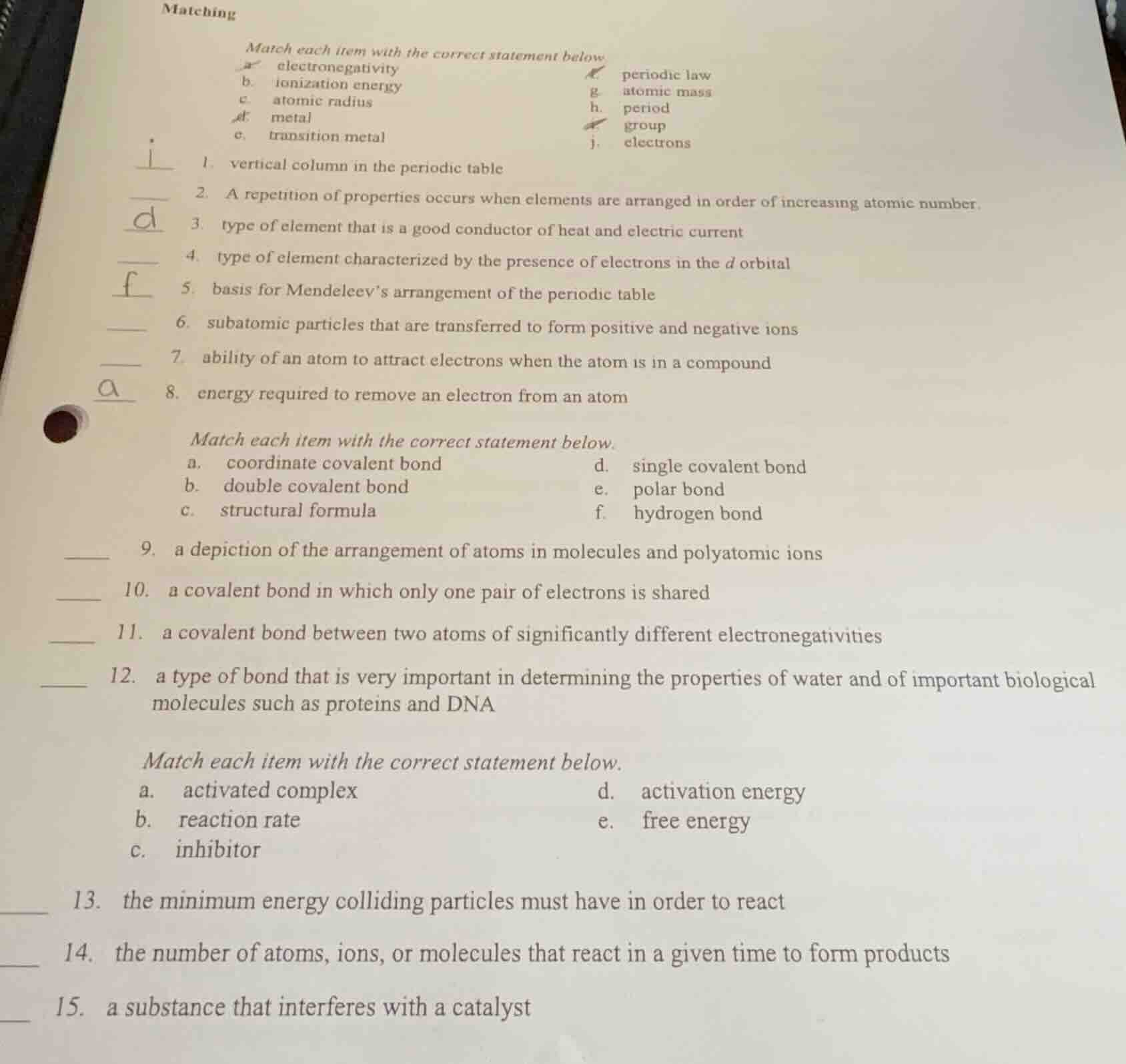
match each item with the correct statement below.
a. electronegativity
b. ionization energy
c. atomic radius
d. metal
e. transition metal
f. periodic law
g. atomic mass
h. period
i. group
j. electrons
- vertical column in the periodic table
- a repetition of properties occurs when elements are arranged in order of increasing atomic number.
- type of element that is a good conductor of heat and electric current
- type of element characterized by the presence of electrons in the d orbital
- basis for mendeleevs arrangement of the periodic table
- subatomic particles that are transferred to form positive and negative ions
- ability of an atom to attract electrons when the atom is in a compound
- energy required to remove an electron from an atom
match each item with the correct statement below.
a. coordinate covalent bond
b. double covalent bond
c. structural formula
d. single covalent bond
e. polar bond
f. hydrogen bond
- a depiction of the arrangement of atoms in molecules and polyatomic ions
- a covalent bond in which only one pair of electrons is shared
- a covalent bond between two atoms of significantly different electronegativities
- a type of bond that is very important in determining the properties of water and of important biological molecules such as proteins and dna
match each item with the correct statement below.
a. activated complex
b. reaction rate
c. inhibitor
d. activation energy
e. free energy
- the minimum energy colliding particles must have in order to react
- the number of atoms, ions, or molecules that react in a given time to form products
- a substance that interferes with a catalyst
Analyze periodic table matching
We match statements 1–8 with items a–j:
- Statement 1: "vertical column in the periodic table" matches group (i).
- Statement 2: "A repetition of properties occurs when elements are arranged in order of increasing atomic number" matches periodic law (f).
- Statement 3: "type of element that is a good conductor of heat and electric current" matches metal (d).
- Statement 4: "type of element characterized by the presence of electrons in the d orbital" matches transition metal (e).
- Statement 5: "basis for Mendeleev's arrangement of the periodic table" matches atomic mass (g).
- Statement 6: "subatomic particles that are transferred to form positive and negative ions" matches electrons (j).
- Statement 7: "ability of an atom to attract electrons when the atom is in a compound" matches electronegativity (a).
- Statement 8: "energy required to remove an electron from an atom" matches ionization energy (b).
Analyze chemical bonding matching
We match statements 9–12 with items a–f:
- Statement 9: "a depiction of the arrangement of atoms in molecules and polyatomic ions" matches structural formula (c).
- Statement 10: "a covalent bond in which only one pair of electrons is shared" matches single covalent bond (d).
- Statement 11: "a covalent bond between two atoms of significantly different electronegativities" matches polar bond (e).
- Statement 12: "a type of bond that is very important in determining the properties of water and of important biological molecules such as proteins and DNA" matches hydrogen bond (f).
Analyze chemical kinetics matching
We match statements 13–15 with items a–e:
- Statement 13: "the minimum energy colliding particles must have in order to react" matches activation energy (d).
- Statement 14: "the number of atoms, ions, or molecules that react in a given time to form products" matches reaction rate (b).
- Statement 15: "a substance that interferes with a catalyst" matches inhibitor (c).

Snap & solve any problem in the app
Get step-by-step solutions on Sovi AI
Photo-based solutions with guided steps
Explore more problems and detailed explanations
| No. | Answer |
|---|---|
| 2 | f |
| 3 | d |
| 4 | e |
| 5 | g |
| 6 | j |
| 7 | a |
| 8 | b |
| 9 | c |
| 10 | d |
| 11 | e |
| 12 | f |
| 13 | d |
| 14 | b |
| 15 | c |