QUESTION IMAGE
Question
- identifie les éléments clés présentés par chaque chimiste à propos de latome
a. dalton
c. rutherford
b. thomson
d. bohr
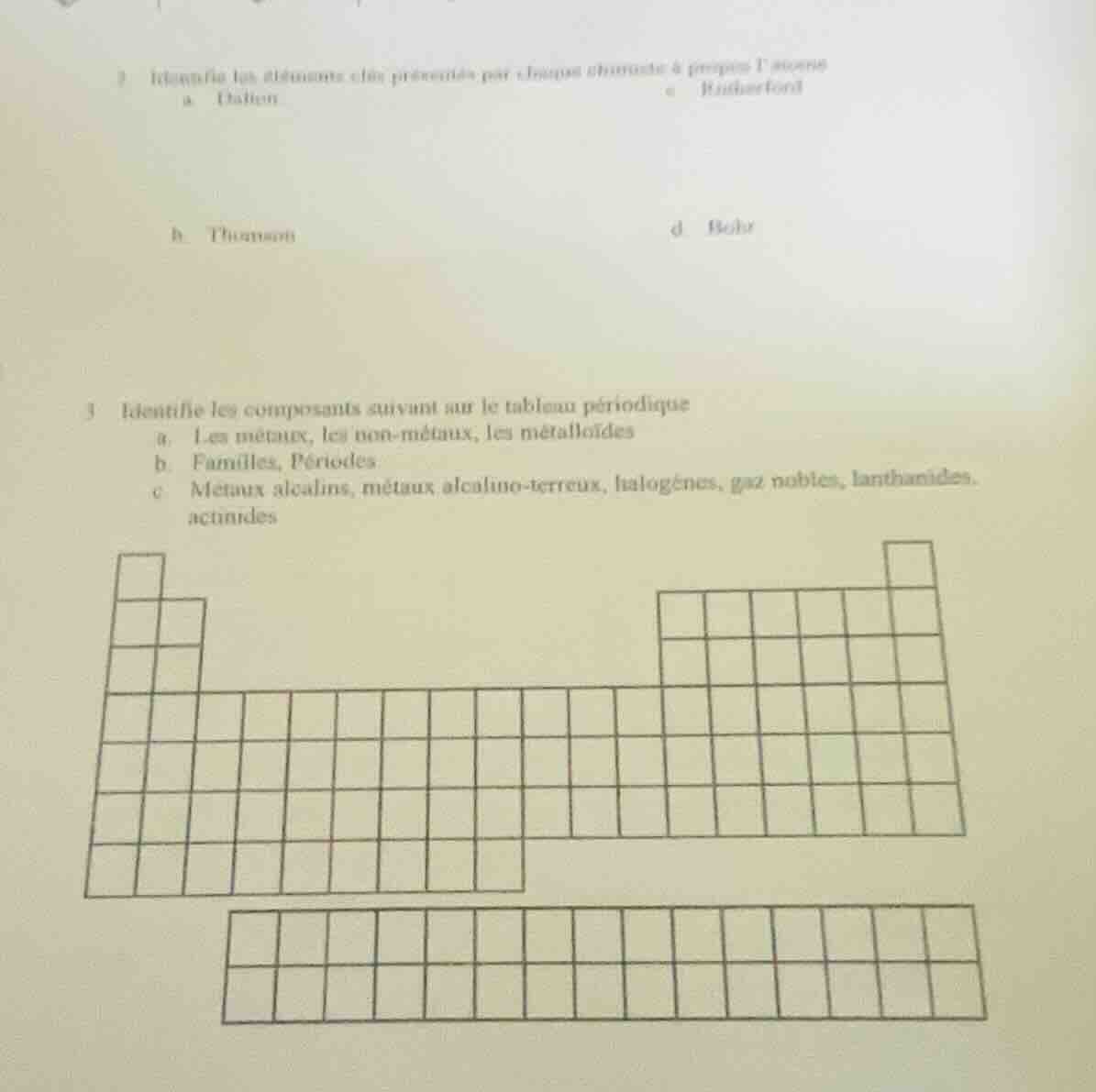
- identifie les composants suivant sur le tableau périodique
a. les métaux, les non-métaux, les métalloïdes
b. familles, périodes
c. métaux alcalins, métaux alcalino-terreux, halogènes, gaz nobles, lanthanides, actinides
Identify key atomic model elements
We analyze the key contributions of each chemist to the atomic model:
- Dalton: Billiard ball model; atoms are indivisible spheres.
- Thomson: Plum pudding model; discovered electrons embedded in a positive sphere.
- Rutherford: Nuclear model; discovered the dense positive nucleus via the gold foil experiment.
- Bohr: Planetary model; electrons travel in specific, quantized energy levels (orbits).
Locate metals, non-metals, metalloids
We describe where these three major categories are located on the periodic table:
- Metals: Located on the left side and center of the periodic table (except hydrogen).
- Non-metals: Located on the far right side of the periodic table (plus hydrogen).
- Metalloids: Located along the staircase boundary separating metals and non-metals (B, Si, Ge, As, Sb, Te, Po).
Locate families and periods
We define the orientation of groups and periods:
- Families (Groups): The vertical columns, numbered 1 to 18.
- Periods: The horizontal rows, numbered 1 to 7.
Locate specific chemical families
We identify the locations of the requested chemical families on the periodic table:
- Alkali metals: Group 1 (first column, excluding hydrogen).
- Alkaline earth metals: Group 2 (second column).
- Halogens: Group 17 (second column from the right).
- Noble gases: Group 18 (far-right column).
- Lanthanides: The top row of the bottom detached block (elements 57–71).
- Actinides: The bottom row of the bottom detached block (elements 89–103).

Snap & solve any problem in the app
Get step-by-step solutions on Sovi AI
Photo-based solutions with guided steps
Explore more problems and detailed explanations
Question 2
Identify the key elements presented by each chemist regarding the atom:
- a. Dalton: Proposed that the atom is an indivisible, solid sphere (the "billiard ball" model) and that all atoms of a given element are identical.
- b. Thomson: Discovered the electron and proposed the "plum pudding" model, where negatively charged electrons are embedded in a sphere of positive charge.
- c. Rutherford: Discovered the dense, positively charged nucleus through the gold foil experiment, proposing that electrons orbit around this central nucleus in mostly empty space.
- d. Bohr: Proposed that electrons travel around the nucleus in specific, quantized circular orbits or energy levels.
Question 3
Identify the following components on the periodic table:
- a. Metals, non-metals, metalloids:
- Metals: Located on the left side and in the center of the periodic table (occupying the majority of the table, to the left of the staircase).
- Non-metals: Located on the upper right side of the periodic table (plus Hydrogen on the top left).
- Metalloids: Located along the diagonal "staircase" line that divides metals and non-metals (includes Boron, Silicon, Germanium, Arsenic, Antimony, Tellurium, and Polonium).
- b. Families, Periods:
- Families (Groups): The vertical columns of the periodic table.
- Periods: The horizontal rows of the periodic table.
- c. Specific chemical families:
- Alkali metals: Group 1 (the first vertical column on the far left, excluding Hydrogen).
- Alkaline earth metals: Group 2 (the second vertical column from the left).
- Halogens: Group 17 (the second vertical column from the right).
- Noble gases: Group 18 (the vertical column on the far right).
- Lanthanides: The first (top) horizontal row of the separate block at the bottom of the table.
- Actinides: The second (bottom) horizontal row of the separate block at the bottom of the table.