QUESTION IMAGE
Question
highest heat of formation
lowest heat of formation
answer bank
\\( \text{hc}\equiv\text{c}\equiv\text{ch} \\)
Identify the chemical formulas
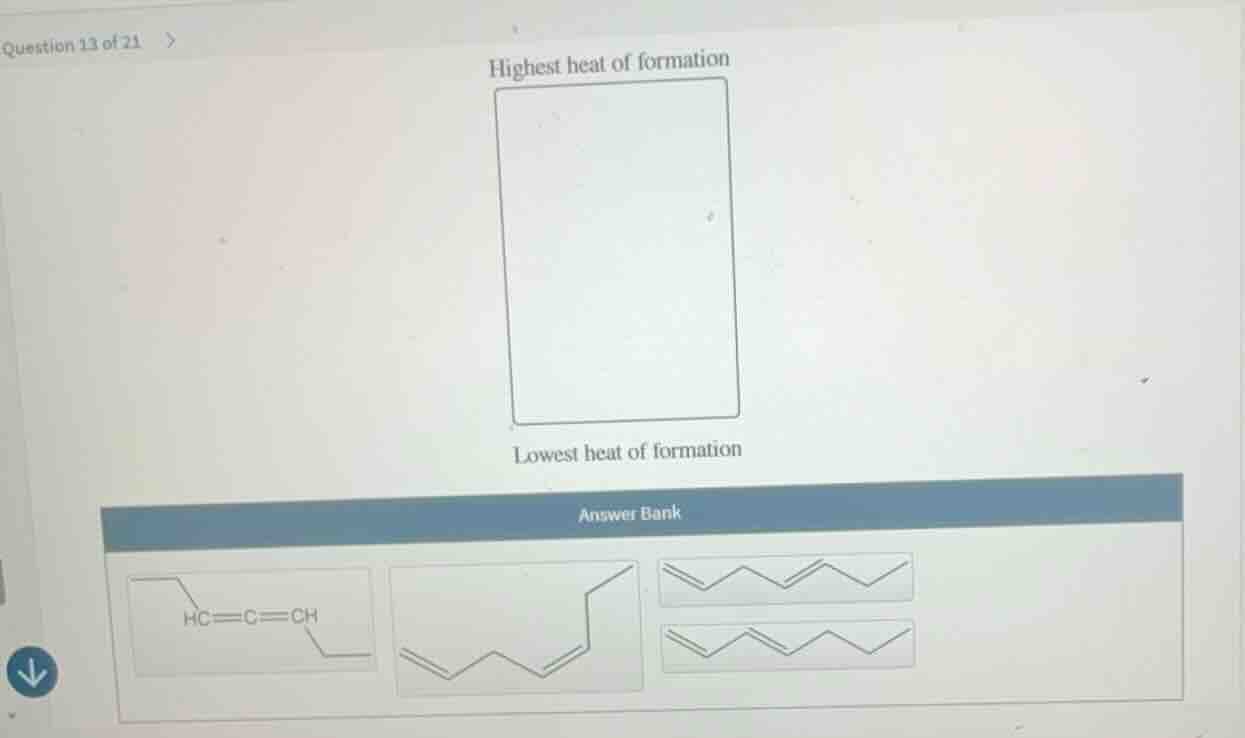
All four compounds in the Answer Bank are isomeric hydrocarbons. Let us determine their molecular formulas by counting carbons and hydrogens:
- First compound (left): \( \text{CH}_3-\text{CH}_2-\text{C}\equiv\text{C}-\text{CH}_2-\text{CH}_3 \) (3-hexyne). It has 6 carbons and 10 hydrogens: \( \text{C}_6\text{H}_{10} \).
- Second compound (middle): 1,5-hexadiene. It has 6 carbons and 10 hydrogens: \( \text{C}_6\text{H}_{10} \).
- Third compound (top right): 1,4-hexadiene. It has 6 carbons and 10 hydrogens: \( \text{C}_6\text{H}_{10} \).
- Fourth compound (bottom right): 1,3-hexadiene. It has 6 carbons and 10 hydrogens: \( \text{C}_6\text{H}_{10} \).
Since all four compounds are isomers with the formula \( \text{C}_6\text{H}_{10} \), we can directly relate their thermodynamic stability to their heats of formation (\( \Delta H_f^\circ \)).
Relate stability to heat of formation
For isomeric compounds:
- A more stable isomer has a lower potential energy, meaning it is lower on the energy scale and has a more negative (lowest) heat of formation.
- A less stable isomer has a higher potential energy, meaning it is higher on the energy scale and has a less negative (highest) heat of formation.
Therefore, we need to rank the stability of these isomers from least stable (highest heat of formation) to most stable (lowest heat of formation).
Analyze stability of each isomer
Let us compare the stability of the four isomers:
- Alkyne vs. Alkenes: Alkynes are generally less stable (higher in energy) than isomeric dienes due to the high ring/bond strain of the triple bond compared to two double bonds. Thus, 3-hexyne is the least stable isomer.
- Conjugated vs. Non-conjugated Dienes:
- 1,3-hexadiene: This is a conjugated diene. Conjugation allows delocalization of \( \pi \) electrons, which provides significant resonance stabilization. This makes it the most stable of the dienes.
- 1,4-hexadiene and 1,5-hexadiene: These are non-conjugated (isolated) dienes.
- In 1,4-hexadiene, one of the double bonds is internal (disubstituted: \( \text{R-CH=CH-R} \)) and the other is terminal (monosubstituted: \( \text{R-CH=CH}_2 \)).
- In 1,5-hexadiene, both double bonds are terminal (monosubstituted), making it less stable than 1,4-hexadiene because internal double bonds are more stable than terminal ones due to hyperconjugation and alkyl group donation.
Rank the isomers
Combining these stability factors, the order of stability from least stable to most stable is:
Since stability is inversely proportional to the heat of formation:
- Highest heat of formation (least stable): 3-hexyne (\( \text{CH}_3\text{CH}_2\text{C}\equiv\text{CCH}_2\text{CH}_3 \))
- Lowest heat of formation (most stable): 1,3-hexadiene (conjugated diene)
The intermediate positions in the box from top to bottom (highest to lowest heat of formation) are:
- 3-hexyne (Highest)
- 1,5-hexadiene
- 1,4-hexadiene
- 1,3-hexadiene (Lowest)

Snap & solve any problem in the app
Get step-by-step solutions on Sovi AI
Photo-based solutions with guided steps
Explore more problems and detailed explanations
The correct ranking in the box from top (Highest heat of formation) to bottom (Lowest heat of formation) is:
- Highest heat of formation: 3-hexyne (the alkyne on the far left: \( \text{CH}_3\text{CH}_2\text{C}\equiv\text{CCH}_2\text{CH}_3 \))
- 1,5-hexadiene (the isolated diene with two terminal double bonds in the middle)
- 1,4-hexadiene (the isolated diene with one internal double bond on the top right)
- Lowest heat of formation: 1,3-hexadiene (the conjugated diene on the bottom right)