QUESTION IMAGE
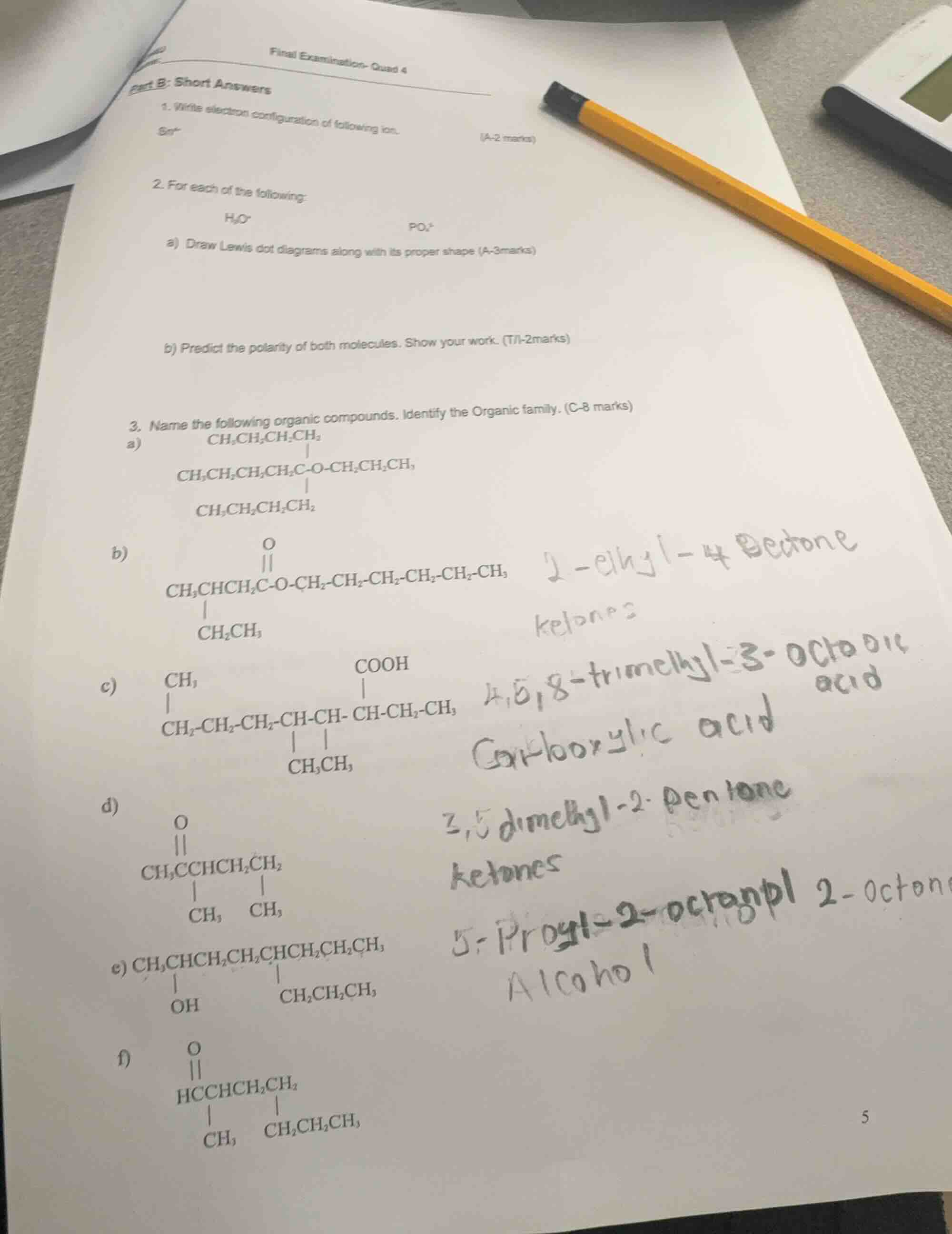
Question
final examination- quad 4
part b: short answers
- write electron configuration of following ion. (a-2 marks)
\\(\text{sn}^{4+}\\)
- for each of the following:
\\(\text{h}_3\text{o}^+\\) \\(\text{po}_4^{3-}\\)
a) draw lewis dot diagrams along with its proper shape (a-3marks)
b) predict the polarity of both molecules. show your work. (t/i-2marks)
- name the following organic compounds. identify the organic family. (c-8 marks)
a)
\\
\
$$\begin{array}{c}
\\text{ch}_2\\text{ch}_2\\text{ch}_2\\text{ch}_3 \\\\
| \\\\
\\text{ch}_3\\text{ch}_2\\text{ch}_2\\text{ch}_2\\text{c}-\\text{o}-\\text{ch}_2\\text{ch}_2\\text{ch}_3 \\\\
| \\\\
\\text{ch}_2\\text{ch}_2\\text{ch}_2\\text{ch}_3
\\end{array}$$
\\
b)
\\
\
$$\begin{array}{c}
\\text{o} \\\\
|| \\\\
\\text{ch}_3\\text{chch}_2\\text{c}-\\text{o}-\\text{ch}_2-\\text{ch}_2-\\text{ch}_2-\\text{ch}_2-\\text{ch}_2-\\text{ch}_3 \\\\
| \\\\
\\text{ch}_2\\text{ch}_3
\\end{array}$$
\\
c)
\\
\
$$\begin{array}{cc}
\\text{ch}_3 & \\text{cooh} \\\\
| & | \\\\
\\text{ch}_2-\\text{ch}_2-\\text{ch}_2-\\text{ch}-\\text{ch}- & \\text{ch}-\\text{ch}_2-\\text{ch}_3 \\\\
| & \\\\
\\text{ch}_2\\text{ch}_3 &
\\end{array}$$
\\
d)
\\
\
$$\begin{array}{c}
\\text{o} \\\\
|| \\\\
\\text{ch}_3\\text{cchch}_2\\text{ch}_2 \\\\
| \\quad | \\\\
\\text{ch}_3 \\quad \\text{ch}_3
\\end{array}$$
\\
e) \\(\text{ch}_3\text{chch}_2\text{ch}_2\text{chch}_2\text{ch}_2\text{ch}_3\\) with \\(-\text{oh}\\) attached to carbon 2 and \\(-\text{ch}_2\text{ch}_2\text{ch}_3\\) attached to carbon 5.
f)
\\
\
$$\begin{array}{c}
\\text{o} \\\\
|| \\\\
\\text{hcchch}_2\\text{ch}_2 \\\\
| \\quad | \\\\
\\text{ch}_3 \\quad \\text{ch}_2\\text{ch}_2\\text{ch}_3
\\end{array}$$
\\
Identify functional groups
We analyze the main functional group in each molecule to determine its organic family.
- a) Contains an oxygen atom single-bonded to two carbon groups: \(\text{R-O-R'}\). This is an ether.
- b) Contains a carbonyl group adjacent to an ether-like oxygen: \(\text{R-C(=O)-O-R'}\). This is an ester.
- c) Contains a carboxyl group: \(\text{-COOH}\). This is a carboxylic acid.
- d) Contains a carbonyl group bonded to two carbons: \(\text{R-C(=O)-R'}\). This is a ketone.
- e) Contains a hydroxyl group: \(\text{-OH}\). This is an alcohol.
- f) Contains a carbonyl group at the end of a chain: \(\text{-CHO}\). This is an aldehyde.
Name compound (a)
- Structure: An oxygen atom connected to a propyl group on the right (\(\text{-CH}_2\text{CH}_2\text{CH}_3\)) and a highly branched carbon on the left.
- Left group analysis: The central carbon is bonded to three butyl groups (\(\text{-CH}_2\text{CH}_2\text{CH}_2\text{CH}_3\)).
- IUPAC naming: The longest continuous carbon chain containing the central carbon is 9 carbons (nonane). The central carbon is carbon-5. At carbon-5, we have a butyl group and a propoxy group (\(\text{-O-CH}_2\text{CH}_2\text{CH}_3\)).
- Name: 5-butyl-5-propoxynonane.
- Family: Ether.
Name compound (b)
- Structure: \(\text{CH}_3\text{CH}(\text{CH}_2\text{CH}_3)\text{CH}_2\text{-C(=O)-O-CH}_2\text{CH}_2\text{CH}_2\text{CH}_2\text{CH}_2\text{CH}_3\)
- Alcohol part (right of O): Hexyl group (6 carbons).
- Acid part (left of O, including carbonyl): The carbonyl carbon is C1. The chain is \(\text{C}^1\text{(=O)-C}^2\text{H}_2\text{-C}^3\text{H}(\text{CH}_2\text{CH}_3)\text{-C}^4\text{H}_3\). The longest chain starting from C1 is 5 carbons (pentanoate) with a methyl group at C3, or 4 carbons with an ethyl group at C3. The longest chain is 5 carbons: \(\text{C}^1\text{-C}^2\text{-C}^3\text{-C}^4\text{-C}^5\) (where C4-C5 is the ethyl group \(\text{-CH}_2\text{CH}_3\)). Thus, it is a 3-methylpentanoate.
- Name: hexyl 3-methylpentanoate.
- Family: Ester.
Name compound (c)
- Structure: \(\text{CH}_3\text{-CH}_2\text{-CH}_2\text{-CH}(\text{CH}_2\text{CH}_3)\text{-CH}(\text{COOH})\text{-CH}_2\text{-CH}_3\)
- IUPAC naming: The carboxylic acid carbon (\(\text{-COOH}\)) is C1. The longest chain starting from C1 goes through the \(\text{-CH}(\text{CH}_2\text{CH}_3)\) and then the propyl chain: \(\text{C}^1\text{OOH - C}^2\text{H}(\text{CH}_2\text{CH}_3)\text{ - C}^3\text{H}(\text{CH}_2\text{CH}_3)\text{ - C}^4\text{H}_2\text{ - C}^5\text{H}_2\text{ - C}^6\text{H}_3\). This is a hexanoic acid.
- Substituents: At C2 we have an ethyl group. At C3 we have an ethyl group.
- Name: 2,3-diethylhexanoic acid.
- Family: Carboxylic acid.
Name compound (d)
- Structure: \(\text{CH}_3\text{-C(=O)-CH}(\text{CH}_3)\text{-CH}_2\text{-CH}_2(\text{CH}_3)\) (Note: the rightmost part is written as \(\text{CH}_2\text{CH}_2\) with a \(\text{CH}_3\) branch below, making it a pentane chain).
- **IUP…

Snap & solve any problem in the app
Get step-by-step solutions on Sovi AI
Photo-based solutions with guided steps
Explore more problems and detailed explanations
Question 3
| Part | IUPAC Name | Organic Family |
|---|---|---|
| b) | hexyl 3-methylpentanoate | Ester |
| c) | 2,3-diethylhexanoic acid | Carboxylic acid |
| d) | 3,5-dimethylhexan-2-one | Ketone |
| e) | 5-propyloctan-2-ol | Alcohol |
| f) | 2-methyl-5-propyloctanal | Aldehyde |