QUESTION IMAGE
Question
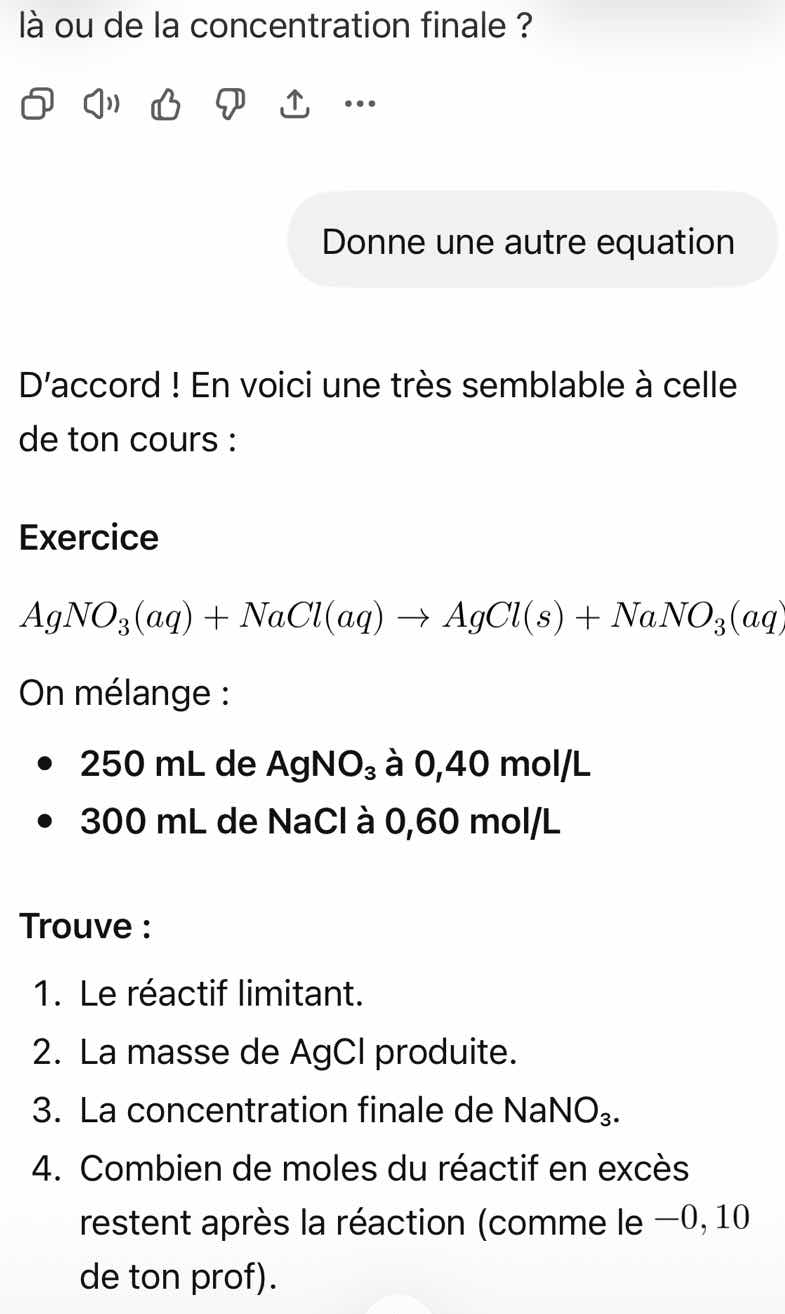
exercice
\\(agno_3(aq) + nacl(aq) \
ightarrow agcl(s) + nano_3(aq)\\)
on mélange :
- \\(250\text{ ml}\\) de \\(agno_3\\) à \\(0,40\text{ mol/l}\\)
- \\(300\text{ ml}\\) de \\(nacl\\) à \\(0,60\text{ mol/l}\\)
trouve :
- le réactif limitant.
- la masse de \\(agcl\\) produite.
- la concentration finale de \\(nano_3\\).
- combien de moles du réactif en excès restent après la réaction (comme le \\(-0,10\\) de ton prof).
🆕 New Concept Discovered: Limiting Reactant and Excess Calculations
Finding which reactant runs out first and what remains
Step 1: Calculate initial moles of reactants
Using the formula \( n = C \times V \):
For \( \text{AgNO}_3 \):
For \( \text{NaCl} \):
Step 2: Determine the limiting reactant
The balanced chemical equation is:
The stoichiometric ratio is \( 1:1 \).
- Since we have \( 0.10\text{ mol} \) of \( \text{AgNO}_3 \) and \( 0.18\text{ mol} \) of \( \text{NaCl} \), \( \text{AgNO}_3 \) will be completely consumed first.
- Limiting reactant: \( \text{AgNO}_3 \)
- Excess reactant: \( \text{NaCl} \)
Step 3: Calculate the mass of \( \text{AgCl} \) produced
Since \( \text{AgNO}_3 \) is the limiting reactant, it determines the amount of product formed:
Molar mass of \( \text{AgCl} \):
Mass of \( \text{AgCl} \):
Step 4: Calculate the final concentration of \( \text{NaNO}_3 \)
The moles of \( \text{NaNO}_3 \) produced are equal to the moles of the limiting reactant consumed:
The total volume of the mixture is:
Final concentration:
Step 5: Calculate remaining moles of excess reactant
The moles of \( \text{NaCl} \) consumed during the reaction:
The remaining moles of \( \text{NaCl} \) are:

Snap & solve any problem in the app
Get step-by-step solutions on Sovi AI
Photo-based solutions with guided steps
Explore more problems and detailed explanations
- Réactif limitant : \( \text{AgNO}_3 \)
- Masse de \( \text{AgCl} \) produite : \( 14.33\text{ g} \)
- Concentration finale de \( \text{NaNO}_3 \) : \( 0.18\text{ mol/L} \)
- Moles de réactif en excès restantes : \( 0.08\text{ mol} \) de \( \text{NaCl} \)