QUESTION IMAGE
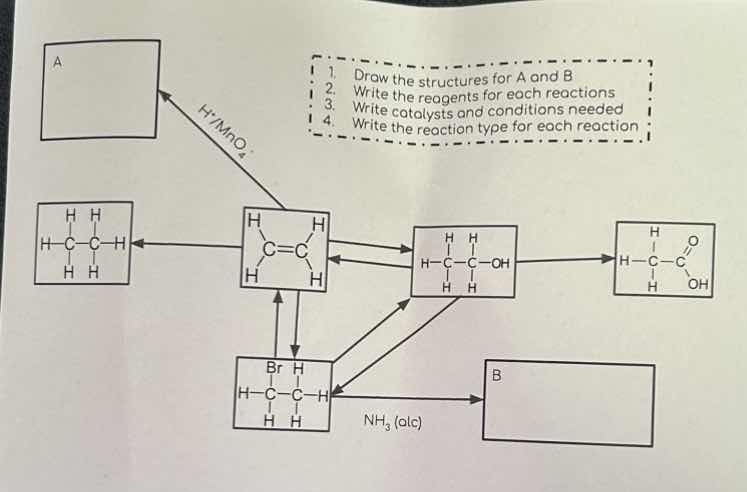
Question
- draw the structures for a and b
- write the reagents for each reactions
- write catalysts and conditions needed
- write the reaction type for each reaction
Identify structures A and B
We analyze the starting materials and reaction conditions to determine the products:
- Structure A: The starting material is ethene (\(\text{CH}_2=\text{CH}_2\)). The reagent is acidified potassium permanganate (\(\text{H}^+/\text{MnO}_4^-\)). Under cold, dilute conditions, this oxidizes ethene to ethane-1,2-diol (a diol). Under hot, concentrated conditions, it cleaves to form carbon dioxide or carboxylic acids. In standard introductory organic pathways, this reaction represents the mild oxidation of an alkene to a diol: ethane-1,2-diol, \(\text{CH}_2(\text{OH})\text{CH}_2(\text{OH})\).
- Structure B: The starting material is bromoethane (\(\text{CH}_3\text{CH}_2\text{Br}\)). The reagent is alcoholic ammonia (\(\text{NH}_3\text{ (alc)}\)) under heat and pressure. This is a nucleophilic substitution reaction where the amino group (\(-\text{NH}_2\)) replaces the bromine atom, forming ethanamine (ethylamine), \(\text{CH}_3\text{CH}_2\text{NH}_2\).
Determine reagents, catalysts, and conditions
We trace each reaction arrow in the pathway:
- **Ethene \(
ightarrow\) Ethane** (\(\text{CH}_2=\text{CH}_2
ightarrow \text{CH}_3\text{CH}_3\)):
- Reagent: Hydrogen gas (\(\text{H}_2\))
- Catalyst/Conditions: Nickel (\(\text{Ni}\)) catalyst at \(150^\circ\text{C}\) (or Platinum/Palladium at room temperature).
- **Ethene \(
ightarrow\) Structure A (Ethane-1,2-diol)**:
- Reagent: Cold, dilute acidified potassium permanganate (\(\text{H}^+/\text{MnO}_4^-\)) or alkaline \(\text{KMnO}_4\).
- **Ethene \(
ightarrow\) Bromoethane** (\(\text{CH}_2=\text{CH}_2
ightarrow \text{CH}_3\text{CH}_2\text{Br}\)):
- Reagent: Hydrogen bromide (\(\text{HBr}\)) gas at room temperature.
- **Bromoethane \(
ightarrow\) Ethene** (\(\text{CH}_3\text{CH}_2\text{Br}
ightarrow \text{CH}_2=\text{CH}_2\)):
- Reagent: Hot ethanolic potassium hydroxide (\(\text{KOH in ethanol}\)) under reflux.
- **Ethene \(
ightarrow\) Ethanol** (\(\text{CH}_2=\text{CH}_2
ightarrow \text{CH}_3\text{CH}_2\text{OH}\)):
- Reagents/Conditions: Steam (\(\text{H}_2\text{O (g)}\)), phosphoric acid (\(\text{H}_3\text{PO}_4\)) catalyst, \(300^\circ\text{C}\), \(60\text{ atm}\).
- **Ethanol \(
ightarrow\) Ethene** (\(\text{CH}_3\text{CH}_2\text{OH}
ightarrow \text{CH}_2=\text{CH}_2\)):
- Reagents/Conditions: Excess concentrated sulfuric acid (\(\text{H}_2\text{SO}_4\)) at \(170^\circ\text{C}\) or passing vapor over hot \(\text{Al}_2\text{O}_3\).
- **Bromoethane \(
ightarrow\) Ethanol** (\(\text{CH}_3\text{CH}_2\text{Br}
ightarrow \text{CH}_3\text{CH}_2\text{OH}\)):
- Reagent/Conditions: Aqueous sodium hydroxide (\(\text{NaOH (aq)}\)) or potassium hydroxide (\(\text{KOH (aq)}\)), heat under reflux.
- **Ethanol \(
ightarrow\) Bromoethane** (\(\text{CH}_3\text{CH}_2\text{OH}
ightarrow \text{CH}_3\text{CH}_2\text{Br}\)):
- Reagents: Concentrated hydrobromic acid (\(\text{HBr}\)) or \(\text{PBr}_3\).
- **Ethanol \(
ightarrow\) Ethanoic acid** (\(\text{CH}_3\text{CH}_2\text{OH}
ightarrow \text{CH}_3\text{COOH}\)):
- Reagents/Conditions: Acidified po…

Snap & solve any problem in the app
Get step-by-step solutions on Sovi AI
Photo-based solutions with guided steps
Explore more problems and detailed explanations
1. Structures for A and B
- Structure A (Ethane-1,2-diol):
- Structure B (Ethanamine / Ethylamine):
---
2. & 3. Reagents, Catalysts, and Conditions
| Reaction Pathway | Reagents | Catalysts & Conditions |
|---|
| **Ethene \(
ightarrow\) Ethane** | \(\text{H}_2\text{ (g)}\) | \(\text{Ni}\) catalyst, \(150^\circ\text{C}\) |
| **Ethene \(
ightarrow\) Structure A** | Cold, dilute \(\text{KMnO}_4\text{ / H}^+\) | Room temperature |
| **Ethene \(
ightarrow\) Bromoethane** | \(\text{HBr}\text{ (g)}\) | Room temperature |
| **Bromoethane \(
ightarrow\) Ethene** | \(\text{KOH}\) or \(\text{NaOH}\) in ethanol | Heat under reflux |
| **Ethene \(
ightarrow\) Ethanol** | \(\text{H}_2\text{O (g)}\) (Steam) | \(\text{H}_3\text{PO}_4\) catalyst, \(300^\circ\text{C}\), \(60\text{ atm}\) |
| **Ethanol \(
ightarrow\) Ethene** | Concentrated \(\text{H}_2\text{SO}_4\) | Heat at \(170^\circ\text{C}\) |
| **Bromoethane \(
ightarrow\) Ethanol** | Aqueous \(\text{NaOH}\) or \(\text{KOH}\) | Heat under reflux |
| **Ethanol \(
ightarrow\) Bromoethane** | \(\text{HBr}\) or \(\text{PBr}_3\) | Heat |
| **Ethanol \(
ightarrow\) Ethanoic acid** | \(\text{K}_2\text{Cr}_2\text{O}_7\text{ / H}^+\) | Heat under reflux |
| **Bromoethane \(
ightarrow\) Structure B** | Excess \(\text{NH}_3\) in ethanol | Heat in a sealed tube |
---
4. Reaction Types
- **Ethene \(
ightarrow\) Ethane**: Addition (Hydrogenation)
- **Ethene \(
ightarrow\) Structure A**: Oxidation (Dihydroxylation)
- **Ethene \(
ightarrow\) Bromoethane**: Electrophilic Addition
- **Bromoethane \(
ightarrow\) Ethene**: Elimination
- **Ethene \(
ightarrow\) Ethanol**: Electrophilic Addition (Hydration)
- **Ethanol \(
ightarrow\) Ethene**: Elimination (Dehydration)
- **Bromoethane \(
ightarrow\) Ethanol**: Nucleophilic Substitution
- **Ethanol \(
ightarrow\) Bromoethane**: Nucleophilic Substitution
- **Ethanol \(
ightarrow\) Ethanoic acid**: Oxidation
- **Bromoethane \(
ightarrow\) Structure B**: Nucleophilic Substitution