QUESTION IMAGE
Question
drag the oval over the words that complete the sentences below:
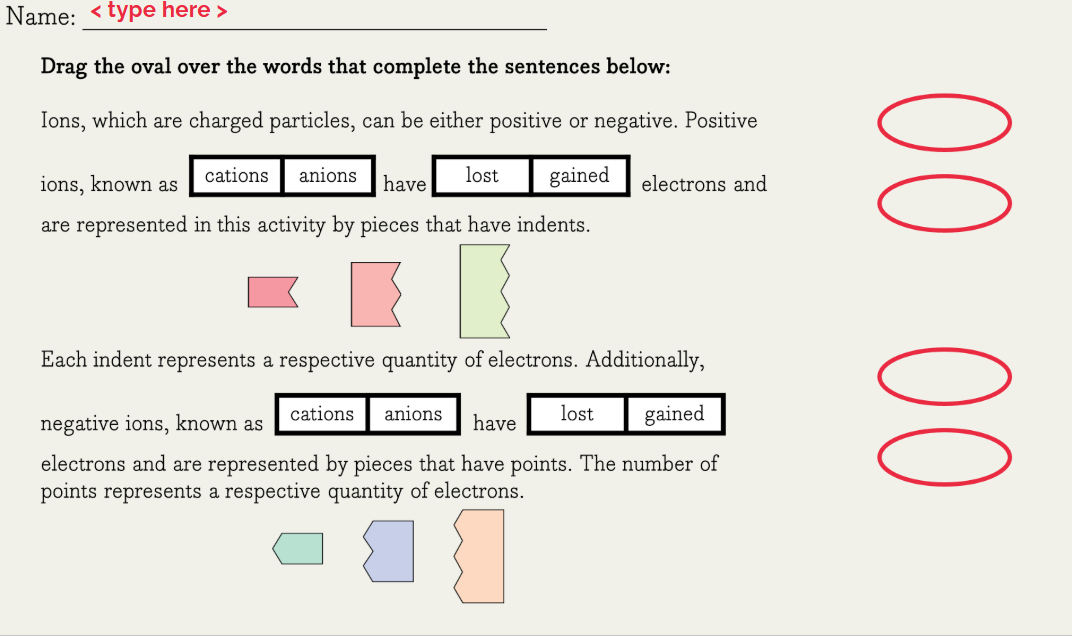
ions, which are charged particles, can be either positive or negative. positive ions, known as cations / anions have lost / gained electrons and are represented in this activity by pieces that have indents.
each indent represents a respective quantity of electrons. additionally, negative ions, known as cations / anions have lost / gained electrons and are represented by pieces that have points. the number of points represents a respective quantity of electrons.
🆕 New Concept Discovered: Ion Formation and Naming
Understanding how atoms gain or lose electrons to form charged ions.
Step 1: Identify positive ions
Positive ions are formed when a neutral atom loses negatively charged electrons, leaving it with a net positive charge.
- Name: Positive ions are called cations (a helpful way to remember this is that the "t" in cation looks like a plus sign \(+\)).
- Electron change: Because electrons have a negative charge, losing them makes the atom positive. Therefore, they have lost electrons.
Step 2: Identify negative ions
Negative ions are formed when a neutral atom gains negatively charged electrons, giving it a net negative charge.
- Name: Negative ions are called anions (a helpful way to remember this is a negative ion = anion).
- Electron change: Because electrons have a negative charge, adding them makes the atom negative. Therefore, they have gained electrons.

Snap & solve any problem in the app
Get step-by-step solutions on Sovi AI
Photo-based solutions with guided steps
Explore more problems and detailed explanations
- First sentence choices:
- Drag an oval over cations
- Drag an oval over lost
- Second sentence choices:
- Drag an oval over anions
- Drag an oval over gained