QUESTION IMAGE
Question
or a chemical change.
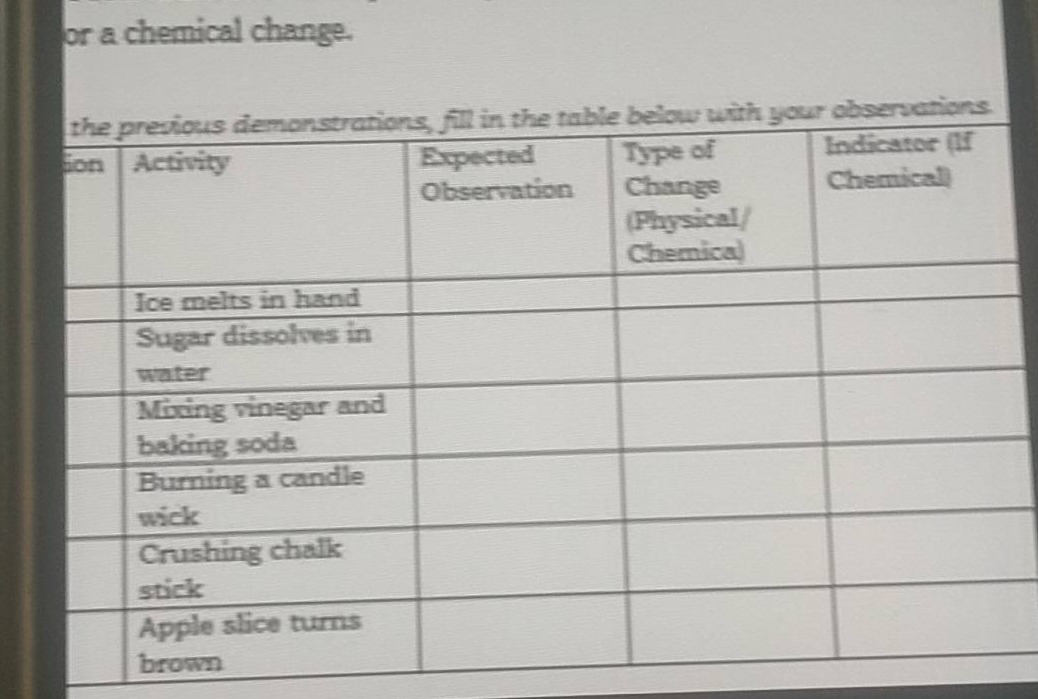
the previous demonstrations, fill in the table below with your observations.
\
$$\begin{tabular}{|l|l|l|l|l|}
\\hline
ion & activity & expected observation & type of change (physical/chemical) & indicator (if chemical) \\\\
\\hline
& ice melts in hand & & & \\\\
\\hline
& sugar dissolves in water & & & \\\\
\\hline
& mixing vinegar and baking soda & & & \\\\
\\hline
& burning a candle wick & & & \\\\
\\hline
& crushing chalk stick & & & \\\\
\\hline
& apple slice turns brown & & & \\\\
\\hline
\\end{tabular}$$
🆕 New Concept Discovered: Physical vs. Chemical Changes
Identifying if a substance changes its identity or just its form.
Step 1: Understand the Difference between Physical and Chemical Changes
To fill out the table, we need to distinguish between two types of changes:
- Physical Change: The substance changes its physical state, shape, or appearance, but its chemical identity remains exactly the same. No new substances are formed. Examples include phase changes (melting, freezing) and dissolving.
- Chemical Change: The substance reacts to form entirely new chemical substances with different properties.
- Indicators of a Chemical Change: Common signs include gas production (bubbling/fizzing), temperature change (release or absorption of heat), light production, unexpected color change, or the formation of a precipitate (solid).
---
Step 2: Analyze Each Activity
Let's look at each activity one by one to determine the expected observation, the type of change, and any chemical indicators:
- Ice melts in hand
- Observation: Solid ice turns into liquid water due to body heat.
- Type of Change: Physical. It is a phase change from solid to liquid; the chemical formula remains \( \text{H}_2\text{O} \).
- Indicator: N/A (Not a chemical change).
- Sugar dissolves in water
- Observation: The solid white sugar crystals disappear into the water, forming a clear solution.
- Type of Change: Physical. Dissolving is a physical process because the sugar molecules are simply dispersed among water molecules; no new chemical bonds are formed, and the sugar can be recovered by evaporating the water.
- Indicator: N/A.
- Mixing vinegar and baking soda
- Observation: Rapid bubbling, fizzing, and foaming occur.
- Type of Change: Chemical. An acid-base reaction occurs between acetic acid and sodium bicarbonate, producing carbon dioxide gas, water, and sodium acetate.
- Indicator: Gas production (bubbling/fizzing).
- Burning a candle wick
- Observation: A flame appears, smoke is released, and the white/black cotton wick turns into black ash.
- Type of Change: Chemical. Combustion is a chemical reaction where the wick reacts with oxygen to produce carbon dioxide, water vapor, and carbon (ash).
- Indicator: Production of light/heat, color change (to black), and gas/smoke production.
- Crushing chalk stick
- Observation: The solid chalk stick breaks down into a fine white powder.
- Type of Change: Physical. Only the shape and size of the chalk have changed; it is still chemically calcium carbonate (\( \text{CaCO}_3 \)).
- Indicator: N/A.
- Apple slice turns brown
- Observation: The exposed white flesh of the apple turns a brownish color over time.
- Type of Change: Chemical. This is enzymatic browning, where compounds in the apple react with oxygen in the air to form new brown pigments (melanins).
- Indicator: Unexpected color change.
---

Snap & solve any problem in the app
Get step-by-step solutions on Sovi AI
Photo-based solutions with guided steps
Explore more problems and detailed explanations
Here is the completed table based on the analysis:
| Activity | Expected Observation | Type of Change (Physical/Chemical) | Indicator (If Chemical) |
|---|---|---|---|
| Sugar dissolves in water | White crystals disappear, forming a clear liquid | Physical | N/A |
| Mixing vinegar and baking soda | Rapid fizzing, bubbling, and foaming | Chemical | Gas production (bubbling) |
| Burning a candle wick | Flame, smoke, and the wick turns to black ash | Chemical | Production of light/heat, color change |
| Crushing chalk stick | Solid stick breaks into a fine white powder | Physical | N/A |
| Apple slice turns brown | The white flesh of the apple turns brown | Chemical | Unexpected color change |