QUESTION IMAGE
Question
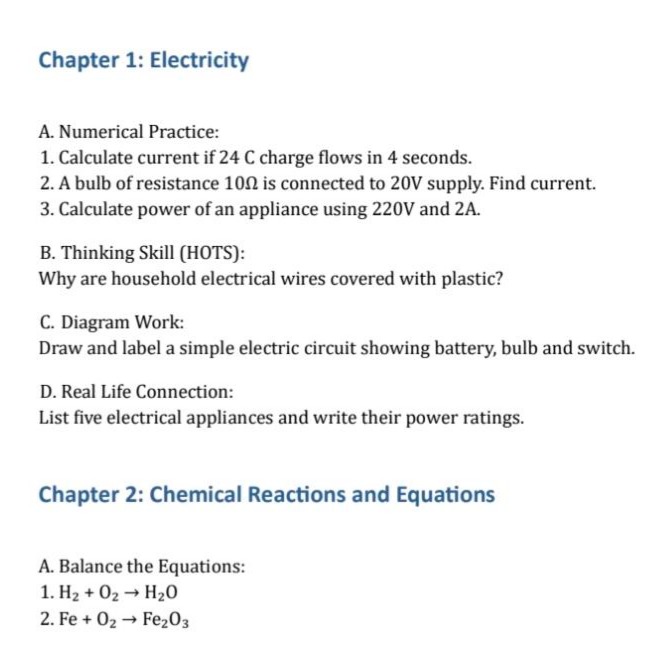
chapter 1: electricity
a. numerical practice:
- calculate current if \\(24\text{ c}\\) charge flows in \\(4\text{ seconds}\\).
- a bulb of resistance \\(10\omega\\) is connected to \\(20\text{v}\\) supply. find current.
- calculate power of an appliance using \\(220\text{v}\\) and \\(2\text{a}\\).
b. thinking skill (hots):
why are household electrical wires covered with plastic?
c. diagram work:
draw and label a simple electric circuit showing battery, bulb and switch.
d. real life connection:
list five electrical appliances and write their power ratings.
chapter 2: chemical reactions and equations
a. balance the equations:
- \\(\text{h}_2 + \text{o}_2 \
ightarrow \text{h}_2\text{o}\\)
- \\(\text{fe} + \text{o}_2 \
ightarrow \text{fe}_2\text{o}_3\\)
🆕 New Concept Discovered: Basic Electrical Relationships and Balancing Chemical Equations
Connecting charge, current, voltage, power, and balancing chemical reactions.
---
Chapter 1: Electricity
Part A: Numerical Practice
Step 1: Calculate current (Question 1)
Electric current \( I \) is the rate of flow of electric charge. It is calculated as the charge \( Q \) divided by the time \( t \):
Given:
- Charge, \( Q = 24\text{ C} \)
- Time, \( t = 4\text{ s} \)
Step 2: Find current using Ohm's Law (Question 2)
Ohm's Law states that current \( I \) is equal to voltage \( V \) divided by resistance \( R \):
Given:
- Resistance, \( R = 10\ \Omega \)
- Voltage, \( V = 20\text{ V} \)
Step 3: Calculate power (Question 3)
Electric power \( P \) consumed by an appliance is the product of voltage \( V \) and current \( I \):
Given:
- Voltage, \( V = 220\text{ V} \)
- Current, \( I = 2\text{ A} \)
---
Part B: Thinking Skill (HOTS)
Step 4: Explain why wires are covered with plastic
Plastic is an electrical insulator, meaning it does not allow electric current to flow through it easily. Covering metal wires (which are conductors) with plastic prevents electricity from escaping the wire. This protects users from electric shocks and prevents short circuits that could cause fires if two bare wires touch.
---
Part C: Diagram Work
Step 5: Describe a simple electric circuit diagram
To draw a simple electric circuit, connect the following components in a single continuous loop using straight lines to represent connecting wires:
- Battery: Represented by two parallel lines of unequal length (a longer thin line for the positive terminal and a shorter thick line for the negative terminal).
- Bulb: Represented by a circle with a loop or an "X" inside it.
- Switch: Represented by two small circles with a line connecting them. If the switch is closed (on), the line connects both circles; if open (off), the line is tilted upwards, breaking the path.
       +  -
     [Battery]
     --| |-- -----------
    |                   |
    |                 [Switch] (closed)
    |                   |
     ------( Bulb )-----
---
Part D: Real Life Connection
Step 6: List five appliances and their typical power ratings
Here are five common household appliances and their typical power ratings:
- LED Light Bulb: \( 9\text{ W} - 15\text{ W} \)
- Laptop Charger: \( 45\text{ W} - 90\text{ W} \)
- Refrigerator: \( 150\text{ W} - 400\text{ W} \)
- Microwave Oven: \( 800\text{ W} - 1200\text{ W} \)
- Electric Kettle: \( 1500\text{ W} - 2200\text{ W} \)
---
Chapter 2: Chemical Reactions and Equations
Part A: Balance the Equations
Step 7: Balance Equation 1 (\(\text{H}_2 + \text{O}_2
ightarrow \text{H}_2\text{O}\))
Count the atoms on both sides:
- Reactants: \( 2\text{ H} \), \( 2\text{ O} \)
- Products: \( 2\text{ H} \), \( 1\text{ O} \)
To balance the oxygen atoms, place a coefficient of \( 2 \) in front of \(\text{H}_2\text{O}\):
Now we have \( 4\text{ H} \) on the product side. To balance the hydrogen atoms, place a coefficient of \( 2 \) in front of \(\text{H}_2\):
…

Snap & solve any problem in the app
Get step-by-step solutions on Sovi AI
Photo-based solutions with guided steps
Explore more problems and detailed explanations
Chapter 1: Electricity
- A. Numerical Practice:
- Current = \( 6\text{ A} \)
- Current = \( 2\text{ A} \)
- Power = \( 440\text{ W} \)
- B. Thinking Skill: Plastic is an electrical insulator. It prevents electric shocks and short circuits by stopping current from flowing out of the metal wires.
- C. Diagram Work: Draw a closed loop containing a battery symbol (\(-| \mathbf{I}-\)), a switch symbol (\(-\circ\ \circ-\)), and a bulb symbol (\(-\otimes-\)) connected by straight lines (wires).
- D. Real Life Connection:
- LED Bulb (\( 10\text{ W} \))
- Laptop (\( 65\text{ W} \))
- Refrigerator (\( 200\text{ W} \))
- Microwave (\( 1000\text{ W} \))
- Electric Kettle (\( 1800\text{ W} \))
Chapter 2: Chemical Reactions and Equations
- A. Balanced Equations:
- \( 2\text{H}_2 + \text{O}_2
ightarrow 2\text{H}_2\text{O} \)
- \( 4\text{Fe} + 3\text{O}_2
ightarrow 2\text{Fe}_2\text{O}_3 \)