QUESTION IMAGE
Question
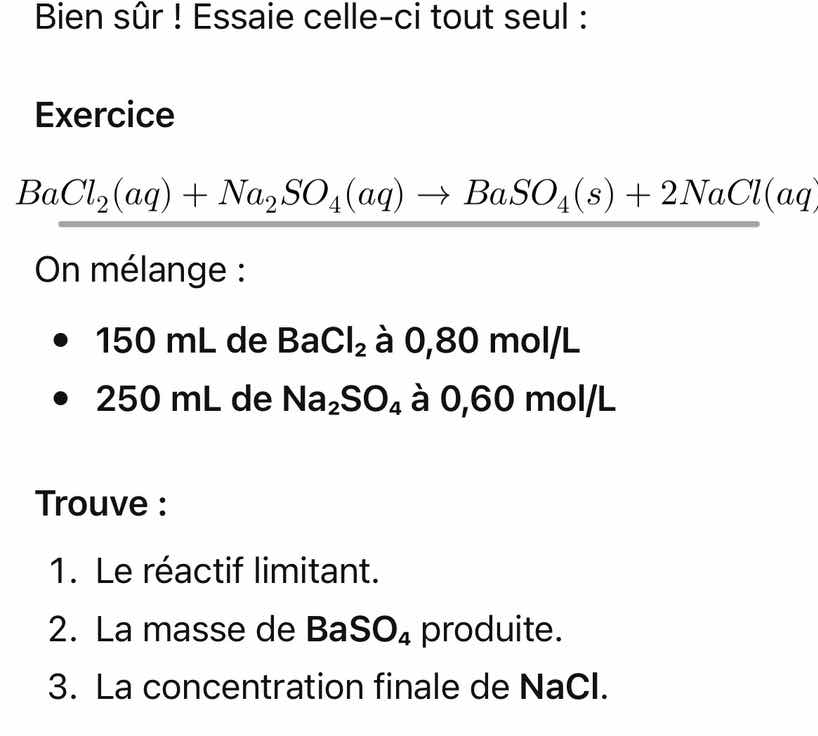
bien sûr ! essaie celle-ci tout seul :
exercice
\bacl_2(aq) + na_2so_4(aq) \
ightarrow baso_4(s) + 2nacl(aq)\\
on mélange :
- \\(150\text{ ml}\\) de \\(bacl_2\\) à \\(0{,}80\text{ mol/l}\\)
- \\(250\text{ ml}\\) de \\(na_2so_4\\) à \\(0{,}60\text{ mol/l}\\)
trouve :
- le réactif limitant.
- la masse de \\(baso_4\\) produite.
- la concentration finale de \\(nacl\\).
🆕 New Concept Discovered: Limiting Reactant and Solution Stoichiometry
Finding which reactant runs out first to calculate product yields in solution
Step 1: Calculate initial moles of reactants
Using the formula \( n = C \times V \):
For \(\text{BaCl}_2\):
For \(\text{Na}_2\text{SO}_4\):
Step 2: Determine the limiting reactant
The balanced chemical equation is:
The stoichiometric ratio between \(\text{BaCl}_2\) and \(\text{Na}_2\text{SO}_4\) is \(1:1\).
Comparing the available moles:
- We have \(0.12\text{ mol}\) of \(\text{BaCl}_2\).
- We have \(0.15\text{ mol}\) of \(\text{Na}_2\text{SO}_4\).
Since \(0.12\text{ mol} < 0.15\text{ mol}\), \(\text{BaCl}_2\) will be completely consumed first.
- Limiting reactant: \(\text{BaCl}_2\)
Step 3: Calculate the mass of \(\text{BaSO}_4\) produced
The mole ratio between the limiting reactant \(\text{BaCl}_2\) and \(\text{BaSO}_4\) is \(1:1\).
Calculate the molar mass of \(\text{BaSO}_4\):
Calculate the mass:
Step 4: Calculate the final concentration of \(\text{NaCl}\)
The mole ratio between \(\text{BaCl}_2\) and \(\text{NaCl}\) is \(1:2\).
The total volume of the mixture is:
Calculate the final concentration of \(\text{NaCl}\):

Snap & solve any problem in the app
Get step-by-step solutions on Sovi AI
Photo-based solutions with guided steps
Explore more problems and detailed explanations
- Le réactif limitant : \(\text{BaCl}_2\)
- La masse de \(\text{BaSO}_4\) produite : \(28.01\text{ g}\) (or \(28\text{ g}\) using two significant figures)
- La concentration finale de \(\text{NaCl}\) : \(0.60\text{ mol/L}\)