QUESTION IMAGE
Question
activity 2: analyze the diagram!
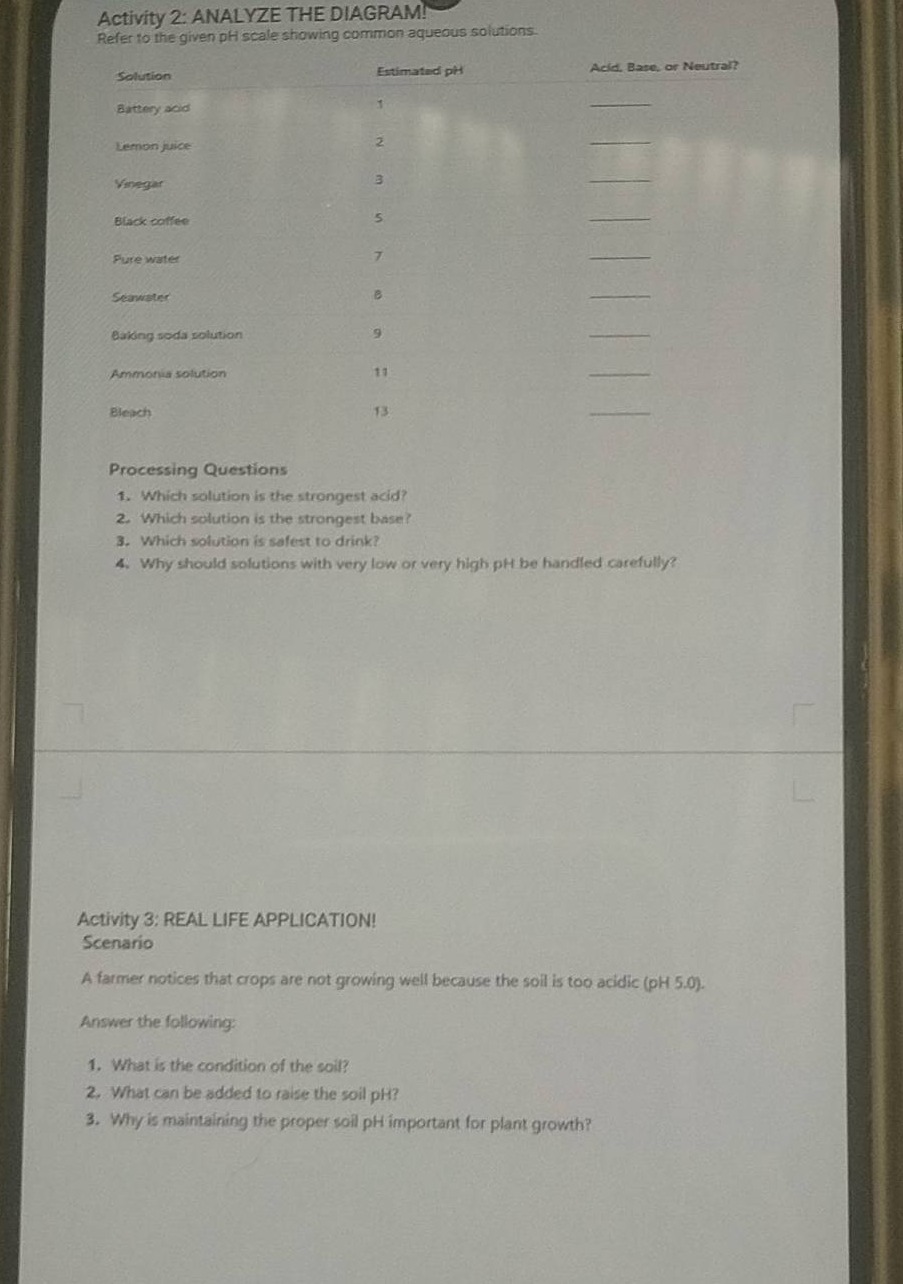
refer to the given ph scale showing common aqueous solutions.
\
$$\begin{tabular}{|l|l|l|}
\\hline
solution & estimated ph & acid, base, or neutral? \\\\
\\hline
battery acid & 1 & \\\\
lemon juice & 2 & \\\\
vinegar & 3 & \\\\
black coffee & 5 & \\\\
pure water & 7 & \\\\
seawater & 8 & \\\\
baking soda solution & 9 & \\\\
ammonia solution & 11 & \\\\
bleach & 13 & \\\\
\\hline
\\end{tabular}$$
processing questions
- which solution is the strongest acid?
- which solution is the strongest base?
- which solution is safest to drink?
- why should solutions with very low or very high ph be handled carefully?
activity 3: real life application!
scenario
a farmer notices that crops are not growing well because the soil is too acidic (ph 5.0).
answer the following:
- what is the condition of the soil?
- what can be added to raise the soil ph?
- why is maintaining the proper soil ph important for plant growth?
🆕 New Concept Discovered: pH Scale and Neutralization
Understanding acids, bases, and how to balance them.
Step 1: Classify the solutions in Activity 2
To classify each solution as an Acid, Base, or Neutral, we use the standard pH scale:
- Acidic: pH less than 7 (the lower the pH, the stronger the acid)
- Neutral: pH equal to 7
- Basic (Alkaline): pH greater than 7 (the higher the pH, the stronger the base)
Applying these rules to the table:
- Battery acid (pH 1): Acid
- Lemon juice (pH 2): Acid
- Vinegar (pH 3): Acid
- Black coffee (pH 5): Acid
- Pure water (pH 7): Neutral
- Seawater (pH 8): Base
- Baking soda solution (pH 9): Base
- Ammonia solution (pH 11): Base
- Bleach (pH 13): Base
---
Step 2: Answer Activity 2 Processing Questions
- Which solution is the strongest acid?
- The strongest acid has the lowest pH value. Battery acid has a pH of 1, making it the strongest acid.
- Which solution is the strongest base?
- The strongest base has the highest pH value. Bleach has a pH of 13, making it the strongest base.
- Which solution is safest to drink?
- Pure water (pH 7) is neutral and completely safe to drink. While black coffee (pH 5) is consumable, pure water is the safest and most neutral option listed.
- Why should solutions with very low or very high pH be handled carefully?
- Solutions with extreme pH values (very low acids like battery acid, or very high bases like bleach) are highly corrosive and reactive. They can cause severe chemical burns to skin, damage eyes, and degrade materials.
---
Step 3: Answer Activity 3 (Real Life Application)
- What is the condition of the soil?
- The soil is highly acidic (pH 5.0), which is below the optimal neutral-to-slightly-acidic range for most crops.
- What can be added to raise the soil pH?
- To raise the pH (make it less acidic), an alkaline substance (a base) must be added to neutralize the acid. Farmers commonly add agricultural lime (calcium carbonate) or wood ash to raise soil pH.
- Why is maintaining the proper soil pH important for plant growth?
- Soil pH directly controls the availability of essential nutrients (like nitrogen, phosphorus, and potassium) to plants. If the soil is too acidic or too basic, plants cannot absorb these nutrients even if they are present in the soil, leading to poor growth or crop failure.
---

Snap & solve any problem in the app
Get step-by-step solutions on Sovi AI
Photo-based solutions with guided steps
Explore more problems and detailed explanations
Activity 2: Table Completion
- Battery acid (pH 1): Acid
- Lemon juice (pH 2): Acid
- Vinegar (pH 3): Acid
- Black coffee (pH 5): Acid
- Pure water (pH 7): Neutral
- Seawater (pH 8): Base
- Baking soda solution (pH 9): Base
- Ammonia solution (pH 11): Base
- Bleach (pH 13): Base
Activity 2: Processing Questions
- Strongest acid: Battery acid
- Strongest base: Bleach
- Safest to drink: Pure water
- Handling precaution: Extremely low or high pH solutions are highly corrosive and can cause chemical burns or tissue damage.
Activity 3: Real Life Application
- Soil condition: Acidic (pH 5.0)
- What to add: Agricultural lime (calcium carbonate) or wood ash
- Importance of soil pH: It determines nutrient availability; extreme pH levels lock away essential nutrients, preventing plants from absorbing them and hindering growth.