QUESTION IMAGE
Question
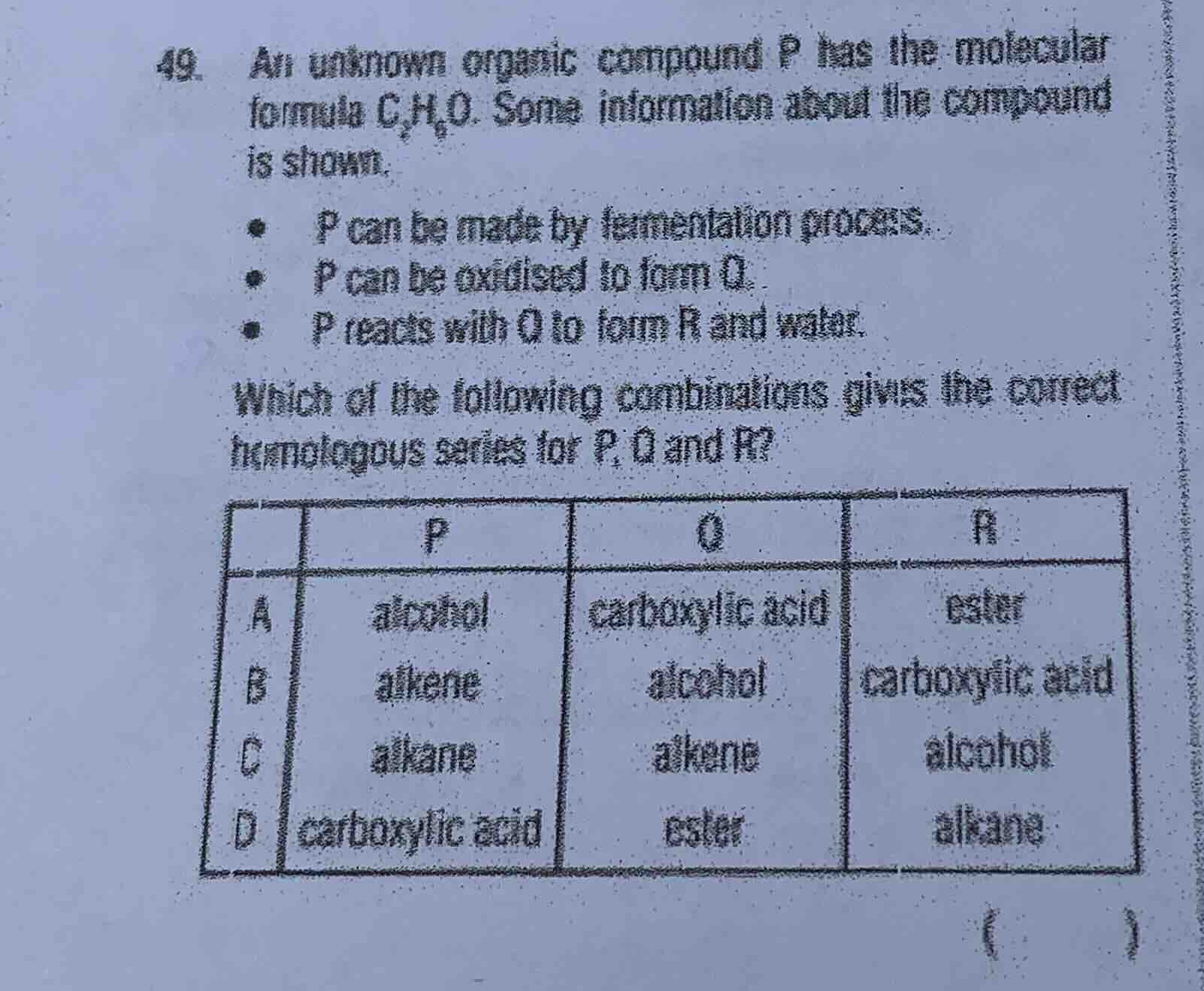
- an unknown organic compound p has the molecular formula \\(c_2h_6o\\). some information about the compound is shown.
- p can be made by fermentation process.
- p can be oxidised to form q.
- p reacts with q to form r and water.
which of the following combinations gives the correct homologous series for p, q and r?
\
<pre_analysis>
{
"quality": "clear",
"question_count": 1,
"skills_matched": [
"step_cot",
"multiple_choice_formatter",
"explain_then_answer",
"tutor",
"mastery_adaptive_brevity"
],
"needs_drawing": false,
"concepts_used": [
"Fermentation of Glucose",
"Alcohol Oxidation"
],
"new_concepts": [
"Esterification Reaction"
],
"current_concepts": [
"Fermentation of Glucose",
"Alcohol Oxidation",
"Esterification Reaction"
]
}
</pre_analysis>
<reasoning>
Identify compound P
Using the Fermentation of Glucose knowledge point
\[
\]
Identify compound Q
Using the Alcohol Oxidation knowledge point
\[
\]
Identify compound R
The reaction between an alcohol and a carboxylic acid in the presence of an acid catalyst produces an ester and water.
\[
\text{CH}_3\text{CH}_2\text{OH} + \text{CH}_3\text{COOH}
ightleftharpoons \text{CH}_3\text{COOCH}_2\text{CH}_3 + \text{H}_2\text{O}
\]
Therefore, compound R is ethyl ethanoate, which belongs to the ester homologous series.
Match with options
Comparing our identified homologous series for P, Q, and R with the table:
- P: alcohol
- Q: carboxylic acid
- R: ester
This matches row A.
</reasoning>
<answer>
<mcq-correct>(A) P: alcohol, Q: carboxylic acid, R: ester</mcq-correct>
<mcq-option>(B) P: alkene, Q: alcohol, R: carboxylic acid</mcq-option>
<mcq-option>(C) P: alkane, Q: alkene, R: alcohol</mcq-option>
<mcq-option>(D) P: carboxylic acid, Q: ester, R: alkane</mcq-option>
</answer>
<post_analysis>
{
"subject": "Natural Science",
"question_type": "Multiple Choice",
"knowledge_point": [
"Natural Science",
"Chemistry",
"Organic Chemistry Reactions"
]
}
</post_analysis>
Snap & solve any problem in the app
Get step-by-step solutions on Sovi AI
Photo-based solutions with guided steps
Explore more problems and detailed explanations
<pre_analysis>
{
"quality": "clear",
"question_count": 1,
"skills_matched": [
"step_cot",
"multiple_choice_formatter",
"explain_then_answer",
"tutor",
"mastery_adaptive_brevity"
],
"needs_drawing": false,
"concepts_used": [
"Fermentation of Glucose",
"Alcohol Oxidation"
],
"new_concepts": [
"Esterification Reaction"
],
"current_concepts": [
"Fermentation of Glucose",
"Alcohol Oxidation",
"Esterification Reaction"
]
}
</pre_analysis>
<reasoning>
Identify compound P
Using the Fermentation of Glucose knowledge point
\[
\]
Identify compound Q
Using the Alcohol Oxidation knowledge point
\[
\]
Identify compound R
The reaction between an alcohol and a carboxylic acid in the presence of an acid catalyst produces an ester and water.
\[
\text{CH}_3\text{CH}_2\text{OH} + \text{CH}_3\text{COOH}
ightleftharpoons \text{CH}_3\text{COOCH}_2\text{CH}_3 + \text{H}_2\text{O}
\]
Therefore, compound R is ethyl ethanoate, which belongs to the ester homologous series.
Match with options
Comparing our identified homologous series for P, Q, and R with the table:
- P: alcohol
- Q: carboxylic acid
- R: ester
This matches row A.
</reasoning>
<answer>
<mcq-correct>(A) P: alcohol, Q: carboxylic acid, R: ester</mcq-correct>
<mcq-option>(B) P: alkene, Q: alcohol, R: carboxylic acid</mcq-option>
<mcq-option>(C) P: alkane, Q: alkene, R: alcohol</mcq-option>
<mcq-option>(D) P: carboxylic acid, Q: ester, R: alkane</mcq-option>
</answer>
<post_analysis>
{
"subject": "Natural Science",
"question_type": "Multiple Choice",
"knowledge_point": [
"Natural Science",
"Chemistry",
"Organic Chemistry Reactions"
]
}
</post_analysis>