QUESTION IMAGE
Question
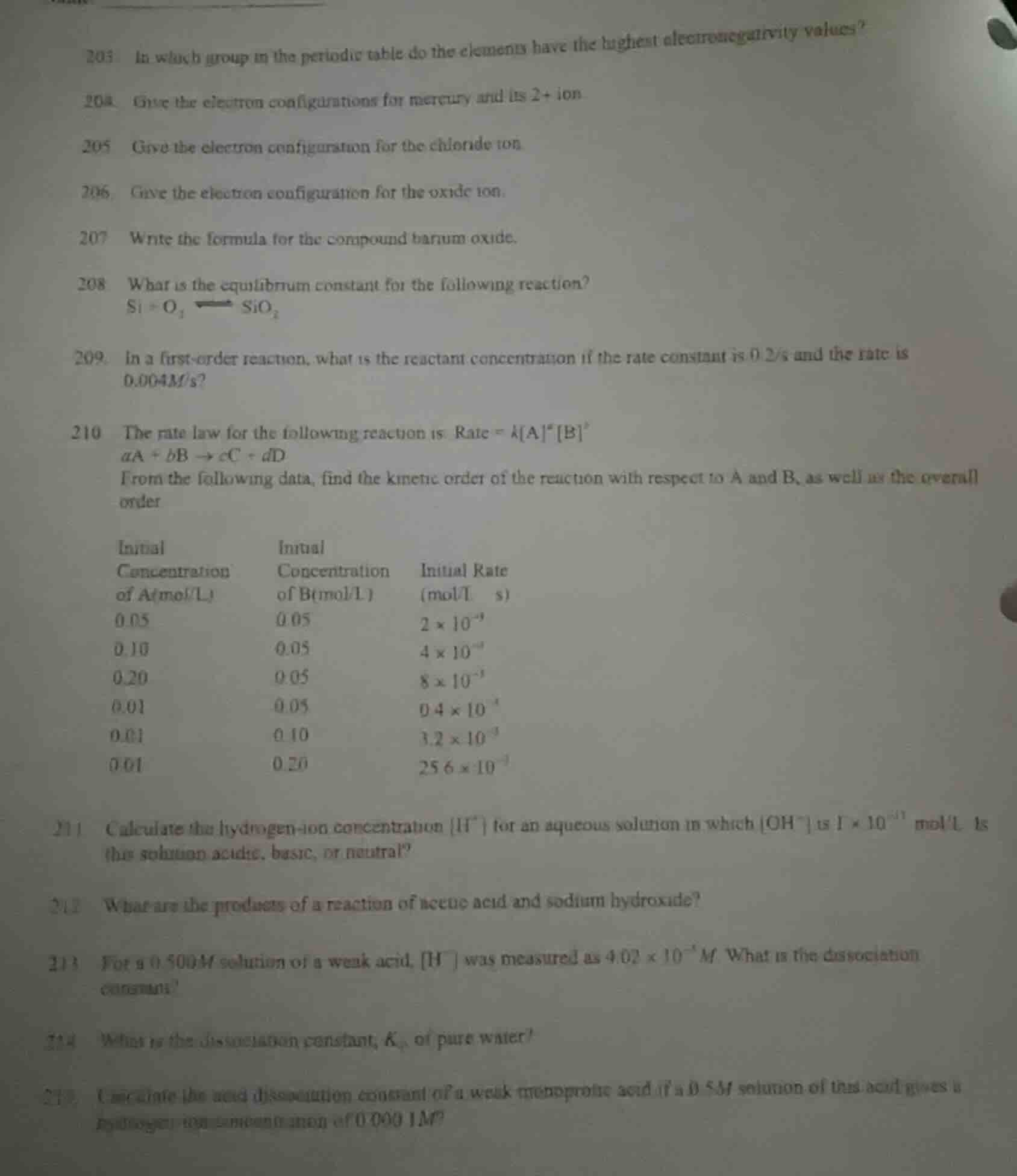
- in which group in the periodic table do the elements have the highest electronegativity values?
- give the electron configurations for mercury and its 2+ ion.
- give the electron configuration for the chloride ion.
- give the electron configuration for the oxide ion.
- write the formula for the compound barium oxide.
- what is the equilibrium constant for the following reaction?
\\(\text{si} + \text{o}_2 \
ightleftharpoons \text{sio}_2\\)
- in a first-order reaction, what is the reactant concentration if the rate constant is \\(0.2/\text{s}\\) and the rate is \\(0.004\text{m}/\text{s}\\)?
- the rate law for the following reaction is: \\(\text{rate} = k\text{a}^x\text{b}^y\\)
\\(a\text{a} + b\text{b} \
ightarrow c\text{c} + d\text{d}\\)
from the following data, find the kinetic order of the reaction with respect to a and b, as well as the overall order:
\
- calculate the hydrogen-ion concentration \\(\text{h}^+\\) for an aqueous solution in which \\(\text{oh}^-\\) is \\(1 \times 10^{-11}\text{ mol/l}\\). is this solution acidic, basic, or neutral?
- what are the products of a reaction of acetic acid and sodium hydroxide?
- for a \\(0.500\text{m}\\) solution of a weak acid, \\(\text{h}^+\\) was measured as \\(4.02 \times 10^{-5}\text{ m}\\). what is the dissociation constant?
- what is the dissociation constant, \\(k_w\\), of pure water?
- calculate the acid dissociation constant of a weak monoprotic acid if a \\(0.5\text{m}\\) solution of this acid gives a hydrogen-ion concentration of \\(0.0001\text{m}\\)?
Electronegativity Trends
Using the Electronegativity Trends knowledge point
Electron Configurations
Using the Electron Configuration Blocks knowledge point
Chemical Formulas and Equilibrium
Using the Ionic Formulas and Chemical Equilibrium knowledge points
Reaction Rates and Kinetics
Using the Reaction Rates and Activation knowledge point
For Question 210, we determine the orders \(x\) and \(y\) in \(\text{Rate} = k[\text{A}]^x[\text{B}]^y\):
- Comparing trials 1, 2, and 3 where \([\text{B}]\) is constant at \(0.05\text{ M}\): doubling \([\text{A}]\) from \(0.05\) to \(0.10\) doubles the rate from \(2 \times 10^{-4}\) to \(4 \times 10^{-4}\). Thus, \(x = 1\).
- Comparing trials 4, 5, and 6 where \([\text{A}]\) is constant at \(0.01\text{ M}\): doubling \([\text{B}]\) from \(0.05\) to \(0.10\) quadruples the rate from \(0.8 \times 10^{-3}\) (which is \(3.2 \times 10^{-3}\) divided by 4). Specifically, \(\frac{3.2 \times 10^{-3}}{0.8 \times 10^{-3}} = 4 = 2^2\), and doubling \([\text{B}]\) from \(0.10\) to \(0.20\) increases the rate by a factor of \(\frac{25.6 \times 10^{-3}}{3.2 \times 10^{-3}} = 8 = 2^3\). Let's re-examine the rates:
- Trial 4: \([\text{B}] = 0.05\), \(\text{Rate} = 0.4 \times 10^{-3}\)
- Trial 5: \([\text{B}] = 0.10\), \(\text{Rate} = 3.2 \times 10^{-3}\)
- Trial 6: \([\text{B}] = 0.20\), \(\text{Rate} = 25.6 \times 10^{-3}\)
- Ratio 5 to 4: \(\frac{3.2 \times 10^{-3}}{0.4 \times 10^{-3}} = 8 = 2^3 \implies y = 3\).
- Ratio 6 to 5: \(\frac{25.6 \times 10^{-3}}{3.2 \times 10^{-3}} = 8 = 2^3 \implies y = 3\).
- Thus, the order with respect to \(\text{A}\) is 1, with respect to \(\text{B}\) is 3, and the overall order is \(1 + 3 = 4\).
Aqueous Equilibria and Neutralization
Using the Self-Ionization of Water and Acid-Base Neutralization knowledge points
\[
\begin{aligned}
&K_w = [\text{H}^+][\text{OH}^-] = 1.0 \times 10^{-14}\\
&[\text{H}^+] = \frac{1.0 \times 10^{-14}}{1 \times 10^{-11}} = 1 \times 10^{-3}\text{ M} \quad (\text{Acidic})\\
&\text{CH}_3\text{COOH} + \text{NaOH}
ightarrow \text{CH}_3\text{COONa} + \text{H}_…

Snap & solve any problem in the app
Get step-by-step solutions on Sovi AI
Photo-based solutions with guided steps
Explore more problems and detailed explanations
| No. | Answer |
|---|---|
| 204 | \(\text{Hg: } [\text{Xe}] 4f^{14} 5d^{10} 6s^2\), \(\text{Hg}^{2+}: [\text{Xe}] 4f^{14} 5d^{10}\) |
| 205 | \([\text{Ne}] 3s^2 3p^6\) (or \([\text{Ar}]\)) |
| 206 | \(1s^2 2s^2 2p^6\) (or \([\text{Ne}]\)) |
| 207 | \(\text{BaO}\) |
| 208 | \(K_{\text{eq}} = \frac{[\text{SiO}_2]}{[\text{Si}][\text{O}_2]}\) |
| 209 | \(0.02\text{ M}\) |
| 210 | Order with respect to A: 1, B: 3; Overall order: 4 |
| 211 | \([\text{H}^+] = 1 \times 10^{-3}\text{ M}\); Acidic |
| 212 | Sodium acetate (\(\text{CH}_3\text{COONa}\)) and water (\(\text{H}_2\text{O}\)) |
| 213 | \(3.23 \times 10^{-7}\) |
| 214 | \(1.0 \times 10^{-14}\) (at \(25^\circ\text{C}\)) |
| 215 | \(2 \times 10^{-8}\) |