QUESTION IMAGE
Question
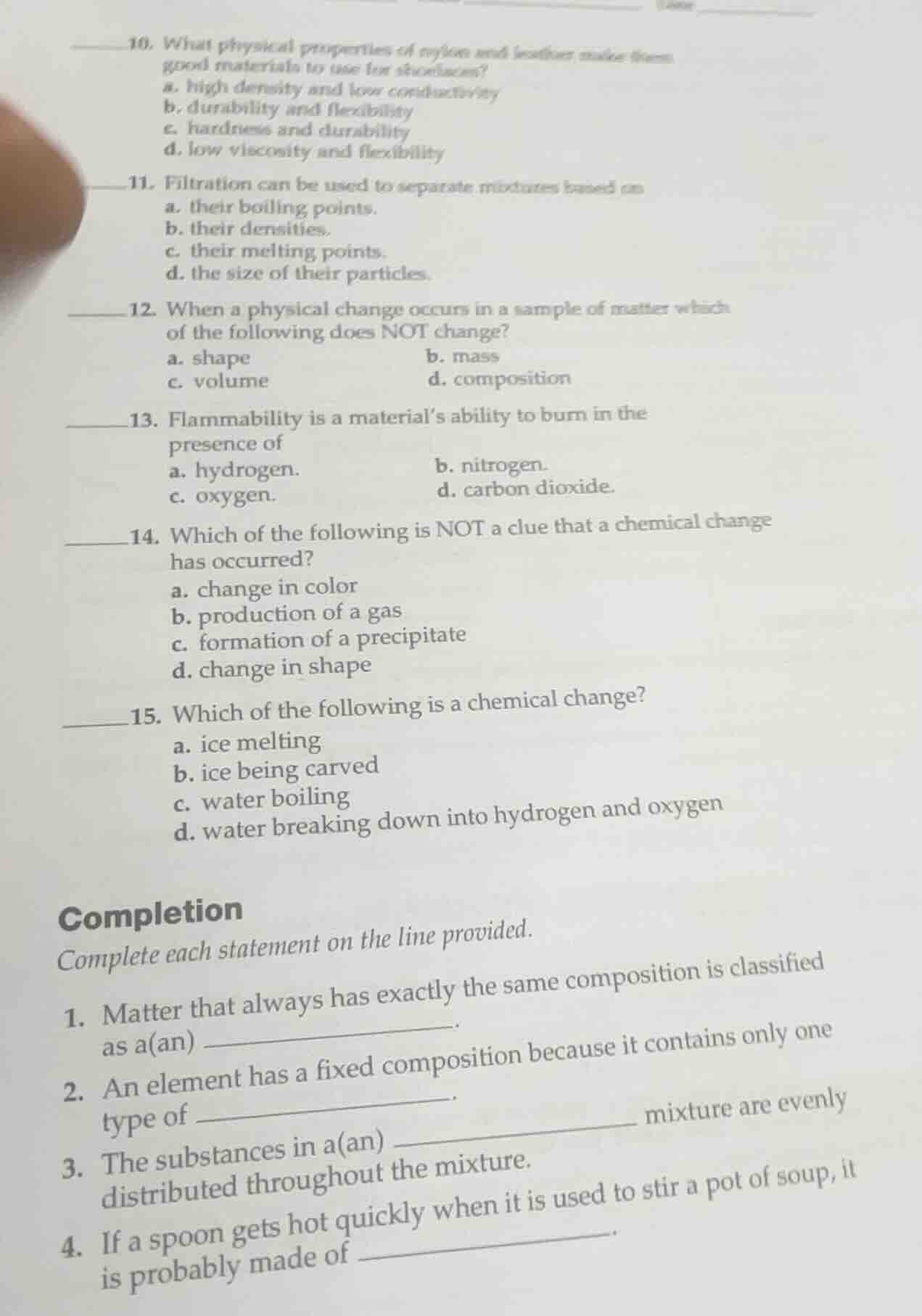
- what physical properties of nylon and leather make them good materials to use for shoelaces?
a. high density and low conductivity
b. durability and flexibility
c. hardness and durability
d. low viscosity and flexibility
- filtration can be used to separate mixtures based on
a. their boiling points.
b. their densities.
c. their melting points.
d. the size of their particles.
- when a physical change occurs in a sample of matter which of the following does not change?
a. shape
b. mass
c. volume
d. composition
- flammability is a materials ability to burn in the presence of
a. hydrogen.
b. nitrogen.
c. oxygen.
d. carbon dioxide.
- which of the following is not a clue that a chemical change has occurred?
a. change in color
b. production of a gas
c. formation of a precipitate
d. change in shape
- which of the following is a chemical change?
a. ice melting
b. ice being carved
c. water boiling
d. water breaking down into hydrogen and oxygen
completion
complete each statement on the line provided.
- matter that always has exactly the same composition is classified as a(an) ______.
- an element has a fixed composition because it contains only one type of ______.
- the substances in a(an) ______ mixture are evenly distributed throughout the mixture.
- if a spoon gets hot quickly when it is used to stir a pot of soup, it is probably made of ______.
Analyze physical properties of shoelaces
Using the Physical Properties knowledge point:
Shoelaces must withstand pulling forces and bend easily around shoes.
- Durability ensures they do not break under tension.
- Flexibility allows them to be tied into knots.
- Therefore, option (b) is correct.
Analyze filtration separation criteria
Using the Separation of Mixtures knowledge point:
Filtration separates components of a mixture using a porous barrier.
- Larger particles are trapped by the filter.
- Smaller particles or liquid pass through.
- Therefore, separation is based on particle size, making option (d) correct.
Analyze conservation during physical changes
Using the Physical Changes knowledge point:
A physical change alters properties without changing chemical identity.
- Shape, mass, and volume can change or remain constant depending on the process.
- The chemical composition never changes during a physical change.
- Therefore, option (d) is correct.
Analyze flammability requirements
Using the Flammability and Reactivity knowledge point:
Flammability is a chemical property describing how a substance burns.
- Combustion is a chemical reaction with an oxidizer.
- Oxygen in the air is the primary gas supporting combustion.
- Therefore, option (c) is correct.
Identify non-clues of chemical changes
Using the Chemical Changes knowledge point:
Chemical changes produce new substances, often accompanied by indicators.
- Color change, gas production, and precipitate formation are chemical clues.
- A change in shape is a physical alteration, not a chemical clue.
- Therefore, option (d) is correct.
Identify chemical change examples
Using the Chemical Changes and Physical Changes knowledge points:
- Melting, carving, and boiling are physical phase or shape changes.
- Breaking water down into hydrogen and oxygen gases forms new chemical substances.
- Therefore, option (d) is correct.
Define constant composition matter
Using the Pure Substances knowledge point:
Matter with a completely uniform and unchanging composition is a pure substance.
- Every sample has identical properties and composition.
- The correct term is "pure substance".
Define element composition
Using the Chemical Elements knowledge point:
An element is a pure substance that cannot be broken down.
- It has a fixed composition because it consists of only one type of atom.
- The correct term is "atom".
Define evenly distributed mixtures
Using the Mixtures and Solutions knowledge point:
Mixtures can be heterogeneous or homogeneous.
- In a homogeneous mixture, substances are distributed uniformly.
- The correct term is "homogeneous".
Analyze thermal conductivity of spoon
Using the **Physical…

Snap & solve any problem in the app
Get step-by-step solutions on Sovi AI
Photo-based solutions with guided steps
Explore more problems and detailed explanations
Question 10
- a. high density and low conductivity
- b. durability and flexibility (Correct answer)
- c. hardness and durability
- d. low viscosity and flexibility
Question 11
- a. their boiling points.
- b. their densities.
- c. their melting points.
- d. the size of their particles. (Correct answer)
Question 12
- a. shape
- b. mass
- c. volume
- d. composition (Correct answer)
Question 13
- a. hydrogen.
- b. nitrogen.
- c. oxygen. (Correct answer)
- d. carbon dioxide.
Question 14
- a. change in color
- b. production of a gas
- c. formation of a precipitate
- d. change in shape (Correct answer)
Question 15
- a. ice melting
- b. ice being carved
- c. water boiling
- d. water breaking down into hydrogen and oxygen (Correct answer)
Completion 1
Matter that always has exactly the same composition is classified as a(an) <blank>pure substance</blank>.
Completion 2
An element has a fixed composition because it contains only one type of <blank>atom</blank>.
Completion 3
The substances in a(an) <blank>homogeneous</blank> mixture are evenly distributed throughout the mixture.
Completion 4
If a spoon gets hot quickly when it is used to stir a pot of soup, it is probably made of <blank>metal</blank>.