QUESTION IMAGE
Question
05 question (10 points)
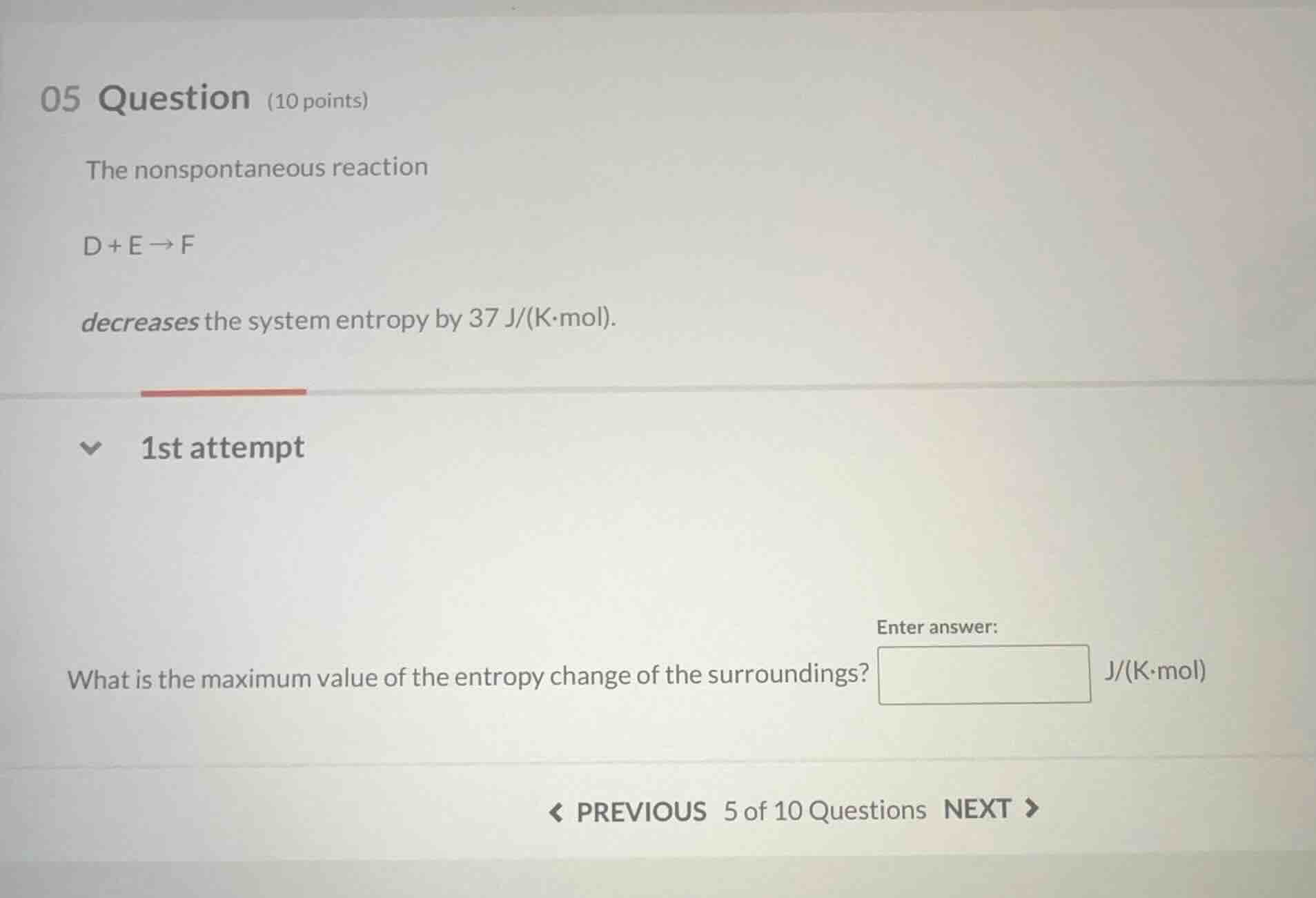
the nonspontaneous reaction
\\d + e \
ightarrow f\\
decreases the system entropy by \\(37\text{ j}/(\text{k}\cdot\text{mol})\\).
what is the maximum value of the entropy change of the surroundings?
Identify the given thermodynamic values
We are given a nonspontaneous reaction:
The change in entropy of the system is:
Apply the Second Law of Thermodynamics
For a process to be spontaneous, the total entropy change of the universe must be positive:
Since the reaction is specified as nonspontaneous, the total entropy change of the universe must be less than or equal to zero:
Solve for the maximum entropy change of the surroundings
Using the inequality for a nonspontaneous process:
Substitute the given system entropy change:
Solve for the surroundings entropy change:
Thus, the maximum possible value is \(37 \text{ J/(K}\cdot\text{mol)}\).

Snap & solve any problem in the app
Get step-by-step solutions on Sovi AI
Photo-based solutions with guided steps
Explore more problems and detailed explanations
What is the maximum value of the entropy change of the surroundings? <blank>37</blank> \(\text{J/(K}\cdot\text{mol)}\)