Sovi.AI - AI Math Tutor

Scan to solve math questions

QUESTION IMAGE

an item is randomly drawn from a bag with 16 fruit cups, 3 vegetable cu…

Question

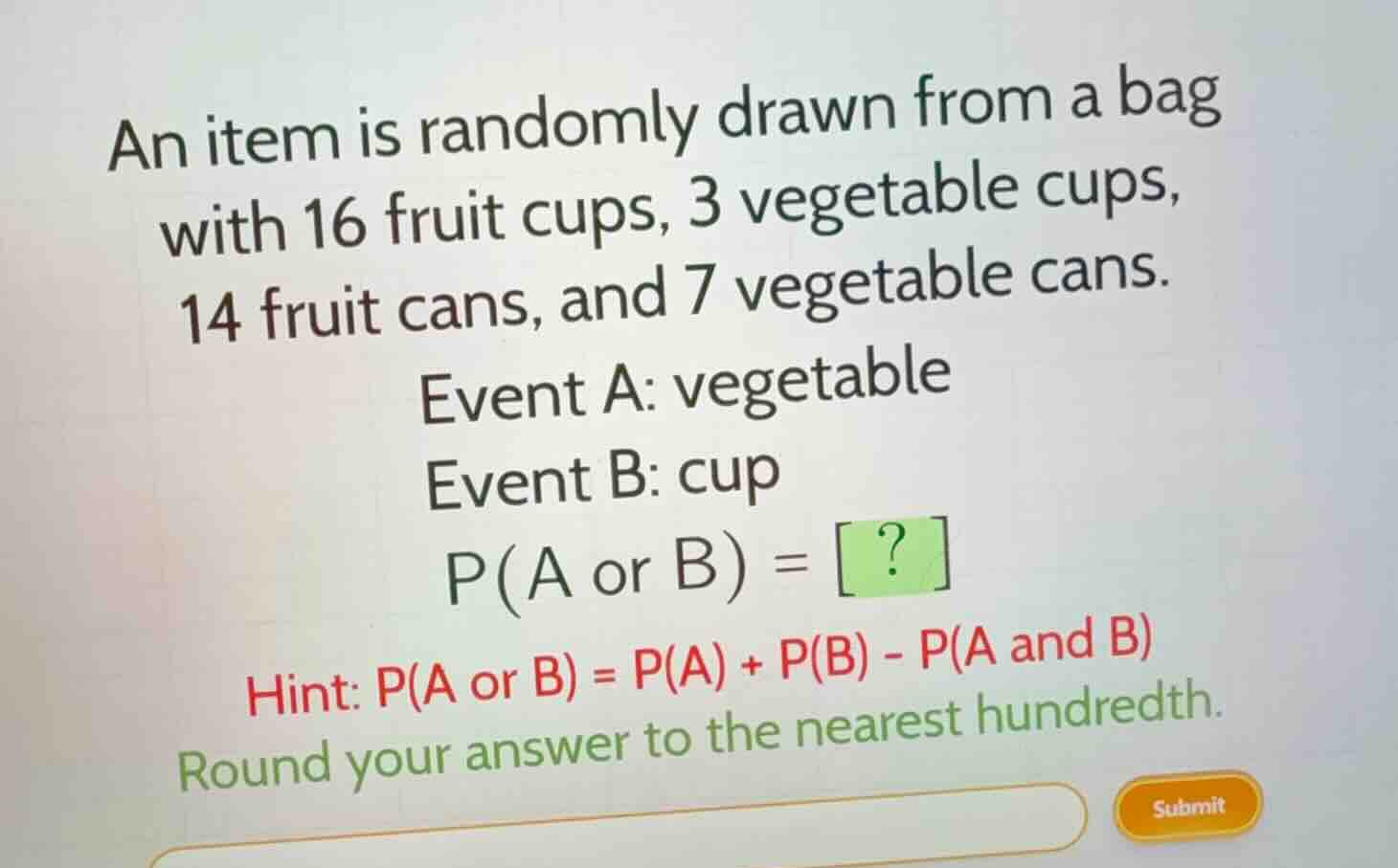
an item is randomly drawn from a bag with 16 fruit cups, 3 vegetable cups, 14 fruit cans, and 7 vegetable cans.

event a: vegetable
event b: cup

\\(p(a \text{ or } b) = ? \\)

hint: \\(p(a \text{ or } b) = p(a) + p(b) - p(a \text{ and } b)\\)
round your answer to the nearest hundredth.

Explanation:

Response

<pre_analysis>
{
"quality": "clear",
"question_count": 1,
"skills_matched": [
"step_cot",
"blank_filling_formatter",
"explain_then_answer",
"tutor"
],
"needs_drawing": false,
"concepts_used": [
"Theoretical Probability",
"Overlapping Events"
],
"new_concepts": [],
"current_concepts": [
"Theoretical Probability",
"Overlapping Events",
"Addition Rule of Probability"
]
}
</pre_analysis>

<reasoning>

Calculate the total number of items

We first find the total number of items in the bag by summing all the categories.
Using the Theoretical Probability knowledge point:
\[
\text{Total items} = 16 \text{ (fruit cups)} + 3 \text{ (vegetable cups)} + 14 \text{ (fruit cans)} + 7 \text{ (vegetable cans)}
\]
\[
\text{Total items} = 40
\]

Determine the probability of Event A

Event A is drawing a vegetable item. We find the total number of vegetable items and divide by the total number of items.
Using the Theoretical Probability knowledge point:
\[
\text{Vegetable items} = 3 \text{ (vegetable cups)} + 7 \text{ (vegetable cans)} = 10
\]
\[
P(A) = \frac{10}{40} = 0.25
\]

Determine the probability of Event B

Event B is drawing a cup. We find the total number of cups and divide by the total number of items.
Using the Theoretical Probability knowledge point:
\[
\text{Total cups} = 16 \text{ (fruit cups)} + 3 \text{ (vegetable cups)} = 19
\]
\[
P(B) = \frac{19}{40} = 0.475
\]

Determine the probability of Event A and B

The intersection represents drawing an item that is both a vegetable and a cup (vegetable cups).
Using the Overlapping Events knowledge point:
\[
\text{Vegetable cups} = 3
\]
\[
P(A \text{ and } B) = \frac{3}{40} = 0.075
\]

Apply the addition rule for overlapping events

We use the given formula to find the probability of drawing a vegetable or a cup.
Using the Overlapping Events knowledge point:
\[
P(A \text{ or } B) = P(A) + P(B) - P(A \text{ and } B)
\]
\[
P(A \text{ or } B) = \frac{10}{40} + \frac{19}{40} - \frac{3}{40} = \frac{26}{40} = 0.65
\]
Rounding to the nearest hundredth gives \(0.65\).
</reasoning>

<answer>
An item is randomly drawn from a bag with 16 fruit cups, 3 vegetable cups, 14 fruit cans, and 7 vegetable cans.
Event A: vegetable
Event B: cup
\(P(A \text{ or } B) =\) <blank>0.65</blank>
</answer>

<post_analysis>
{
"subject": "Mathematics",
"question_type": "Fill-in-the-blank",
"knowledge_point": [
"Mathematics",
"Statistics",
"Probability of Overlapping Events"
]
}
</post_analysis>

Answer:

<pre_analysis>
{
"quality": "clear",
"question_count": 1,
"skills_matched": [
"step_cot",
"blank_filling_formatter",
"explain_then_answer",
"tutor"
],
"needs_drawing": false,
"concepts_used": [
"Theoretical Probability",
"Overlapping Events"
],
"new_concepts": [],
"current_concepts": [
"Theoretical Probability",
"Overlapping Events",
"Addition Rule of Probability"
]
}
</pre_analysis>

<reasoning>

Calculate the total number of items

We first find the total number of items in the bag by summing all the categories.
Using the Theoretical Probability knowledge point:
\[
\text{Total items} = 16 \text{ (fruit cups)} + 3 \text{ (vegetable cups)} + 14 \text{ (fruit cans)} + 7 \text{ (vegetable cans)}
\]
\[
\text{Total items} = 40
\]

Determine the probability of Event A

Event A is drawing a vegetable item. We find the total number of vegetable items and divide by the total number of items.
Using the Theoretical Probability knowledge point:
\[
\text{Vegetable items} = 3 \text{ (vegetable cups)} + 7 \text{ (vegetable cans)} = 10
\]
\[
P(A) = \frac{10}{40} = 0.25
\]

Determine the probability of Event B

Event B is drawing a cup. We find the total number of cups and divide by the total number of items.
Using the Theoretical Probability knowledge point:
\[
\text{Total cups} = 16 \text{ (fruit cups)} + 3 \text{ (vegetable cups)} = 19
\]
\[
P(B) = \frac{19}{40} = 0.475
\]

Determine the probability of Event A and B

The intersection represents drawing an item that is both a vegetable and a cup (vegetable cups).
Using the Overlapping Events knowledge point:
\[
\text{Vegetable cups} = 3
\]
\[
P(A \text{ and } B) = \frac{3}{40} = 0.075
\]

Apply the addition rule for overlapping events

We use the given formula to find the probability of drawing a vegetable or a cup.
Using the Overlapping Events knowledge point:
\[
P(A \text{ or } B) = P(A) + P(B) - P(A \text{ and } B)
\]
\[
P(A \text{ or } B) = \frac{10}{40} + \frac{19}{40} - \frac{3}{40} = \frac{26}{40} = 0.65
\]
Rounding to the nearest hundredth gives \(0.65\).
</reasoning>

<answer>
An item is randomly drawn from a bag with 16 fruit cups, 3 vegetable cups, 14 fruit cans, and 7 vegetable cans.
Event A: vegetable
Event B: cup
\(P(A \text{ or } B) =\) <blank>0.65</blank>
</answer>

<post_analysis>
{
"subject": "Mathematics",
"question_type": "Fill-in-the-blank",
"knowledge_point": [
"Mathematics",
"Statistics",
"Probability of Overlapping Events"
]
}
</post_analysis>