QUESTION IMAGE
Question
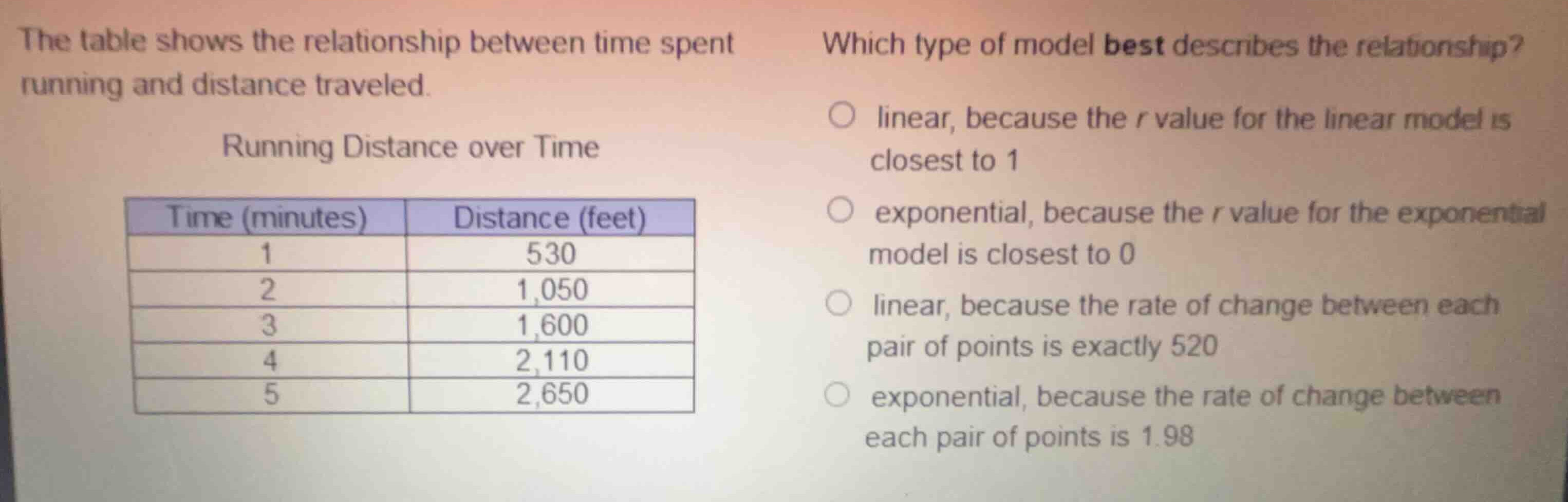
the table shows the relationship between time spent running and distance traveled.
running distance over time
\
which type of model best describes the relationship?
linear, because the \\(r\\) value for the linear model is closest to 1
exponential, because the \\(r\\) value for the exponential model is closest to 0
linear, because the rate of change between each pair of points is exactly 520
exponential, because the rate of change between each pair of points is 1.98
<pre_analysis>
{
"quality": "clear",
"question_count": 1,
"skills_matched": [
"step_cot",
"multiple_choice_formatter",
"explain_then_answer",
"tutor",
"mastery_adaptive_brevity"
],
"needs_drawing": false,
"concepts_used": [
"Linear Rate of Change",
"Linear Modeling"
],
"new_concepts": [
"Correlation Coefficient",
"Model Selection"
],
"current_concepts": [
"Linear Rate of Change",
"Linear Modeling",
"Correlation Coefficient",
"Model Selection"
]
}
</pre_analysis>
<reasoning>
Calculate rates of change
Using the Linear Rate of Change knowledge point
\[
\]
Evaluate model options
Using the Linear Modeling knowledge point
\[
\]
</reasoning>
<answer>
<mcq-correct>(A) linear, because the \(r\) value for the linear model is closest to 1</mcq-correct>
<mcq-option>(B) exponential, because the \(r\) value for the exponential model is closest to 0</mcq-option>
<mcq-option>(C) linear, because the rate of change between each pair of points is exactly 520</mcq-option>
<mcq-option>(D) exponential, because the rate of change between each pair of points is 1.98</mcq-option>
</answer>
<post_analysis>
{
"subject": "Mathematics",
"question_type": "Multiple Choice",
"knowledge_point": [
"Mathematics",
"Statistics",
"Model Selection"
]
}
</post_analysis>
Snap & solve any problem in the app
Get step-by-step solutions on Sovi AI
Photo-based solutions with guided steps
Explore more problems and detailed explanations
<pre_analysis>
{
"quality": "clear",
"question_count": 1,
"skills_matched": [
"step_cot",
"multiple_choice_formatter",
"explain_then_answer",
"tutor",
"mastery_adaptive_brevity"
],
"needs_drawing": false,
"concepts_used": [
"Linear Rate of Change",
"Linear Modeling"
],
"new_concepts": [
"Correlation Coefficient",
"Model Selection"
],
"current_concepts": [
"Linear Rate of Change",
"Linear Modeling",
"Correlation Coefficient",
"Model Selection"
]
}
</pre_analysis>
<reasoning>
Calculate rates of change
Using the Linear Rate of Change knowledge point
\[
\]
Evaluate model options
Using the Linear Modeling knowledge point
\[
\]
</reasoning>
<answer>
<mcq-correct>(A) linear, because the \(r\) value for the linear model is closest to 1</mcq-correct>
<mcq-option>(B) exponential, because the \(r\) value for the exponential model is closest to 0</mcq-option>
<mcq-option>(C) linear, because the rate of change between each pair of points is exactly 520</mcq-option>
<mcq-option>(D) exponential, because the rate of change between each pair of points is 1.98</mcq-option>
</answer>
<post_analysis>
{
"subject": "Mathematics",
"question_type": "Multiple Choice",
"knowledge_point": [
"Mathematics",
"Statistics",
"Model Selection"
]
}
</post_analysis>