QUESTION IMAGE
Question
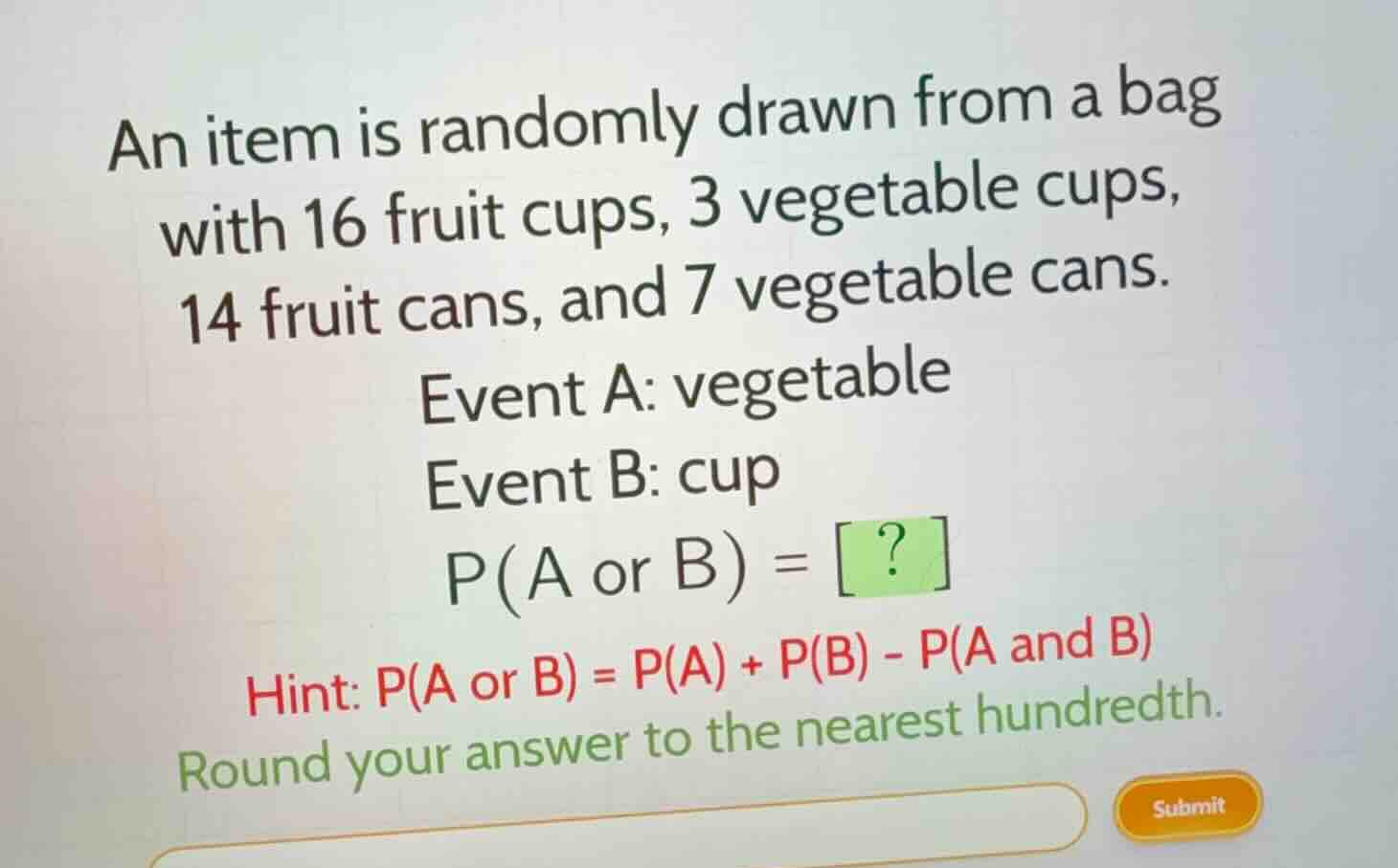
an item is randomly drawn from a bag with 16 fruit cups, 3 vegetable cups, 14 fruit cans, and 7 vegetable cans.
event a: vegetable
event b: cup
\\(p(a \text{ or } b) = ? \\)
hint: \\(p(a \text{ or } b) = p(a) + p(b) - p(a \text{ and } b)\\)
round your answer to the nearest hundredth.
Calculate the total number of items
We first find the total number of items in the bag by summing all the categories.
Using the Theoretical Probability knowledge point:
Determine the probability of Event A
Event A is drawing a vegetable item. We find the total number of vegetable items and divide by the total number of items.
Using the Theoretical Probability knowledge point:
Determine the probability of Event B
Event B is drawing a cup. We find the total number of cups and divide by the total number of items.
Using the Theoretical Probability knowledge point:
Determine the probability of Event A and B
The intersection represents drawing an item that is both a vegetable and a cup (vegetable cups).
Using the Overlapping Events knowledge point:
Apply the addition rule for overlapping events
We use the given formula to find the probability of drawing a vegetable or a cup.
Using the Overlapping Events knowledge point:
Rounding to the nearest hundredth gives \(0.65\).

Snap & solve any problem in the app
Get step-by-step solutions on Sovi AI
Photo-based solutions with guided steps
Explore more problems and detailed explanations
An item is randomly drawn from a bag with 16 fruit cups, 3 vegetable cups, 14 fruit cans, and 7 vegetable cans.
Event A: vegetable
Event B: cup
\(P(A \text{ or } B) =\) <blank>0.65</blank>