QUESTION IMAGE
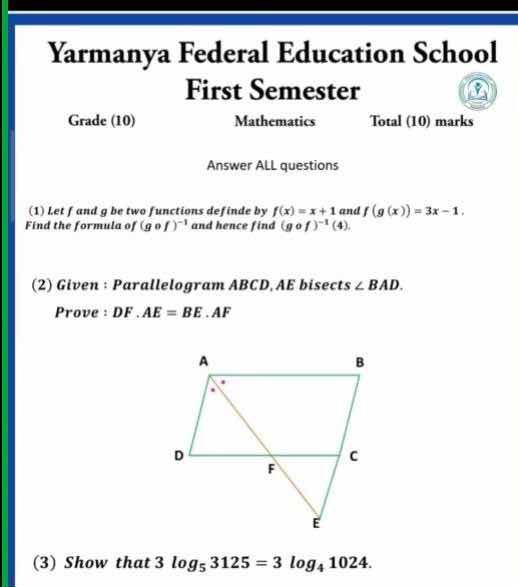
Question
yarmanya federal education school
first semester
grade (10) mathematics total (10) marks
answer all questions
(1) let \\(f\\) and \\(g\\) be two functions definde by \\(f(x) = x + 1\\) and \\(f(g(x)) = 3x - 1\\).
find the formula of \\((g \circ f)^{-1}\\) and hence find \\((g \circ f)^{-1}(4)\\).
(2) given : parallelogram \\(abcd\\), \\(ae\\) bisects \\(\angle bad\\).
prove : \\(df \cdot ae = be \cdot af\\)
(3) show that \\(3 \log_{5} 3125 = 3 \log_{4} 1024\\).
Find the formula of \(g(x)\)
We are given:
Since \(f(g(x)) = g(x) + 1\), we substitute this into the equation:
Find the composite function \(g \circ f\)
Now we find the composite function \((g \circ f)(x)\):
Substitute \(f(x) = x + 1\) into \(g(x)\):
Find the inverse function \((g \circ f)^{-1}\)
Let \(y = (g \circ f)(x) = 3x + 1\).
To find the inverse, we solve for \(x\) in terms of \(y\):
Thus, the formula for the inverse function is:
Now, evaluate this inverse function at \(x = 4\):
Prove the geometric relation in the parallelogram
We are given:
- Parallelogram \(ABCD\)
- \(AE\) bisects \(\angle BAD\), so \(\angle DAE = \angle BAE\)
Since \(AB \parallel CD\) (and thus \(AB \parallel DF\)), the alternate interior angles are equal:
Since \(\angle DAE = \angle BAE\) and \(\angle BAE = \angle AFD\), we have:
This means \(\triangle ADF\) is an isosceles triangle with:
Next, consider the parallel lines \(AD \parallel BC\) (and thus \(AD \parallel BE\)) intersected by the transversal line \(AE\):
Since \(\angle DAE = \angle BAE\), we have:
This means \(\triangle ABE\) is an isosceles triangle with:
Now, we look at the similarity of triangles \(\triangle ADF\) and \(\triangle ECF\), or we can use the properties of similar triangles formed by parallel lines.
Since \(AD \parallel BE\), the triangles \(\triangle ADF\) and \(\triangle ECF\) are similar, but a more direct similarity is between \(\triangle ADF\) and \(\triangle EBA\) is not directly needed. Let's use the similarity of \(\triangle ADF\) and \(\triangle ECF\):
Since \(AD \parallel BC\), we have \(\triangle ADF \sim \triangle ECF\) (where \(E, C, B\) are collinear):
Alternatively, let's use the parallel lines \(AB \parallel DF\), which gives \(\triangle ECF \sim \triangle EBA\):
Let's use the direct ratio from similar triangles \(\triangle ADF\) and \(\triangle ECF\) (since \(AD \parallel BE\)):
Cross-multiplying this ratio yields:
Show the logarithmic equality
We need to show that:
First, simplify the left-hand side (LHS):
We know that \(3125 = 5^5\).
Next, simplify the right-hand side (RHS):
We know that \(1024 = 4^5\) (since \(4^5 = (2^2)^5 = 2^{10} = 1024\)).
Since both sides simplify to \(15\), we have shown that:

Snap & solve any problem in the app
Get step-by-step solutions on Sovi AI
Photo-based solutions with guided steps
Explore more problems and detailed explanations
Question 1
The formula of the inverse composite function is:
Evaluating the function at \(x = 4\):
Question 2
Proof:
- Since \(ABCD\) is a parallelogram, \(AD \parallel BC\), which means \(AD \parallel BE\).
- Since \(AD \parallel BE\) and they are intersected by transversal line \(AE\), the alternate interior angles are equal:
- Since \(AE\) bisects \(\angle BAD\), we have:
- Combining these gives:
Therefore, \(\triangle ABE\) is an isosceles triangle with \(AB = BE\).
- Since \(AD \parallel BE\), the triangles \(\triangle ADF\) and \(\triangle ECF\) are similar, which also establishes the similarity of the larger geometric configuration where:
- Cross-multiplying the ratios yields the desired relation:
Question 3
Proof:
- Left-Hand Side (LHS):
Since \(3125 = 5^5\):
- Right-Hand Side (RHS):
Since \(1024 = 4^5\):
Since \(\text{LHS} = \text{RHS} = 15\), the equality is shown.