QUESTION IMAGE
Question
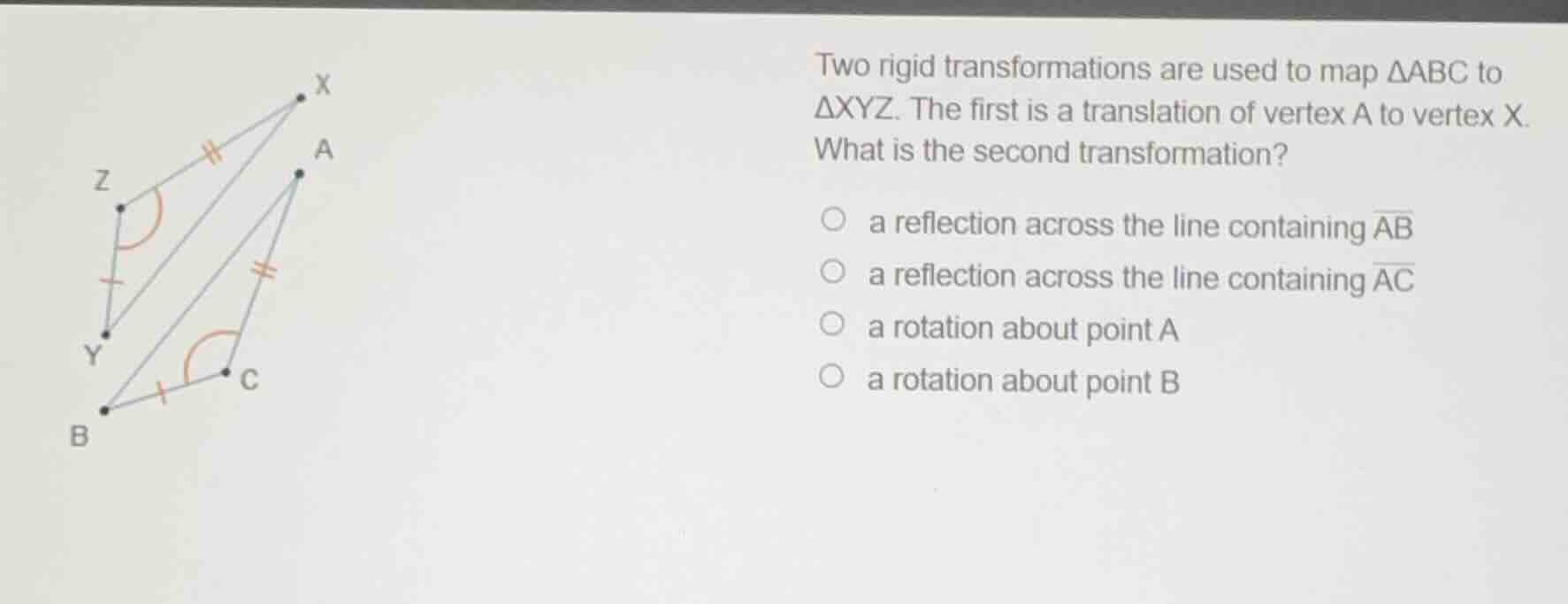
two rigid transformations are used to map \\(\delta abc\\) to \\(\delta xyz\\). the first is a translation of vertex a to vertex x. what is the second transformation?
a reflection across the line containing \\(\overline{ab}\\)
a reflection across the line containing \\(\overline{ac}\\)
a rotation about point a
a rotation about point b
Analyze the first transformation
Using the Rigid Transformations knowledge point
The first transformation is a translation mapping vertex \(A\) to vertex \(X\). After this translation, the image of \(\Delta ABC\), let's call it \(\Delta A'B'C'\), has its vertex \(A'\) coinciding with \(X\).
Determine the orientation and mapping
Using the Congruence Mapping knowledge point
From the markings on the triangles:
- Side \(AC\) corresponds to side \(XZ\) (both have double tick marks).
- Side \(BC\) corresponds to side \(YZ\) (both have single tick marks).
- \(\angle C\) corresponds to \(\angle Z\) (both have arc markings).
Thus, the congruence mapping is \(\Delta ABC \cong \Delta XYZ\), which means \(A \to X\), \(B \to Y\), and \(C \to Z\).
Identify the second transformation
Using the Rigid Transformations knowledge point
After translating \(A\) to \(X\), the vertex \(A'\) is fixed at \(X\). To map the remaining parts of the triangle:
- We need to align the segment \(A'C'\) with \(XZ\).
- Since \(A'\) is already at \(X\), we can rotate \(\Delta A'B'C'\) about this shared point (which is point \(A\) in the original pre-image coordinate system) until the ray \(A'C'\) lies along the ray \(XZ\).
- Since \(AC = XZ\), this rotation will map \(C'\) directly onto \(Z\).
- Because rigid transformations preserve distance and angle measures, \(B'\) will also map to \(Y\).
Therefore, the second transformation is a rotation about point \(A\).

Snap & solve any problem in the app
Get step-by-step solutions on Sovi AI
Photo-based solutions with guided steps
Explore more problems and detailed explanations
- a reflection across the line containing \(\overline{AB}\)
- a reflection across the line containing \(\overline{AC}\)
- a rotation about point A (Correct answer)
- a rotation about point B