QUESTION IMAGE
Question
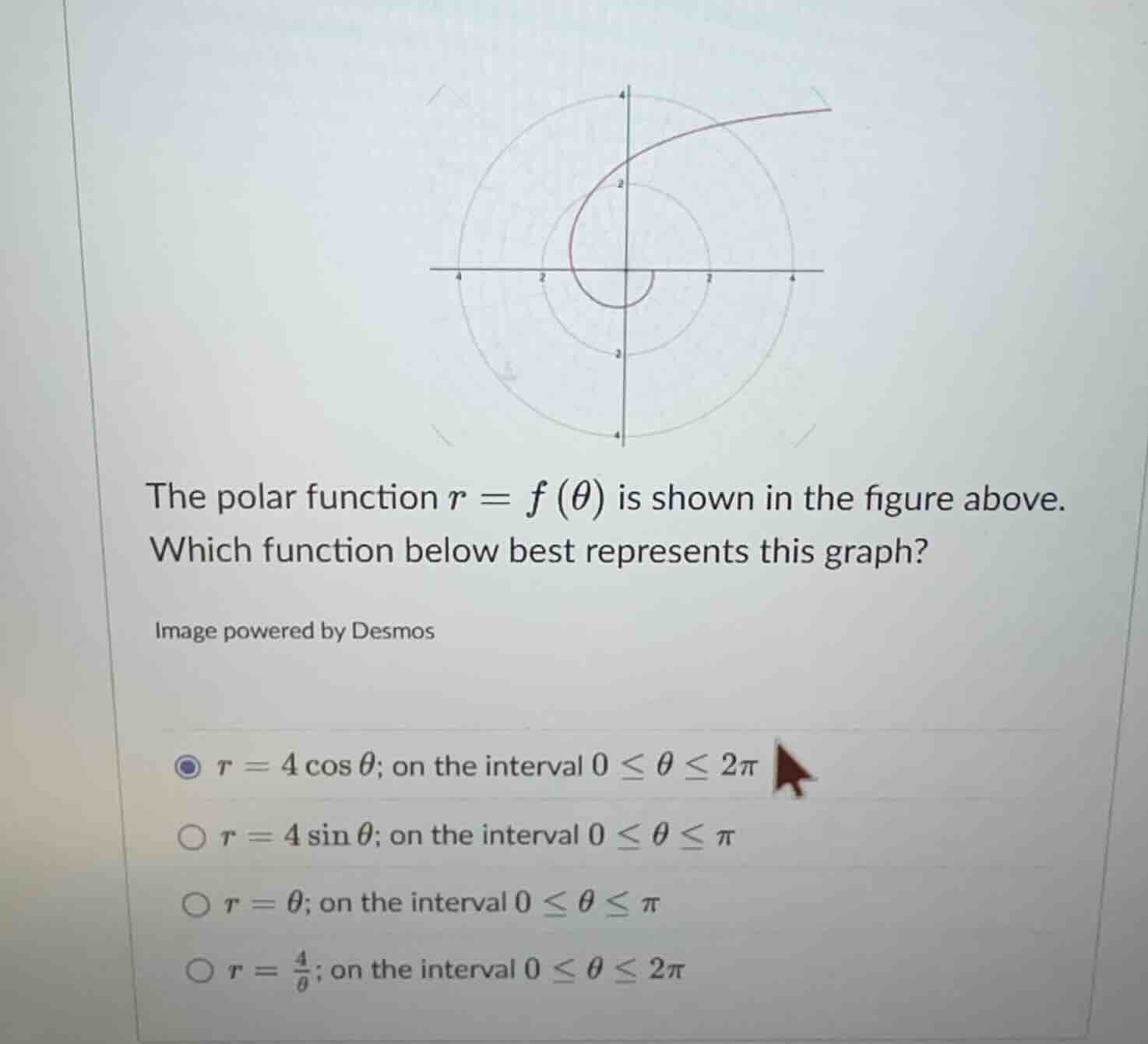
the polar function (r = f(\theta)) is shown in the figure above. which function below best represents this graph?
image powered by desmos
(r = 4 cos \theta); on the interval (0 le \theta le 2pi)
(r = 4 sin \theta); on the interval (0 le \theta le pi)
(r = \theta); on the interval (0 le \theta le pi)
(r = \frac{4}{\theta}); on the interval (0 le \theta le 2pi)
Analyze the geometric shape of the polar graph
The graph shows a spiral starting at the origin (pole) and winding outwards as the angle increases.
- A circle in polar coordinates is typically represented by equations of the form \(r = a \cos \theta\) or \(r = a \sin \theta\).
- A spiral where the radius \(r\) is directly proportional to the angle \(\theta\) (i.e., \(r = a\theta\)) is known as an Archimedean spiral.
- Since the graph is a spiral starting at the origin and expanding outwards, it is represented by a function where \(r\) increases as \(\theta\) increases, such as \(r = \theta\).
Evaluate specific points on the graph
Let's test the candidate function \(r = \theta\) on the interval \(0 \le \theta \le \pi\):
- At \(\theta = 0\), the radius is \(r = 0\), which matches the start of the spiral at the origin.
- At \(\theta = \frac{\pi}{2} \approx 1.57\), the curve crosses the positive y-axis. Looking at the graph, the intersection on the positive y-axis is indeed between \(1\) and \(2\), around \(1.6\).
- At \(\theta = \pi \approx 3.14\), the curve crosses the negative x-axis. Looking at the graph, the spiral ends on the negative x-axis at a value slightly past \(3\), which perfectly matches \(r = \pi \approx 3.14\).
Compare with other options
Let's check why the other options are incorrect:
- \(r = 4 \cos \theta\) represents a circle centered on the polar axis (x-axis) with a diameter of 4.
- \(r = 4 \sin \theta\) represents a circle centered on the vertical axis (y-axis) with a diameter of 4.
- \(r = \frac{4}{\theta}\) is a hyperbolic spiral where \(r \to \infty\) as \(\theta \to 0\), which does not start at the origin.
Thus, the function that best represents this graph is \(r = \theta\) on the interval \(0 \le \theta \le \pi\).

Snap & solve any problem in the app
Get step-by-step solutions on Sovi AI
Photo-based solutions with guided steps
Explore more problems and detailed explanations
- (A) \(r = 4 \cos \theta\); on the interval \(0 \le \theta \le 2\pi\)
- (B) \(r = 4 \sin \theta\); on the interval \(0 \le \theta \le \pi\)
- (C) \(r = \theta\); on the interval \(0 \le \theta \le \pi\) (Correct answer)
- (D) \(r = \frac{4}{\theta}\); on the interval \(0 \le \theta \le 2\pi\)